
Eris: The Brilliant Icy Sentinel Guarding the Frozen Frontier of Our Solar System
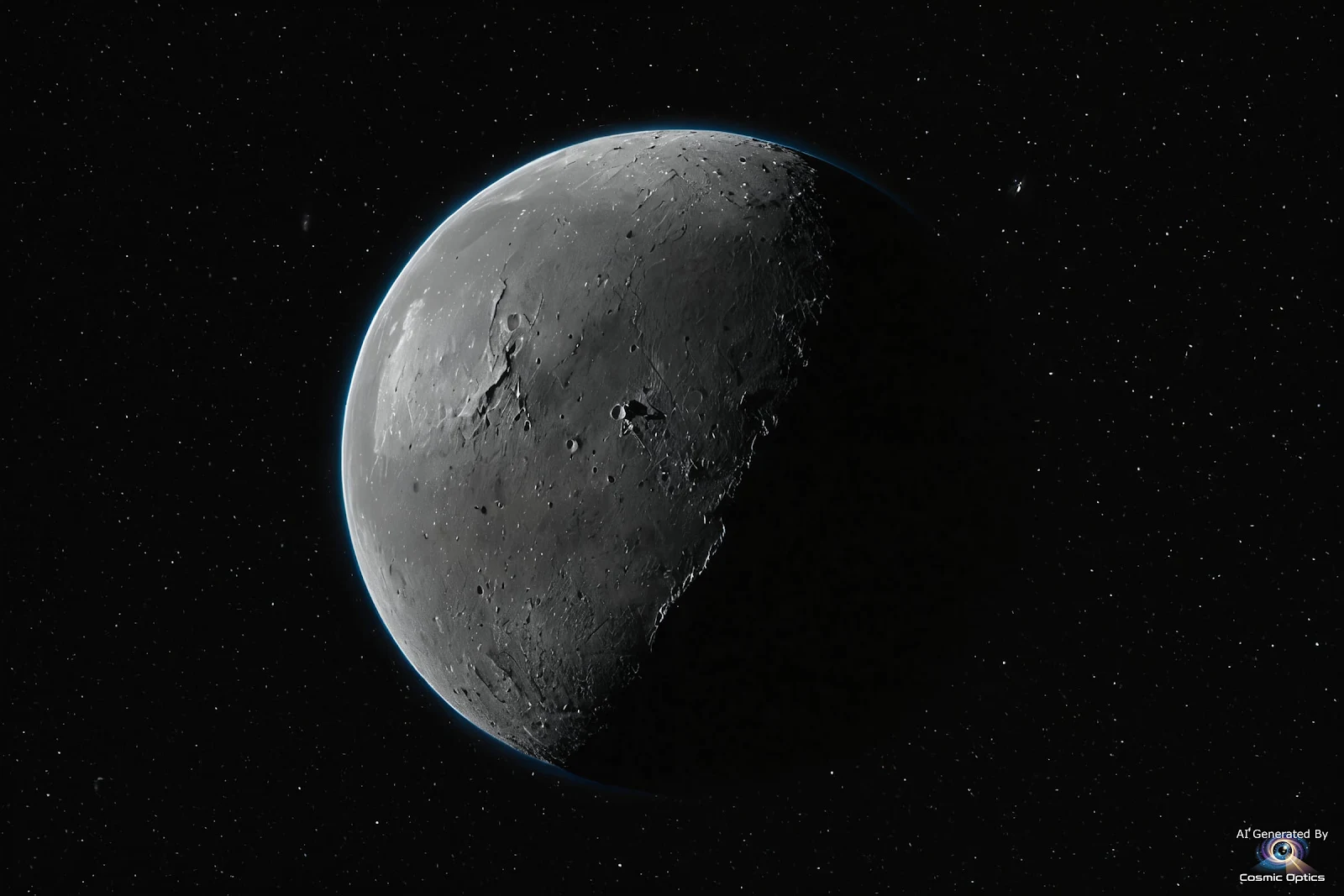
An authentic, photorealistic standalone astronomical snapshot of the dwarf planet Eris in deep space_00003
Deep within the frozen frontier of our solar system, far beyond the familiar orbits of the gas giants and the sentimental warmth of the inner planets, lies a world of chilling beauty and profound scientific mystery. Eris, the second-largest dwarf planet currently known to exist in our celestial neighborhood, stands as a silent sentinel in the "Scattered Disc"—a desolate, icy region that stretches far beyond the Kuiper Belt. Its discovery in the early 21st century did more than just add a name to our cosmic maps; it fundamentally reshaped our understanding of what it means to be a planet and forced humanity to reconsider the very architecture of the solar system.
The journey to understanding Eris begins with its sheer, staggering distance. On average, this icy titan orbits roughly 68 astronomical units (AU) from the Sun, which is nearly twice the distance of Pluto. To put that into perspective, light from the Sun—which takes a mere eight minutes to reach Earth—must travel for over nine hours before it touches the reflective surface of Eris. This extreme isolation makes Eris a time capsule of the early solar system, preserving chemical signatures and materials that have remained largely unchanged for billions of years. Its orbit is not a neat circle but a highly eccentric, elongated path that takes 558 Earth years to complete a single revolution. This means that since Eris was last in its current position, human civilizations have risen, fallen, and undergone industrial and digital revolutions.
Physically, Eris is a masterpiece of cosmic chemistry. For years, astronomers debated whether it was larger than Pluto, a question that sparked intense international interest. Recent measurements, particularly those taken during stellar occultations where Eris passes in front of a distant star, have refined its diameter to approximately 2,326 kilometers. While this makes it ever-so-slightly smaller in volume than Pluto, Eris is remarkably about 27 percent more massive. This suggests a dense, rocky core beneath its icy exterior, hinting at a complex internal structure that could include a subsurface ocean or a history of geological activity that we are only beginning to theorize. The surface itself is an incredibly bright landscape, boasting one of the highest albedos in the solar system. It reflects nearly 96 percent of the light that hits it, a characteristic likely caused by a fresh coating of nitrogen and methane ices that "snow" out of its thin atmosphere as the dwarf planet moves away from the Sun.
The naming of Eris is as evocative as the world itself. In Greek mythology, Eris was the goddess of discord and strife, a name chosen by its discoverers—Mike Brown, Chad Trujillo, and David Rabinowitz—as a playful nod to the scientific upheaval its discovery caused. Because Eris was found to be so similar in scale to Pluto, the International Astronomical Union (IAU) was forced to draft a formal definition of a planet in 2006. This ultimately led to the reclassification of Pluto and the creation of the "dwarf planet" category. While some viewed this as a demotion for Pluto, for astronomers, it was an exhilarating expansion of our horizons. It revealed that the outer solar system is teeming with large, complex bodies, and that the eight major planets are merely the inner residents of a much larger and more diverse orbital family.
Accompanying Eris in its lonely trek is its small, faithful moon, Dysnomia. Named after the daughter of Eris (the goddess of lawlessness), this moon plays a vital role in our study of the dwarf planet. By observing Dysnomia’s orbit around Eris, scientists were able to calculate the dwarf planet's mass with high precision. This relationship between the two bodies provides essential clues about the origins of the system. It is widely believed that Dysnomia formed following a massive collision between Eris and another Kuiper Belt object billions of years ago, mirroring the catastrophic impact theory that explains the origin of our own Moon. This suggests that violent, world-shaping collisions were a common occurrence in the early, chaotic days of the outer solar system.
The atmosphere of Eris is a fascinating subject of study for planetary scientists. Due to its extreme distance from the Sun, the surface temperature hovers around a bone-chilling -240 degrees Celsius (-400 degrees Fahrenheit). At such temperatures, the atmosphere exists in a state of precarious balance. When Eris is at its closest point to the Sun (perihelion), its icy surface sublimates slightly, creating a thin, gaseous envelope of nitrogen and methane. However, as it retreats into the dark reaches of its 500-year orbit, this atmosphere likely freezes solid and collapses, falling back to the surface as shimmering frost. This cycle of atmospheric "breathing" creates a dynamic surface that is constantly being refreshed, explaining why Eris remains so brilliantly reflective despite eons of exposure to cosmic radiation.
Exploring Eris presents one of the greatest challenges for the future of space exploration. While the New Horizons mission provided us with breathtaking views of Pluto, Eris remains a distant, enigmatic point of light to even our most powerful telescopes. A dedicated mission to Eris would require propulsion technology far beyond what we currently utilize for routine satellite launches, likely involving gravity assists from multiple planets and a journey lasting several decades. Yet, the scientific rewards would be unparalleled. Eris represents the "Third Zone" of our solar system—a region of icy dwarf planets that hold the keys to understanding how the building blocks of life were distributed throughout the cosmos.
As we look toward the future, Eris serves as a reminder of how much remains to be discovered. It challenges our definitions, tests our technological limits, and fuels our curiosity about the dark, cold corners of our celestial neighborhood. It is not just a cold rock in the dark; it is a brilliant, reflective jewel that tells the story of the solar system’s birth, its violent youth, and its enduring mysteries. To study Eris is to peer into the deep past and to realize that our sun’s influence reaches much further, and holds much more wonder, than we ever dared to imagine. It stands as a testament to the fact that the more we learn about the universe, the more we realize how truly vast and full of surprises it really is.


