
Exploring Neptune the Distant Blue World of Mathematical Precision and Violent Winds
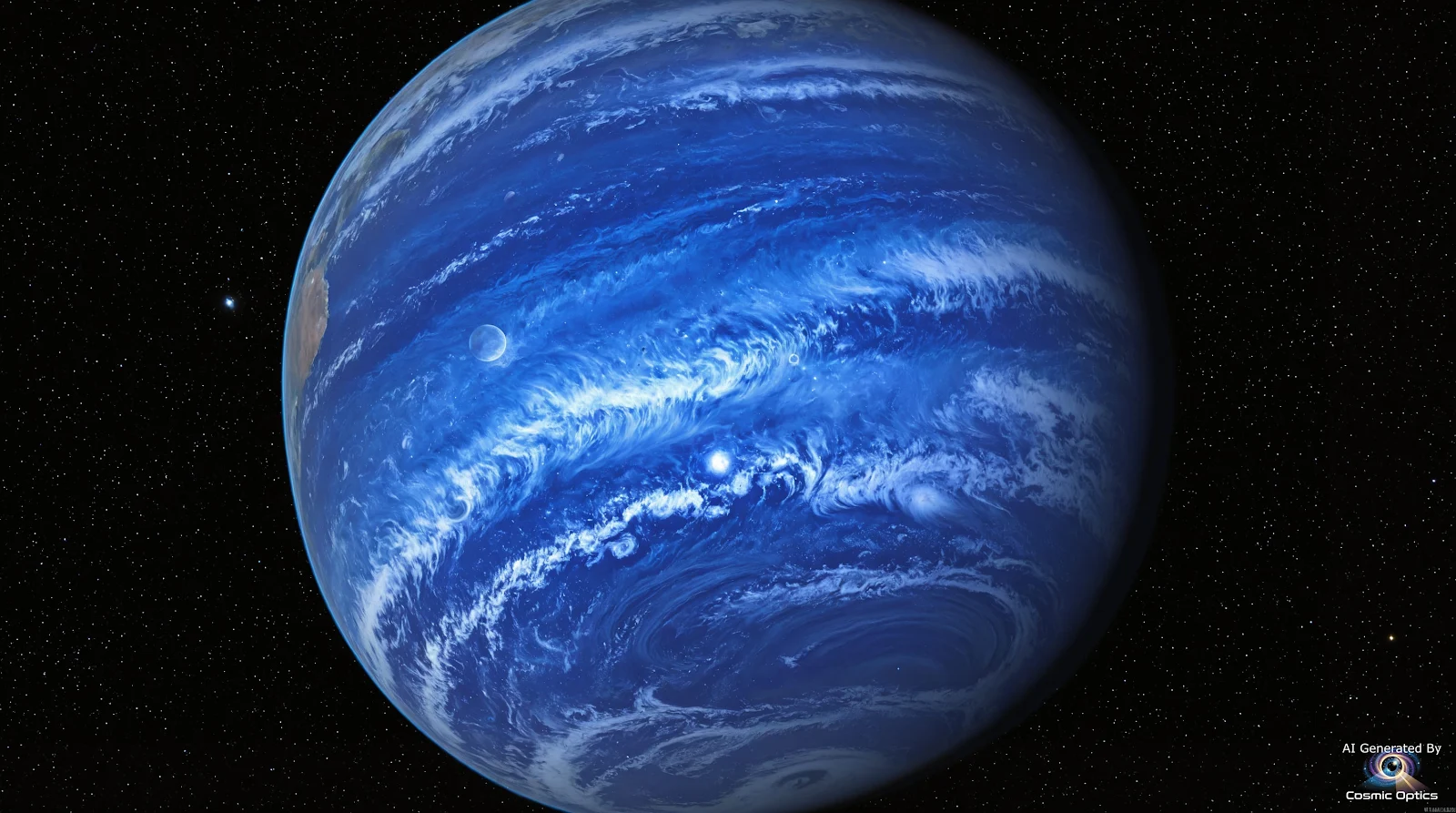
The reaches of our solar system hold wonders that defy the imagination, operating on scales of time and physical intensity that make our terrestrial experiences seem tranquil by comparison. Among these celestial giants, the eighth planet from the Sun stands as a sentinel of the deep, a sapphire-hued world that represents the absolute frontier of the major planetary system. This distant ice giant is not merely a frozen ball of gas but a dynamic, roaring engine of atmospheric fury and internal mystery, challenging our understanding of planetary formation and fluid dynamics.
What makes this distant world truly remarkable is the story of its discovery, which remains one of the greatest triumphs of the human intellect. Unlike the other planets known since antiquity, or even Uranus which was found by systematic sky-scanning, the presence of the eighth planet was first revealed through the precision of mathematics. Astronomers noticed strange perturbations in the orbit of Uranus, suggesting that an unseen mass was tugging on it from further out in the void. In 1846, Urbain Le Verrier and John Couch Adams independently calculated where such a body must be. When observers finally pointed their telescopes to the coordinates provided by the mathematicians, they found the planet almost exactly where it was predicted to be. It was a moment that proved the laws of physics could reach across billions of miles of empty space to reveal hidden truths.
The visual splendor of this world is defined by its deep, mesmerizing blue. While it shares many structural similarities with Uranus, its sister ice giant, the eighth planet possesses a much more vivid and saturated azure hue. This coloration is a product of its complex atmospheric chemistry. Methane in the upper atmosphere absorbs the red end of the light spectrum from the Sun, reflecting back the brilliant blues we see. However, scientists believe there must be an additional, unidentified component or a thinner layer of haze compared to Uranus that allows this world to appear so much more vibrant. It is a world cloaked in a chemical veil, swirling with hydrogen, helium, and traces of ices like water and ammonia.
Beneath that serene blue exterior lies a chaotic environment characterized by the most violent weather in the known solar system. Winds here can reach speeds of over 1,200 miles per hour (2,000 kilometers per hour), which is significantly faster than the speed of sound on Earth. These supersonic gales whip around the planet, driving massive storm systems that can be the size of our entire Earth. One of the most famous features ever observed was the Great Dark Spot, a massive anticyclonic storm that mirrored Jupiter's Great Red Spot in scale, though it proved to be far more ephemeral, vanishing and reappearing in different latitudes over the decades. The sheer energy required to drive such winds at a distance of 2.8 billion miles from the Sun is a subject of intense scientific inquiry, as the planet receives only a tiny fraction of the solar energy that Earth does.
The source of this energy appears to be internal. This world radiates more than twice the energy it receives from the Sun, suggesting a core that remains surprisingly hot despite billions of years of cooling. Deep within the planet, the pressures are so immense that they may cause one of the most exotic phenomena imaginable: diamond rain. Scientists hypothesize that the high pressure and temperature can break down methane molecules, squeezing the carbon into crystalline diamonds that slowly sink through the mantle like sparkling hailstones. This process would release gravitational energy, helping to fuel the planet's intense atmospheric activity and maintain its internal heat.
The planetary system is further enriched by its collection of moons and rings, with the moon Triton standing out as a geological anomaly. Triton is the only large moon in the solar system that orbits in the opposite direction of its planet’s rotation—a retrograde orbit. This suggests that Triton did not form alongside the planet but was once a rogue world from the Kuiper Belt, captured by the planet's gravity eons ago. Triton is one of the few geologically active moons we know of, featuring cryovolcanoes that erupt with nitrogen gas and dark dust, which then drift across its frozen surface. The relationship between the planet and this moon is ultimately a tragic one; tidal forces are slowly dragging Triton closer, and in several hundred million years, it will likely be torn apart by gravity, potentially forming a spectacular ring system that would rival Saturn's.
As we look to the future of space exploration, the ice giants represent the next great frontier. While the Voyager 2 mission provided a brief, tantalizing glimpse of this blue world in 1989, we have not returned with a dedicated orbiter. Understanding these worlds is crucial not just for our knowledge of our own neighborhood, but for understanding the galaxy at large. Data from the Kepler and TESS missions show that "sub-Neptune" sized planets are among the most common types of exoplanets found orbiting other stars. By studying the sapphire guardian of our own solar system, we are essentially learning about the most frequent blueprints for planets across the Milky Way.
The eighth planet remains a symbol of the sublime—a place where math meets reality, where diamonds may fall from the sky, and where the winds roar with a power beyond human comprehension. It reminds us that the further we look into the darkness of the outer solar system, the more we find beauty and complexity that challenges our terrestrial biases. It is a world of shadows, ices, and incredible speed, waiting silently in the cold for the next time humanity decides to venture into the deep to uncover its final secrets.


