
From Scorching Venus to Freezing Neptune: Exploring the Diverse Extremes of Our Solar System
neptune_00004_
The cosmos is a vast, intricate theater where the laws of physics perform in ways that often defy our terrestrial intuition. When we look up at the night sky, we see a clockwork universe, yet the gears of this celestial machinery turn at vastly different speeds. One of the most mind-bending paradoxes in our immediate neighborhood involves the planet Venus. In a stunning reversal of what we consider the "natural" order of time, Venus manages to complete a full trip around the Sun faster than it can manage a single rotation on its own axis. This means that a day on Venus is technically longer than a year. Such a phenomenon invites us to reconsider everything we know about planetary evolution and the chaotic history of our solar system.
To understand this temporal quirk, we must look at the specific measurements. Venus takes roughly 225 Earth days to complete one orbit around the Sun. However, its sidereal day—the time it takes to rotate once relative to the stars—lasts about 243 Earth days. This sluggish rotation is further complicated by the fact that Venus spins in the opposite direction of most other planets. While Earth and the majority of its siblings spin counter-clockwise, Venus turns slowly clockwise. This "retrograde" rotation creates a unique solar day for any hypothetical observer on the surface: between two sunrises, only about 117 Earth days would pass. Even with this distinction, the fundamental sluggishness of the planet’s spin remains one of the great mysteries of planetary science. Many astronomers theorize that this was caused by a colossal collision in the planet's early history, or perhaps the friction caused by its incredibly thick, high-pressure atmosphere essentially "braked" the planet's rotation over billions of years.
As we move further out into the solar system, leaving the rocky inner planets behind, we encounter worlds that operate on an entirely different scale of majesty and violence. The outer reaches are dominated by the giants—monuments of gas and ice that hold secrets of the solar system's formation. Among these, the distant blue sentinel stands as a testament to the sheer power of planetary weather and the elegance of gravitational mathematics. This world was not found through a telescope at first, but through the tip of a lead pencil. Astronomers noticed irregularities in the orbit of Uranus and used complex calculations to predict that another massive body must be pulling on it from further out. When telescopes were finally pointed toward the predicted coordinates, they found the eighth planet, shimmering in a deep, cobalt hue.
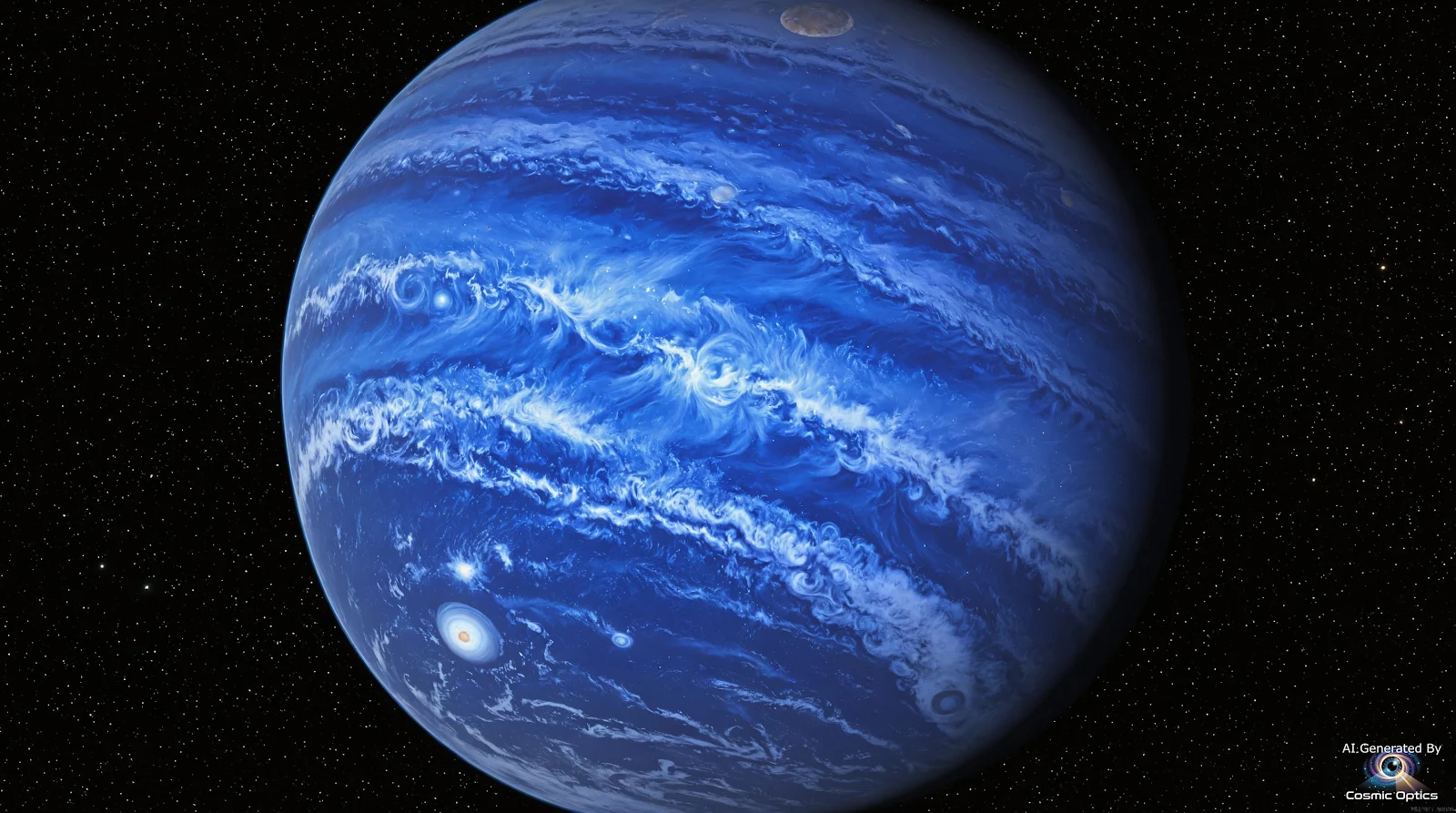
The striking blue color of these distant ice giants is a result of their atmospheric composition. While hydrogen and helium make up the bulk of the air, traces of methane act as a filter, absorbing red light and reflecting the brilliant blues and magentas we see in high-resolution imagery. Unlike the gas giants Jupiter and Saturn, which are composed mostly of hydrogen and helium, the ice giants contain a higher proportion of "ices" such as water, ammonia, and methane. Deep beneath the swirling clouds, pressures are so intense that scientists believe it might actually rain diamonds, as carbon atoms are squeezed into crystalline forms and sink toward the core like sparkling hailstones.
Weather on these distant worlds makes the most powerful hurricanes on Earth look like gentle breezes. Because these planets are so far from the Sun, they receive very little solar energy, yet they possess internal heat sources that drive incredible atmospheric activity. We see winds that surpass the speed of sound, whipping around the planet at over 1,200 miles per hour. These winds sustain massive storm systems, some the size of the entire Earth, which appear as dark spots on the planet's surface. These storms can persist for years, wandering across the latitudinal bands before vanishing and being replaced by new, equally gargantuan vortices. This high-energy environment is a fascinating paradox: the coldest reaches of our solar system host the most kinetic and violent atmospheres.
The study of these planets provides a vital window into the "middle weights" of the universe. When we look at planetary systems around other stars, we find that planets of this size—larger than Earth but smaller than Jupiter—are incredibly common. By studying the dynamics of our own local ice giants, we gain the expertise needed to interpret the data coming from light-years away. Every cloud streak and every magnetic fluctuation recorded by passing probes like Voyager 2 helps us build a comprehensive model of how worlds are born and how they change over eons. The intricate relationship between a planet's internal heat, its rotation, and its distance from its host star determines its ultimate character.
Comparing the slow, scorching rotation of Venus to the rapid, freezing whirl of the outer giants highlights the incredible diversity of our celestial neighborhood. It reminds us that "time" is a relative concept, dictated by the specific circumstances of a planet's birth and the gravitational environment it inhabits. Whether it is a world where the sun rises in the west and sets in the east over the course of months, or a world where supersonic winds scream through a methane-tinted sky, the solar system continues to offer a wealth of information that challenges our imagination and fuels our desire for exploration. As we continue to refine our instruments and plan future missions to these distant frontiers, we are not just looking at cold spheres of gas and rock; we are looking at the history of our own origins, written in the stars and the swirling clouds of our planetary neighbors.


