
Io: The Volcanic Moon Being Turned Inside Out by Jupiter’s Powerful Gravitational Forces
The sheer scale of our solar system often defies human intuition. While we are accustomed to the steady, quiet presence of our own Moon, a dead world of silver dust and ancient craters, the outer reaches of our neighborhood tell a much more violent and vibrant story. At the heart of this cosmic drama sits Jupiter, a gas giant so massive that it exerts a gravitational influence felt across billions of miles. Among its retinue of dozens of moons, one stands out as a defiant, hyperactive anomaly: Io. This moon is not merely a celestial body; it is a chaotic laboratory of thermodynamics and celestial mechanics, a world that is literally being turned inside out by the invisible hands of gravity.
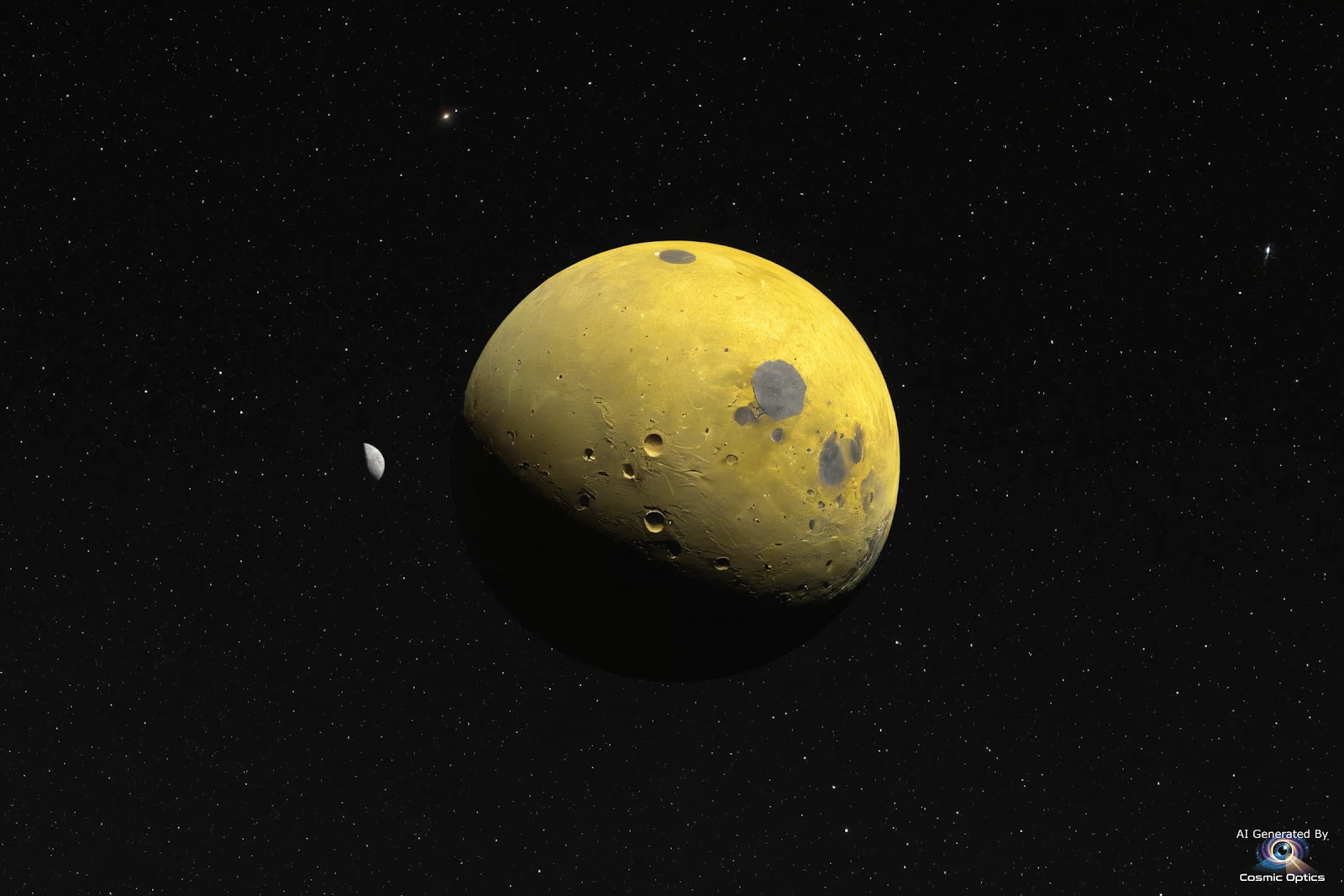
An authentic, standalone astrophotography snapshot of Jupiter's moon Io in deep space. A single, sol_00022
Io is the innermost of the four Galilean moons, and its proximity to Jupiter defines every aspect of its existence. While many moons in the outer solar system are composed largely of water ice, Io is a rocky world, dense and scorched. It holds the title of the most geologically active object in the known solar system, boasting hundreds of active volcanoes that erupt with a frequency and intensity that dwarf anything seen on Earth. This relentless activity is not powered by the decay of radioactive elements, as is the case with Earth’s internal heat, but rather by a process known as tidal heating. It is a testament to the power of gravity as a physical force that can stretch and squeeze solid rock until it melts.
The mechanism behind this heat is a complex gravitational "tug-of-war." As Io orbits Jupiter, it is caught between the immense mass of the planet and the rhythmic gravitational pulls of its sibling moons, Europa and Ganymede. These moons are locked in an orbital resonance; for every two orbits Europa completes, Io completes four, and for every orbit Ganymede completes, Io completes eight. This periodic alignment ensures that Io’s orbit remains slightly elliptical rather than perfectly circular. As Io moves closer to and then further away from Jupiter, the varying gravitational pull causes the moon to physically bulge and retract. These "solid-body tides" can raise and lower the surface of Io by as much as 100 meters. The resulting internal friction generates an incredible amount of heat, liquefying the moon's mantle and fueling its volcanic firestorms.
Visually, Io is a spectacle of color that looks unlike any other world. Its surface is painted in vivid hues of yellow, orange, red, and black, leading many astronomers to affectionately compare it to a giant pizza. These colors are the result of various forms of sulfur and sulfur dioxide frost. When volcanoes erupt on Io, they send plumes of gas and debris hundreds of kilometers into the vacuum of space. As this material falls back to the surface, it undergoes chemical transitions depending on the temperature, creating a shifting mosaic of volcanic deposits. Unlike the Moon or Mars, which are scarred by billions of years of impact history, Io’s surface is remarkably smooth in terms of craters. This is because the moon is constantly "resurfacing" itself. The volcanic output is so high that any impact crater is quickly buried under new layers of lava and ash, keeping the face of the moon eternally young.
One of the most awe-inspiring features on Io is Loki Patera, a massive volcanic depression filled with a lake of molten lava. This lake is over 200 kilometers in diameter and is so large that it has its own internal dynamics, with crustal plates of cooling lava sinking into the depths, only to be replaced by fresh, glowing magma from below. The sheer energy output of Loki Patera alone is greater than the total volcanic output of the entire Earth. This level of activity makes Io a primary target for planetary scientists who wish to understand the early, molten stages of planetary evolution, as Io provides a real-time window into the processes that shaped the terrestrial planets billions of years ago.
The influence of Io extends far beyond its own surface. The moon is essentially a giant electric generator moving through Jupiter’s intense magnetic field. As Io’s volcanic plumes ionize, they strip away particles that become trapped in Jupiter’s magnetosphere, creating a structure known as the Io Plasma Torus—a donut-shaped ring of charged particles encircling the planet. This interaction generates a massive electrical current of roughly three million amperes between Io and Jupiter’s upper atmosphere. This "flux tube" of energy triggers permanent, powerful auroras in Jupiter’s polar regions, effectively linking the moon and the planet in a continuous electromagnetic embrace. It is a profound reminder that in space, no object exists in total isolation; the movements of a moon can dictate the weather and light shows of its parent planet.
Exploration of Io has been a journey of constant surprise. When the Voyager 1 spacecraft first flew past in 1979, scientists expected to see a cold, cratered rock. Instead, they discovered an alien world of fire and brimstone, marking the first time active volcanism was observed anywhere other than Earth. Subsequent missions, such as Galileo and the more recent Juno flybys, have provided high-resolution data on the moon’s topography and the composition of its atmosphere. These missions have revealed that Io's atmosphere is thin and composed mostly of sulfur dioxide, which collapses and freezes onto the surface when the moon passes into Jupiter’s shadow, only to sublimate back into a gas when it returns to the sunlight.
Studying Io is not just about cataloging extreme environments; it is about refining our understanding of the habitability of the universe. While Io itself is far too hostile for life as we know it, the tidal heating that keeps it molten is the same process that warms the hidden oceans of Europa and Enceladus. By understanding the limits of tidal energy on Io, we gain a better grasp of how life might thrive in the dark, subsurface reaches of icy moons across the galaxy. Io stands as a sentinel of the outer solar system, a vibrant, volatile world that challenges our perceptions of what a moon can be and serves as a glowing beacon of the dynamic energy that permeates our cosmic neighborhood.
As we look toward the future, new missions like the European Space Agency’s JUICE and NASA’s Europa Clipper will continue to study the Jovian system. While their primary targets may be the icy worlds nearby, they will undoubtedly capture more data on the enigmatic Io. Each new observation reinforces the fact that we live in a solar system of incredible diversity, where a single moon can be a world of endless fire, sculpting the magnetic environment of a giant planet and teaching us the fundamental laws of celestial movement and heat. Io remains one of the most fascinating destinations in our reach, a place where gravity becomes heat, and where the surface is rewritten with every passing day.


