
Jupiter’s Moon Io: The Most Geologically Active Body in Our Solar System
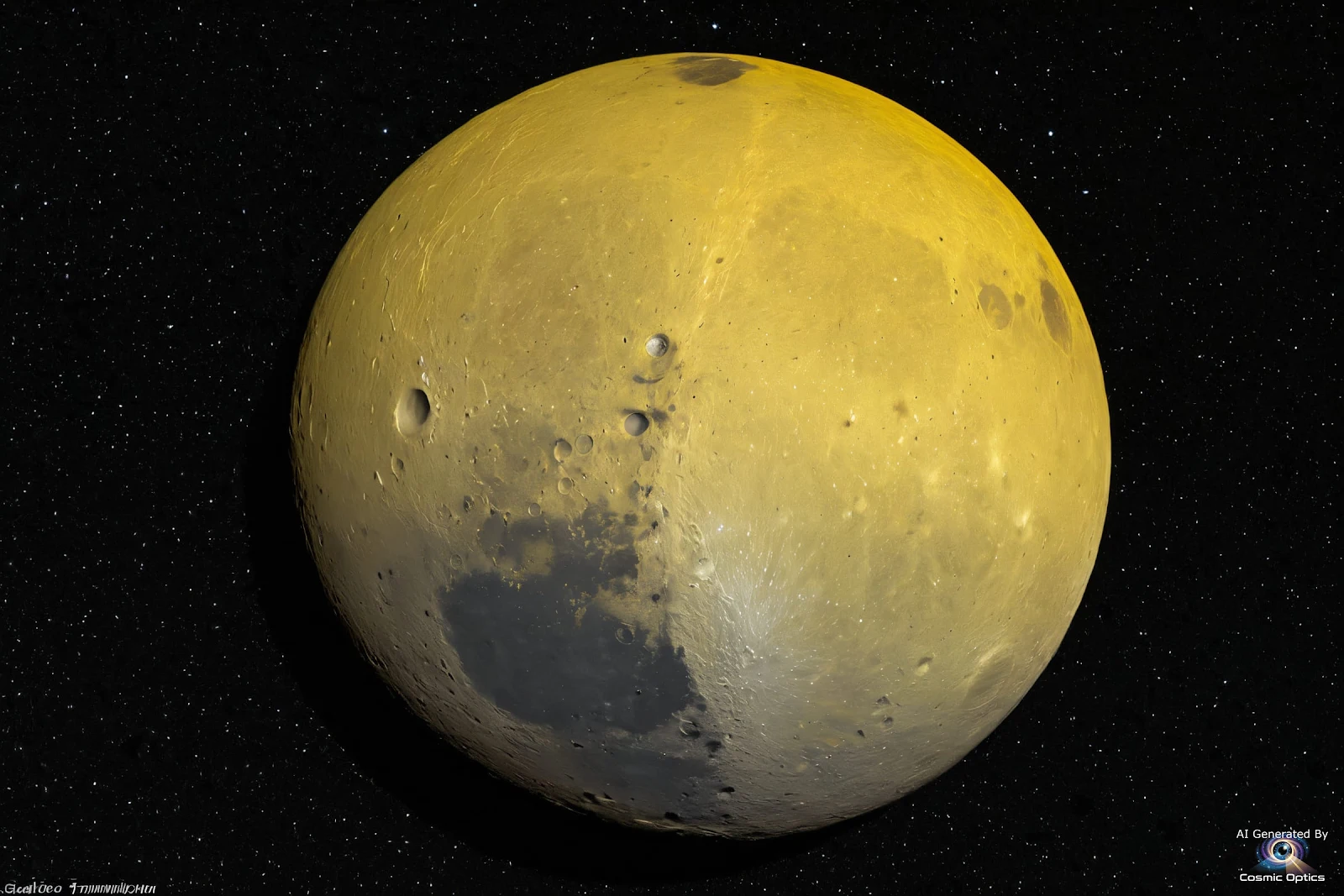
An authentic, standalone astrophotography snapshot of Jupiter's moon Io in deep space. A single, sol_00001
The Jovian system serves as a miniature solar system in its own right, a complex dance of gravity, radiation, and celestial mechanics centered around the king of planets. Among its many jewels, the moon Io stands out as one of the most exotic and physically violent environments ever discovered. While many moons in the outer solar system are frozen, silent shells of rock and ice, Io is a vibrant, churning world of fire and brimstone. It is the most geologically active object in our entire solar system, a fact that challenges our understanding of how small planetary bodies retain heat and drive internal processes billions of miles from the Sun.
The sheer intensity of Io’s volcanic activity is difficult to overstate. There are over 400 active volcanoes scattered across its surface, some of which blast plumes of sulfur and sulfur dioxide hundreds of miles into the cold vacuum of space. These eruptions are so powerful that they can be captured by telescopes on Earth and by passing spacecraft, appearing as bright, incandescent spots against the dark backdrop of the Jovian neighborhood. Unlike Earth, where plate tectonics drive much of our volcanic activity, Io’s geology is fueled by a relentless gravitational tug-of-war. This phenomenon, known as tidal heating, is the engine behind the moon’s spectacular displays of power.
To understand the source of this energy, one must look at the orbital resonance shared by the Galilean moons. Io is caught in a rhythmic dance with its neighbors, Europa and Ganymede. For every orbit Ganymede makes around Jupiter, Europa makes two, and Io makes four. This precise alignment means the moons regularly pass one another at the same points in their orbits, exerting a gravitational pull that stretches Io’s orbit into an elliptical shape. As Io moves closer to and then further away from the massive gravity of Jupiter, the planet’s immense tidal forces literally stretch and squeeze the moon like a piece of putty. This internal friction generates a staggering amount of heat, melting the moon’s interior and forcing its way to the surface in the form of magma.
The visual result of this constant resurfacing is a world that looks like no other. While the Moon and Mercury are scarred by ancient impact craters, Io’s surface is remarkably smooth in terms of cratering because the volcanic flows are constantly "paving" over any new impacts. This creates a landscape dominated by vast plains of sulfurous frost, towering volcanic peaks, and enormous lakes of molten silicate lava. The colors of Io are equally striking—vibrant yellows, oranges, reds, and blacks dominate the palette, largely due to the various forms and compounds of sulfur deposited across the surface. From a distance, this has led many astronomers to affectionately compare the moon’s appearance to a giant, cosmic pizza.
One of the most fascinating features of Io is the Loki Patera, an enormous volcanic depression that functions as a massive lava lake. It is larger than many terrestrial lakes and exhibits a cyclic brightening that suggests its crust periodically founders and sinks into the molten depths below, exposing fresh, glowing lava. The scale of such features is a testament to the extreme energies at work. When a plume erupts from a site like Pele, the material is ejected at speeds reaching 1,000 meters per second. Because Io has very little atmosphere and relatively low gravity, these plumes create massive, umbrella-shaped canopies of gas and dust that eventually settle back down as colorful frost, changing the face of the moon almost daily.
The influence of Io extends far beyond its own surface, creating a profound impact on the entire Jovian magnetosphere. As Io’s volcanoes spew material into space, about one ton of that material is stripped away every second by Jupiter’s powerful magnetic field. This ionized gas forms a giant, donut-shaped ring around Jupiter known as the Io Plasma Torus. As Jupiter rotates, its magnetic field sweeps through this torus, generating an enormous electric current. This interaction produces millions of watts of electricity and creates powerful radio emissions that can be detected from Earth. Furthermore, some of these ions travel along Jupiter’s magnetic field lines toward the planet’s poles, creating permanent, glowing auroras that are far more intense than anything seen on Earth.
For scientists, Io is a living laboratory for the study of extreme geophysics. It provides a unique window into the early history of planets, including the young Earth, which likely experienced much higher levels of volcanic activity shortly after its formation. By studying the composition of the lavas on Io—which are believed to be primarily silicates like basalt, but much hotter than most modern terrestrial lavas—researchers can gain insights into the thermal evolution of rocky worlds. The presence of ultra-high-temperature lavas, reaching upwards of 1,600 degrees Celsius, suggests a mantle that is significantly more dynamic than previously theorized for a body of its size.
Exploring Io presents significant challenges for robotic missions. The moon is nestled deep within Jupiter’s radiation belts, an environment so harsh that it can fry the sensitive electronics of most spacecraft in a matter of hours. Missions like Galileo and Juno have had to be carefully shielded and managed to capture the data we have today. Every image and every reading of Io’s gravity and magnetic interactions is a hard-won victory for planetary science. As we look toward future missions to the Jovian system, Io remains a primary target for understanding the complex interplay between orbital dynamics and planetary interiors, reminding us that even in the cold reaches of the outer solar system, the fires of creation are still burning bright.
The story of Io is one of constant transformation. It is a moon that refuses to be still, a world where the very ground beneath your feet is in a state of perpetual renewal. Its existence proves that the "habitable zone" is not the only place where interesting things happen; even far from the Sun’s warmth, gravity itself can breathe life into a world, turning a small, rocky moon into a powerhouse of celestial energy. To observe Io is to witness the raw, unfiltered power of nature on a planetary scale, a spectacle that continues to inspire awe and curiosity in every generation of explorers who look toward the stars.


