
The Cerulean Sentinel: Exploring Neptune’s World of Diamond Rain and Supersonic Winds
The vast expanse of our solar system holds secrets that challenge our understanding of physics, chemistry, and the very nature of planetary formation. While the inner rocky planets like Earth and Mars have long captured our collective imagination, the true mysteries lie much further out, in the cold, dark reaches where the sun is little more than a brilliant star in a perpetual twilight. Here, the ice giants reign supreme, standing as monumental sentinels of the outer frontier. These worlds are not merely larger versions of the planets we know; they are exotic realms where the rules of meteorology and geology are rewritten in shades of deep azure and cobalt.
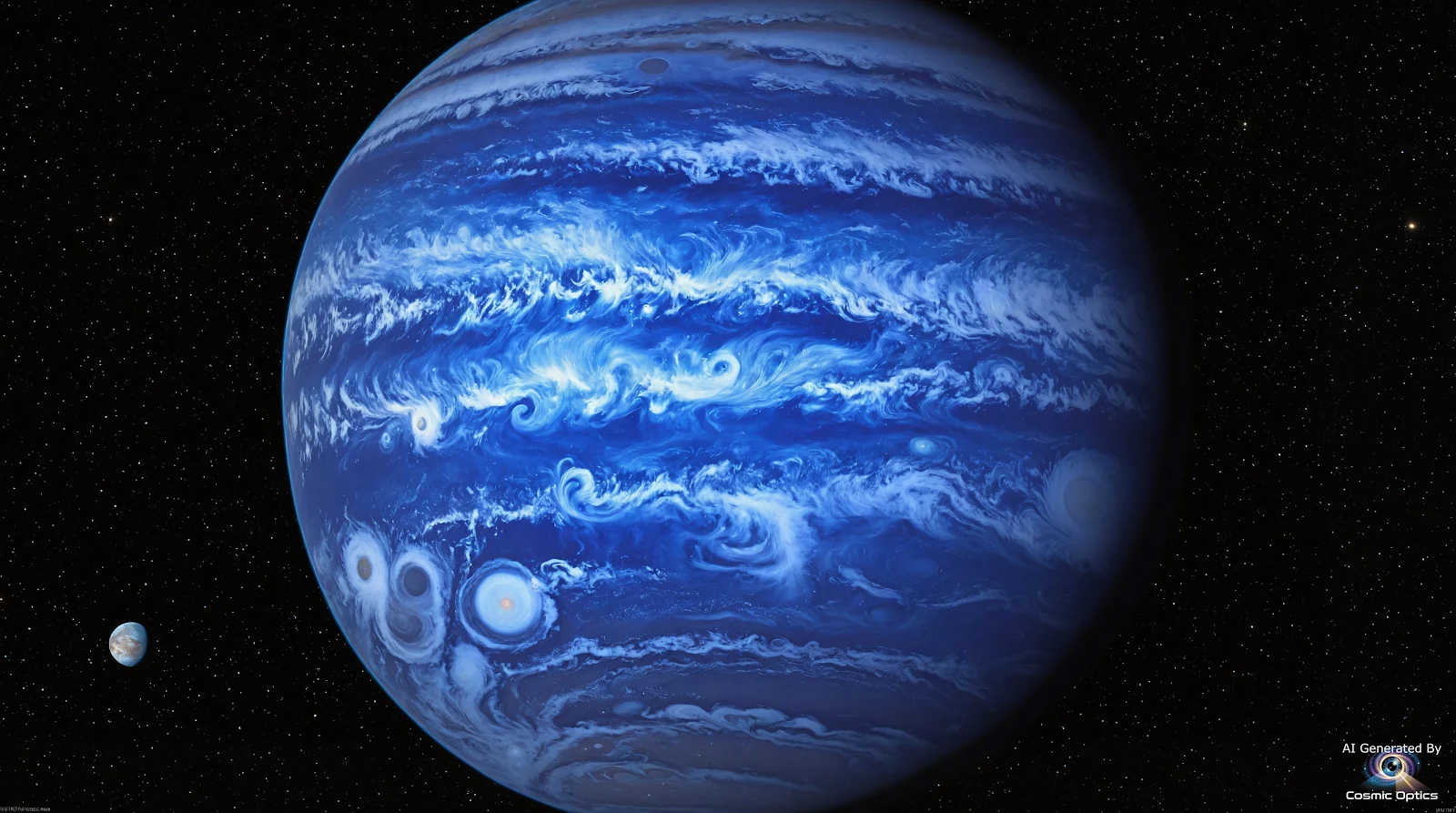
One of the most breathtaking sights in the cosmos is the deep blue brilliance of the eighth planet from the sun. This world is a masterpiece of atmospheric chemistry, draped in a hue so intense it seems almost artificial. This striking color is the result of methane in the upper atmosphere, which absorbs the red end of the spectrum from the faint sunlight and reflects a vibrant blue back into space. However, beneath this serene-looking exterior lies a world of unimaginable chaos and power. Unlike the calm, solid ground we stand upon, this distant giant is a fluid world, a swirling cauldron of water, ammonia, and methane ices wrapped in a thick, high-pressure atmosphere.
The discovery of this distant world remains one of the greatest triumphs of human intellect and the power of mathematics. In the mid-19th century, astronomers noticed that the orbit of Uranus did not quite match the predictions of Newtonian physics. Instead of assuming the laws of gravity were wrong, they theorized that an unseen mass must be pulling on Uranus from even further out. Through painstaking manual calculations, mathematicians Urbain Le Verrier and John Couch Adams independently predicted the exact location of this hidden planet. When astronomers finally pointed their telescopes to that specific patch of sky in 1846, they found it within a single degree of Le Verrier's prediction. It was the first planet discovered with a pen rather than a lens, proving that the universe operates on a logical, predictable scale that the human mind can decipher.
To understand the sheer scale of the environment on this ice giant, one must look at its weather patterns. It hosts the most violent winds recorded anywhere in the solar system. These are not the gentle breezes of Earth or even the fierce hurricanes of the tropics; these are supersonic gales that can reach speeds of over 1,200 miles per hour. Scientists are still baffled as to how a planet so far from the sun, receiving only a tiny fraction of the solar energy Earth receives, can generate such terrifying kinetic energy. It is believed that the planet’s internal heat—leftover from its formation and potentially generated by gravitational contraction—drives these massive storms from deep within, creating a dynamic and ever-changing face that features massive dark spots and bright, scudding clouds of frozen methane.
Deep inside the planet, the conditions become even more surreal. As you descend through the layers of the atmosphere, the pressure increases to millions of times that of Earth's surface. At these depths, carbon atoms are squeezed so intensely that scientists believe they crystallize into actual diamonds. This leads to the fascinating hypothesis of diamond rain, where precious gemstones precipitate through the slushy mantle like hailstones, sinking toward the planet's core. This internal structure, consisting of a hot, dense fluid of "icy" materials over a rocky core, creates a complex and tilted magnetic field that behaves unlike anything found in the inner solar system, wobbling and shifting as the planet rotates.
The satellite system surrounding this blue giant is equally captivating, dominated by the massive moon Triton. Triton is a geological oddity; it is the only large moon in the solar system that orbits in the opposite direction of its planet's rotation, a "retrograde" orbit. This suggests that Triton did not form alongside its parent planet but was instead a rogue traveler from the Kuiper Belt—the icy debris field beyond the planets—that was ensnared by the giant's gravity billions of years ago. Triton is one of the few geologically active moons we know of, featuring cryovolcanoes that erupt with nitrogen gas and dust instead of molten rock. These plumes can rise miles into the thin atmosphere, coating the moon's surface in a fresh layer of nitrogen frost and creating a landscape that is both haunting and beautiful.
Our direct knowledge of this far-flung system is surprisingly limited, primarily stemming from a single, historic encounter. In 1989, the Voyager 2 spacecraft screamed past the planet, providing the first and only close-up images we possess of this majestic world. Every high-resolution detail of its rings, its clouds, and its moons comes from that brief flyby. Since then, we have relied on the Hubble Space Telescope and sophisticated ground-based observatories to track its seasonal changes and atmospheric shifts. Despite the distance, the data we gather is vital; by studying these ice giants, we gain a blueprint for the most common type of exoplanet found orbiting other stars in our galaxy.
Looking toward the future, the scientific community is eager to return. Proposed missions involve atmospheric probes that could descend into the clouds to taste the chemistry of this ancient world, and orbiters that could study the complex interactions between the planet, its rings, and its captured moons over several years. Such a mission would be a journey through time, as these outer planets preserve the primitive materials from which our solar system was built. They are the chemical "time capsules" of our celestial neighborhood, holding the answers to how water and organic molecules were distributed during the early days of the sun's birth.
The blue giant at the edge of our sun's reach is a reminder of how much of the universe remains to be explored. It is a world of diamond rain, supersonic winds, and captured moons, standing as a testament to the diversity of planetary evolution. It challenges our definitions of "weather" and "geology," pushing the boundaries of what we believe is possible in nature. As we develop new technologies and venture further into the dark, our fascination with this cerulean sentinel only grows, beckoning us to solve its mysteries and, in doing so, better understand our own place among the stars. Every time we point a telescope toward that faint blue dot, we are not just looking at a distant planet; we are looking at the frontier of human knowledge, a place where the ordinary ends and the extraordinary begins.


