
The Crimson Frontier: Unlocking the Geological Secrets and Future of the Red Planet
The crimson allure of Mars has beckoned to humanity since the first stargazers looked upward and noticed a wandering red spark in the velvet night. Named for the Roman god of war due to its blood-like hue, this rust-colored world is far more than a desolate desert; it is a complex, geologically diverse planet that holds the keys to understanding the history of our solar system and, perhaps, the potential for life beyond Earth. As our closest neighbor with a solid surface, Mars represents the ultimate frontier—a laboratory for planetary evolution and the primary candidate for the first human footsteps on another world.
The striking coloration that defines the Martian landscape is the result of iron oxide, better known as rust. The planet’s surface is covered in a fine, powdery dust rich in iron minerals that have oxidized over billions of years. This process is not merely superficial; it speaks to a deep chemical history where oxygen and water once played a more active role. Beneath this reddish veneer lies a world of extremes, featuring geological formations that dwarf anything found on Earth. Mars is home to Olympus Mons, the largest volcano in the solar system. Standing at a staggering 13.6 miles high, it is nearly three times the height of Mount Everest. Because Mars lacks the plate tectonics that shift Earth’s crust, volcanic hotspots remain stationary, allowing shield volcanoes to grow to gargantuan proportions over eons of eruptions.
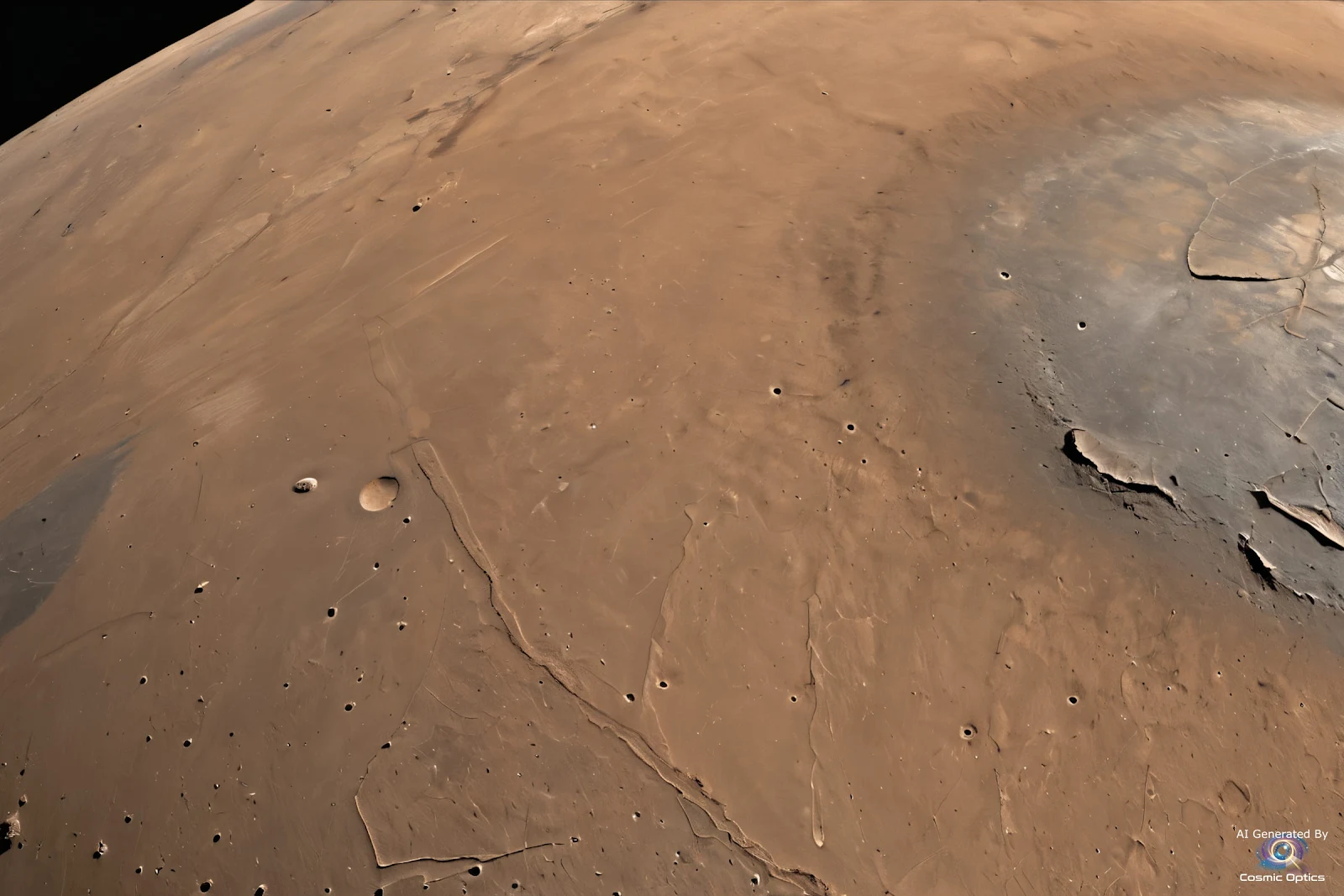
An authentic, photorealistic astronomical photograph of the planet Mars in deep space. A highly deta_00034
Complementing its massive peaks are its profound depths. Valles Marineris, a sprawling canyon system, stretches over 2,500 miles along the Martian equator. To put its scale into perspective, if it were placed on Earth, it would span the entire width of the United States. In some areas, the canyon reaches depths of seven miles, revealing layers of rock that provide a vertical timeline of the planet’s history. Scientists believe this feature formed as the planet’s crust cracked during the uplift of the Tharsis volcanic region, creating a rift that was later widened by erosion and mass wasting. These features suggest a planet that was once intensely geologically active, shaped by internal heat and perhaps the flow of ancient fluids.
The question of water is central to our fascination with Mars. While the planet today is a frigid desert with an atmosphere 100 times thinner than Earth’s, evidence suggests a much wetter past. Satellite imagery and rover data have identified ancient riverbeds, alluvial fans, and sedimentary rock layers that could only have formed in the presence of liquid water. The discovery of hydrated minerals and the presence of vast ice reserves at the polar caps—and even buried beneath the mid-latitude soil—prove that Mars was once a world of lakes and perhaps even oceans. This historical presence of water is the primary driver behind the search for past or present microbial life. If life emerged on Earth shortly after its formation, could the same have happened on a young, wet Mars?
Modern exploration has entered a golden age with the deployment of sophisticated robotic emissaries. NASA’s Curiosity and Perseverance rovers act as mobile laboratories, drilling into the Martian surface to analyze its chemical composition. Perseverance, currently exploring the Jezero Crater, is specifically searching for signs of ancient life in what was once a river delta. By collecting rock and soil samples for a future return to Earth, this mission represents the first step in a trans-planetary relay race. Meanwhile, the InSight lander has provided us with a look into the "heart" of Mars, using seismometers to detect "marsquakes" and mapping the planet’s internal structure, revealing a core that is surprisingly liquid and enriched with lighter elements like sulfur.
Living on Mars, however, presents formidable challenges. The atmosphere is composed of 95% carbon dioxide, and the lack of a global magnetic field means the surface is constantly bombarded by solar radiation. Furthermore, the planet experiences global dust storms that can shroud the entire globe for months, blocking out the sun and dropping temperatures to extreme lows. Despite these hurdles, the drive to send humans to Mars remains a cornerstone of 21st-century space policy. It is not merely about the "because it is there" spirit of exploration; it is about the long-term survival of the human species. Becoming a multi-planetary species ensures that the flame of human consciousness is not extinguished by a single planetary catastrophe.
The transformation of Mars from a point of light in the sky to a tangible world with its own geography and history is one of the greatest triumphs of modern science. Every mission brings us closer to answering the fundamental questions of our existence: Are we alone? Is life a universal constant or a terrestrial fluke? As we look toward the horizon of the next decade, with plans for manned lunar bases acting as a springboard for Martian voyages, the Red Planet remains our most vital and vibrant target. It stands as a testament to our curiosity and a mirror to our own planet’s fragile beauty, reminding us that in the vastness of the cosmos, the journey of discovery is only just beginning.


