
The Dynamic Landscapes and Towering Ice Mountains of the Solar System's Remote Frontiers
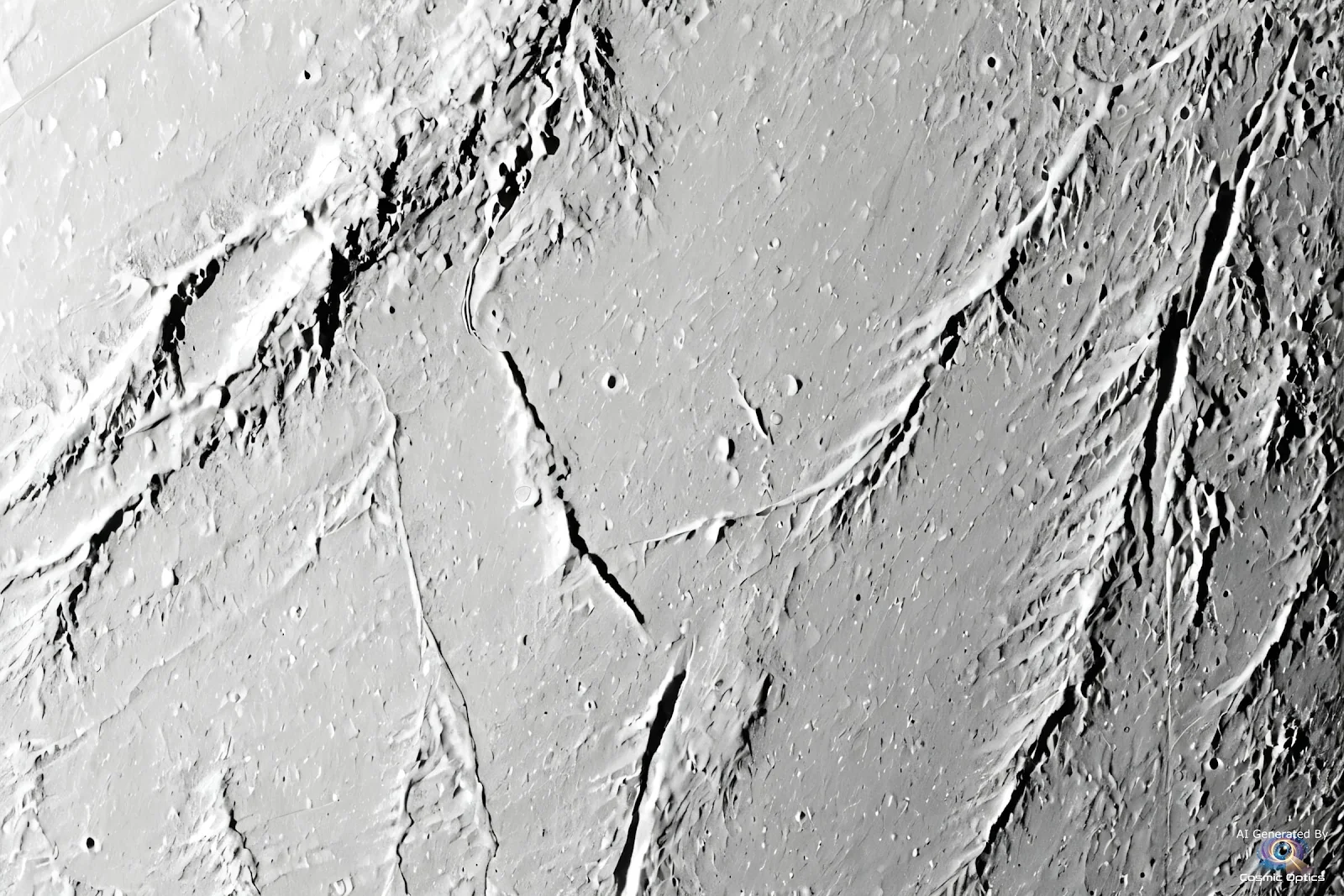
An authentic, true-color NASA photograph of a high-resolution orbital map of the towering ice mounta_00005
The outer reaches of our solar system were once envisioned as a vast, dark graveyard of frozen relics—static worlds where time had stood still for billions of years. This perception was shattered when modern reconnaissance missions finally reached the Kuiper Belt, revealing that the "frozen" frontier is, in fact, one of the most geologically diverse and active regions in the known universe. Far from being inert lumps of rock and ice, these distant bodies possess complex landscapes characterized by towering mountain ranges, sprawling nitrogen glaciers, and tectonic features that rival the grandest vistas on Earth.
The transformation of our understanding began in earnest when high-resolution imaging technology allowed us to peer closely at the surfaces of these remote worlds. What we discovered was a masterclass in exotic geology. On worlds like Pluto, the sheer scale of the topographical relief is breathtaking. Massive peaks rise several miles into the thin, hazy atmosphere, casting long shadows over plains of volatile ices. These features present a fascinating puzzle for planetary scientists: how can a world so small and so far from the sun sustain the internal energy required to push mountains toward the stars?
To understand these towering structures, one must first reconsider the nature of "ice." In the temperate environment of Earth, water ice is a fragile substance, prone to melting and flowing. However, in the extreme cold of the outer solar system, where surface temperatures can plummet to -390 degrees Fahrenheit, water ice behaves remarkably differently. At these cryogenic temperatures, the molecular structure of water ice becomes as rigid and unyielding as terrestrial granite. This "bedrock" of water ice forms the structural foundation of the massive mountains we observe. Without this crystalline strength, the towering peaks would collapse under their own weight, unable to maintain their elevation against the pull of gravity.
While water ice provides the skeletal framework of these landscapes, it is the more "volatile" ices—composed of nitrogen, methane, and carbon monoxide—that act as the sculptors of the surface. These substances have much lower melting points and remain relatively soft or even fluid-like at temperatures where water ice is solid rock. They flow through canyons, fill massive basins, and undergo a constant cycle of sublimation and deposition. This creates a dynamic environment where "glaciers" of solid nitrogen crawl across the surface, carving out terrain in a process that mirrors the glacial movements seen in the Alps or the Antarctic, albeit using entirely different chemical building blocks.
One of the most striking revelations from orbital mapping is the presence of vast, smooth plains that appear almost entirely devoid of impact craters. In planetary science, a lack of craters is a definitive sign of a young surface. This implies that the landscape is being constantly renewed by geological processes. This "resurfacing" can occur through various mechanisms, including the convection of nitrogen ice. In massive basins, the warmth from the planetary interior—feeble as it may be—is enough to cause the solid nitrogen to churn in a slow, convective dance. Warmer ice rises to the center of giant polygonal cells, cools, and sinks back down at the edges, effectively erasing the scars of meteoritic impacts over millions of years.
Beyond the glaciers and plains lie the enigmatic features known as cryovolcanoes. On Earth, volcanoes erupt with molten rock, driven by the intense heat of the mantle. In the outer solar system, "ice volcanoes" erupt with a slushy mix of water, ammonia, and other volatiles. These cryolavas spread across the surface, smoothing out rugged terrain and creating massive, domed structures. The existence of such features suggests that these small worlds possess a reservoir of internal heat, likely generated by the slow decay of radioactive elements in their rocky cores or, in the case of moons like Europa or Enceladus, by the tidal tugging of a massive host planet.
The study of these icy landscapes also provides profound insights into the atmospheric interactions of distant worlds. Many of these bodies possess thin, layered atmospheres that interact directly with the surface. During the long orbital years, seasons change with dramatic intensity. As a planet moves further from the sun, its atmosphere can literally freeze and fall to the ground as "snow." When it moves closer, the ices on the surface sublimate—turning directly from a solid to a gas—to replenish the atmospheric envelope. This constant exchange creates complex weather patterns and contributes to the unique colorations observed in the high-resolution maps, where organic compounds called tholins settle on the ice, staining the landscape in hues of deep red and mahogany.
The implications of these discoveries extend far beyond geology. The presence of liquid-like movement, internal heat, and a rich chemistry of organic molecules raises the tantalizing possibility of subsurface oceans. If liquid water exists beneath the insulating crust of these ice worlds, they may represent some of the most promising environments for astrobiology in the solar system. The rugged mountains and smooth plains we see today are merely the "skin" of a complex, layered world that may hold secrets about the origins of life and the evolution of planetary systems.
As we continue to process the data from these historic missions, the high-resolution maps serve as a testament to human ingenuity. They bridge the gap between a distant, blurry point of light and a real, tangible place with a history written in its ice. Each ridge, valley, and peak tells a story of billions of years of thermal evolution and celestial mechanics. We are no longer looking at simple, frozen spheres; we are looking at living, breathing worlds that challenge our definitions of "activity" and "geology." The exploration of these towering ice mountains is not just a study of cold rocks, but a journey into the heart of the solar system's most enduring mysteries.
Looking forward, the next generation of space telescopes and robotic explorers will aim to delve even deeper into these icy frontiers. We seek to understand the precise composition of the dark streaks found in the valleys and the exact mechanism that fuels the cryovolcanic plumes. The data gathered from orbital maps acts as a roadmap for these future endeavors, highlighting areas of high scientific interest where a future lander might touch down. The era of seeing these worlds as distant ghosts is over; they are now the primary targets in our quest to understand the full diversity of the cosmos.


