
The Enigmatic Dwarf Planet Eris: Exploring a Frozen Giant at the Solar Edge
Deep within the obsidian silence of the outer solar system, far beyond the familiar orbits of the gas giants and the icy reaches of the Kuiper Belt, lies a world of profound mystery and frozen majesty. This distant sentinel, a dwarf planet of remarkable scale and significance, serves as a gateway to our understanding of the primordial materials that formed our celestial neighborhood. Its discovery did more than simply add a name to the astronomical charts; it fundamentally reshaped our definition of what constitutes a planet and forced a radical reappraisal of the architecture of our solar system.
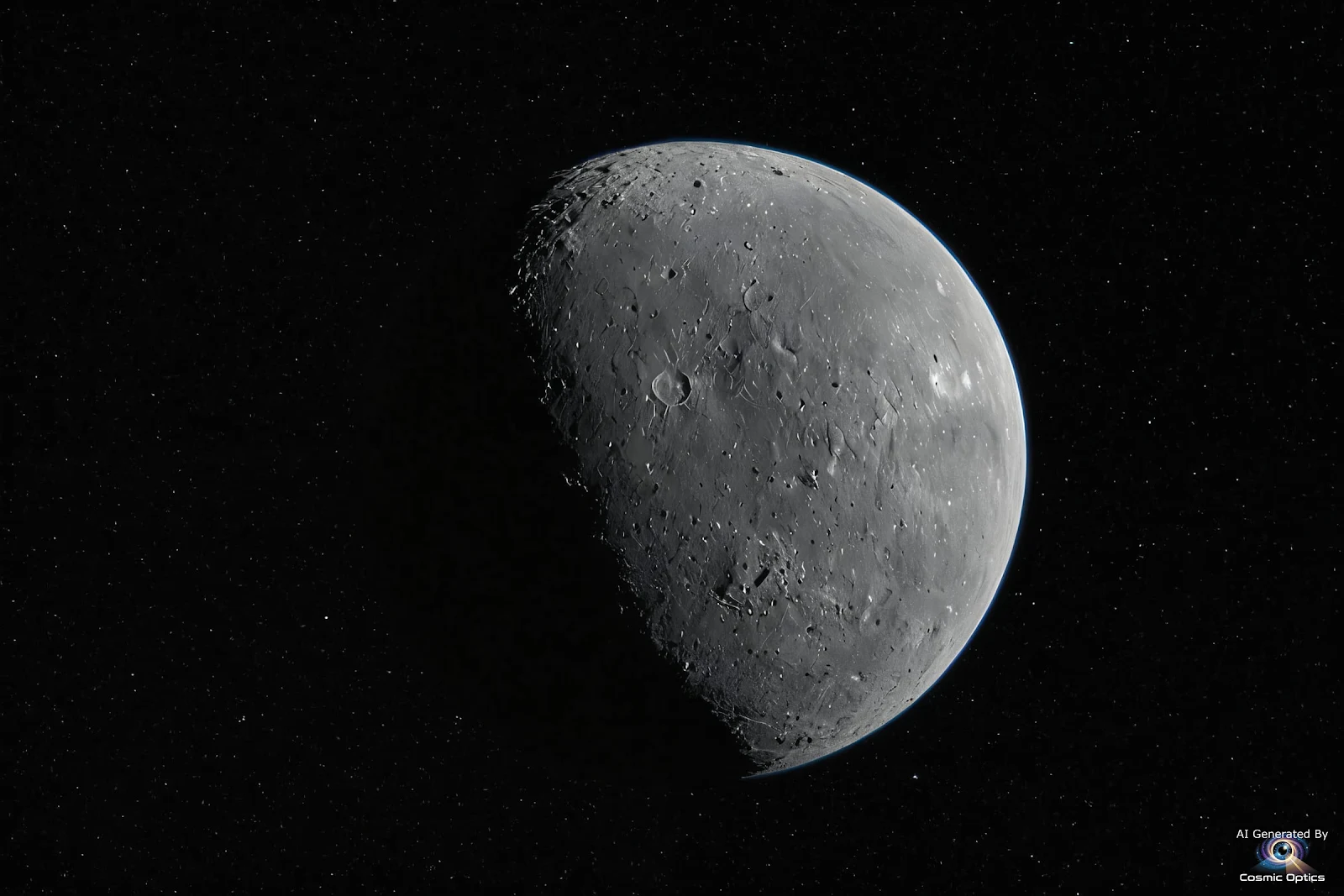
The story of this enigmatic body began in early 2005, when a team of astronomers led by Mike Brown, Chad Trujillo, and David Rabinowitz identified a moving object in images taken at the Palomar Observatory. Initially nicknamed "Xena," this object was located so far from the Sun that it appeared as nothing more than a tiny, slow-moving speck against a backdrop of distant stars. However, preliminary data suggested something startling: this new world was comparable in size to Pluto, and significantly more massive. This revelation sent shockwaves through the scientific community, as it suggested that the region beyond Neptune was far more populated with large bodies than previously imagined.
The physical characteristics of this dwarf planet are nothing short of extraordinary. It resides in a region known as the "scattered disc," a high-energy environment populated by icy bodies that have been gravitationally flung into eccentric and highly inclined orbits by the influence of the giant planets. Its journey around the Sun is a marathon that spans 557 Earth years. At its farthest point, known as aphelion, it drifts nearly 97 astronomical units (AU) from the Sun—roughly three times the distance of Neptune. Even at its closest approach, it remains more than 38 AU away, lingering in a realm of eternal twilight where the Sun appears as little more than an intensely bright star.
One of the most striking features of this distant world is its surface. Observations from powerful ground-based telescopes and the Hubble Space Telescope have revealed that it is one of the most reflective objects in the entire solar system. Its albedo, or reflectivity, is approximately 0.96, meaning it reflects 96 percent of the light that hits it. To put this in perspective, fresh-fallen snow on Earth has an albedo of about 0.80 to 0.90. This incredible brightness is attributed to a layer of nitrogen and methane ice that coats the surface. Because the dwarf planet is currently so far from the Sun, its atmosphere—composed largely of nitrogen and methane—has completely collapsed and frozen solid, blanketing the landscape in a pristine, glittering frost.
While size measurements initially suggested it might be larger than Pluto, a stellar occultation in 2010—where the dwarf planet passed in front of a distant star—allowed for a more precise measurement. The results showed it to be roughly 2,326 kilometers in diameter, making it slightly smaller than Pluto’s 2,377 kilometers. However, what it lacks in volume, it makes up for in density. It is approximately 27 percent more massive than Pluto, indicating a much higher proportion of rock to ice in its interior. This high density suggests that the world has a significant rocky core, likely differentiated from an icy mantle, a structure similar to the larger moons of Jupiter and Saturn.
Accompanying this icy giant is a solitary moon, Dysnomia. The discovery of this moon was a pivotal moment for planetary scientists, as it provided the means to weigh the dwarf planet. By observing the orbital period and distance of Dysnomia, researchers were able to apply Kepler's laws of planetary motion to calculate the mass of the primary body with high precision. Dysnomia itself is a fascinating object, likely formed from the debris of a massive collision between its parent and another Kuiper Belt object billions of years ago. This "giant impact" hypothesis mirrors the theorized origin of Earth's Moon and the Pluto-Charon system, suggesting that such catastrophic events were common in the early, crowded days of the solar system's formation.
The presence of such a massive body so far from the Sun was the primary catalyst for the International Astronomical Union’s (IAU) 2006 decision to define the term "planet." Before this discovery, Pluto was the clear outlier of the solar system. The discovery of a "tenth planet" that was more massive than the ninth forced astronomers to decide whether to expand the list of planets indefinitely or to create a new category. The result was the classification of "dwarf planets," a category that includes Pluto, Ceres, Haumea, Makemake, and this distant world of ice. This reclassification remains one of the most debated topics in modern science, yet it underscores the dynamic nature of astronomical discovery; as our tools improve, our definitions must evolve to reflect the reality of the cosmos.
Scientifically, this world acts as a deep-freeze laboratory. Because it is so distant and cold, the chemical signatures present on its surface have remained relatively undisturbed since the dawn of the solar system. Spectroscopic analysis has shown a surface dominated by methane ice, similar to Pluto but with subtle differences that suggest a unique thermal history. Unlike Pluto, which shows distinct reddish patches likely caused by complex organic molecules called tholins, this world appears more uniformly grey or white, perhaps due to the extreme cold preventing certain chemical reactions or the periodic refreshing of its surface by atmospheric collapse.
Exploring such a distant world presents a monumental challenge for future space missions. While the New Horizons mission provided a breathtaking look at Pluto, a similar mission to this dwarf planet would require significantly more time and energy. However, the scientific rewards would be unparalleled. A close-up view would reveal the geological activity of a high-density icy world, the topography of its nitrogen-frosted plains, and the nature of its interaction with its moon. Until such a mission is realized, we must rely on our most advanced telescopes to peer into the darkness, catching glimpses of this frozen monarch as it continues its slow, silent vigil at the edge of the Sun's domain.
Understanding these outer realms is essential for piecing together the history of our planetary system. These icy bodies are the "leftovers" of planet formation, carrying the chemical fingerprints of the solar nebula. By studying their composition, orbits, and internal structures, we gain insight into the migration of the giant planets and the violent processes that shaped the environment we inhabit today. This distant dwarf planet is more than just a cold rock in space; it is a vital chapter in the epic story of our origins, a reminder that the solar system is far larger, more complex, and more beautiful than we ever imagined.


