
The Fiery Landscapes of Io: Jupiter's Most Geologically Active and Volcanic Moon
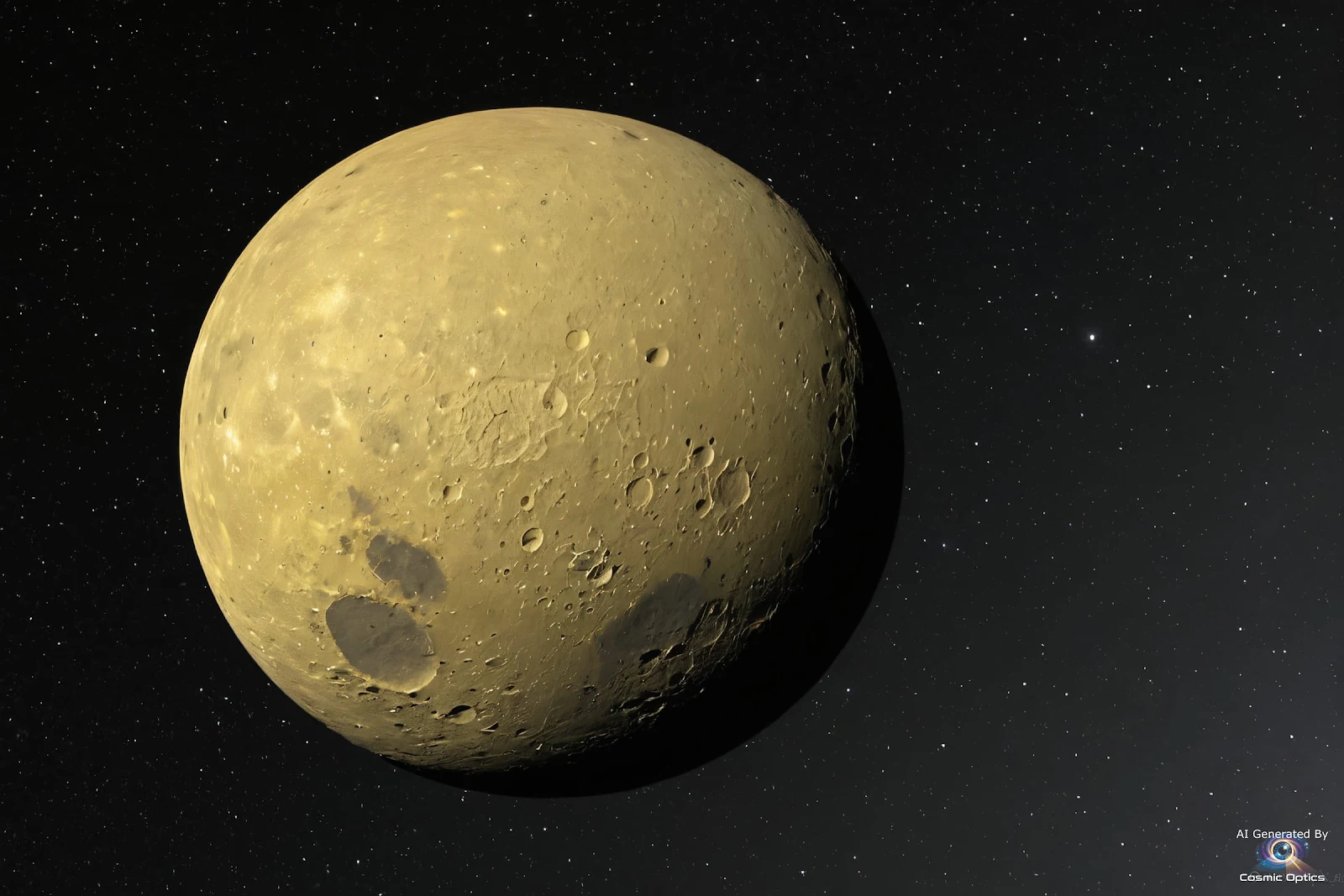
In the vast, cold reaches of the outer solar system, where sunlight is a mere fraction of what we experience on Earth, exists a world of unimaginable violence and vibrant color. This is Io, the innermost of the four Galilean moons of Jupiter. While its neighbors, Europa and Ganymede, are famed for their icy crusts and potential hidden oceans, Io is a celestial anomaly—a world defined not by ice, but by fire. It is the most geologically active object in our solar system, a place where the very ground is constantly being recycled in a display of planetary physics that defies common expectation.
The striking appearance of Io is the first clue to its chaotic nature. Often described by astronomers as looking like a "giant moldy pizza," its surface is a mottled tapestry of yellows, oranges, reds, and blacks. These colors are not the result of vegetation or traditional rock weathering, but are instead a direct consequence of intense volcanic activity. The dominant hues come from various allotropes of sulfur and sulfur dioxide frost. When molten sulfur is ejected from the moon's interior and cools, its color changes depending on the temperature and the speed of the cooling process, creating the surreal palette that defines this moon's landscape.
The engine driving this relentless activity is a phenomenon known as tidal heating. Io finds itself in a gravitational "tug-of-war" between the massive gravity of Jupiter and the smaller but significant gravitational pulls of the outer moons, Europa and Ganymede. These moons are locked in what is called an orbital resonance. For every orbit Ganymede makes, Europa makes two, and Io makes four. This periodic alignment ensures that Io's orbit remains slightly elliptical rather than perfectly circular. As Io moves closer to and then further from Jupiter, the massive planet’s gravity stretches and squeezes the moon by as much as 100 meters. This internal friction generates a staggering amount of heat, melting the moon's silicate interior into magma that must find a way to the surface.
This internal pressure manifests as hundreds of active volcanic centers. Unlike Earth, where volcanism is largely confined to tectonic plate boundaries, Io’s volcanoes are scattered across its entire surface. Some of these eruptions are so powerful that they send plumes of sulfur and sulfur dioxide gas 500 kilometers high into space. These plumes are so large they can be seen by passing spacecraft and even the Hubble Space Telescope. One of the most famous features is Loki Patera, a massive volcanic crater larger than the state of Maryland, which contains a lake of molten lava that periodically "overturns" its crust in a cycle of cooling and sinking.
The environment on Io is one of extreme contrasts. While the lava flows can reach temperatures of 1,300 degrees Celsius (higher than most volcanic eruptions on Earth), the surface temperature away from the vents averages around -130 degrees Celsius. This results in a bizarre geological process where sulfur dioxide snows down from the volcanic plumes, coating the landscape in a thin, frosty layer that is immediately vaporized again by the next lava flow. This constant cycle of deposition and destruction means that Io has no impact craters. While other moons are scarred by billions of years of meteorite impacts, Io’s surface is "new," constantly being paved over by fresh volcanic material.
Beyond its surface, Io plays a critical role in the wider Jovian environment. As it orbits through Jupiter's incredibly strong magnetic field, Io acts as a giant electrical generator. It strips away about a ton of material every second—mostly sulfur and oxygen atoms—which becomes ionized. This creates a massive, doughnut-shaped cloud of charged particles known as the Io Plasma Torus. These particles are accelerated by Jupiter's magnetic field, creating a powerful current that connects Io directly to Jupiter’s poles. This "Io flux tube" carries about 400,000 volts and 3 million amperes, contributing to the spectacular, permanent auroras that dance at Jupiter's poles.
For scientists, Io is more than just a visual marvel; it is a laboratory for understanding the evolution of planets and moons. The sheer scale of its heat dissipation challenges our models of planetary cooling. Observations from missions like Voyager, Galileo, and more recently, the Juno spacecraft, have provided glimpses into the moon's complex "magma ocean" that likely resides beneath its crust. Understanding how Io handles such immense energy helps researchers hypothesize about the early stages of Earth’s own formation, when our planet was far more volcanically active than it is today.
Io also serves as a warning of the hazards of deep-space exploration. The radiation environment around the moon is lethal. Because Io orbits within the heart of Jupiter’s radiation belts, a human standing on its surface would receive a fatal dose of radiation in just a few minutes. Any robotic mission sent to study Io must be heavily shielded, and even then, the electronics are slowly fried by the relentless bombardment of high-energy particles. Despite these dangers, the scientific community remains captivated by this moon. It represents the extreme limit of what a moon can be—not a dead, frozen rock, but a living, breathing, and violently changing world that continues to reshape itself every single day.
As we look toward the future of space exploration, Io remains a primary target for high-priority research. New proposals for dedicated Io observers aim to map its heat flow with unprecedented precision. By studying the timing and location of its eruptions, we can begin to unlock the secrets of its interior structure and the mysteries of tidal resonance. Io stands as a testament to the dynamic and often violent nature of our solar system, reminding us that even in the cold darkness of the outer reaches, the fires of creation and destruction are still burning brightly.


