
The Fiery Wonders of Io: Jupiter’s Most Geologically Active and Volcanic Moon
The Jovian system serves as a miniature solar system, a swirling collection of diverse worlds that defy our expectations of what celestial bodies should look like. Among these, the moon Io stands out as an absolute marvel of planetary physics and geological intensity. While many of the moons in the outer solar system are frozen capsules of ice and ancient craters, Io is a vibrant, chaotic, and perpetually renewing world. It is the most geologically active object in our entire solar system, a place where the ground is constantly shifting and the sky is frequently filled with the debris of subterranean fury.
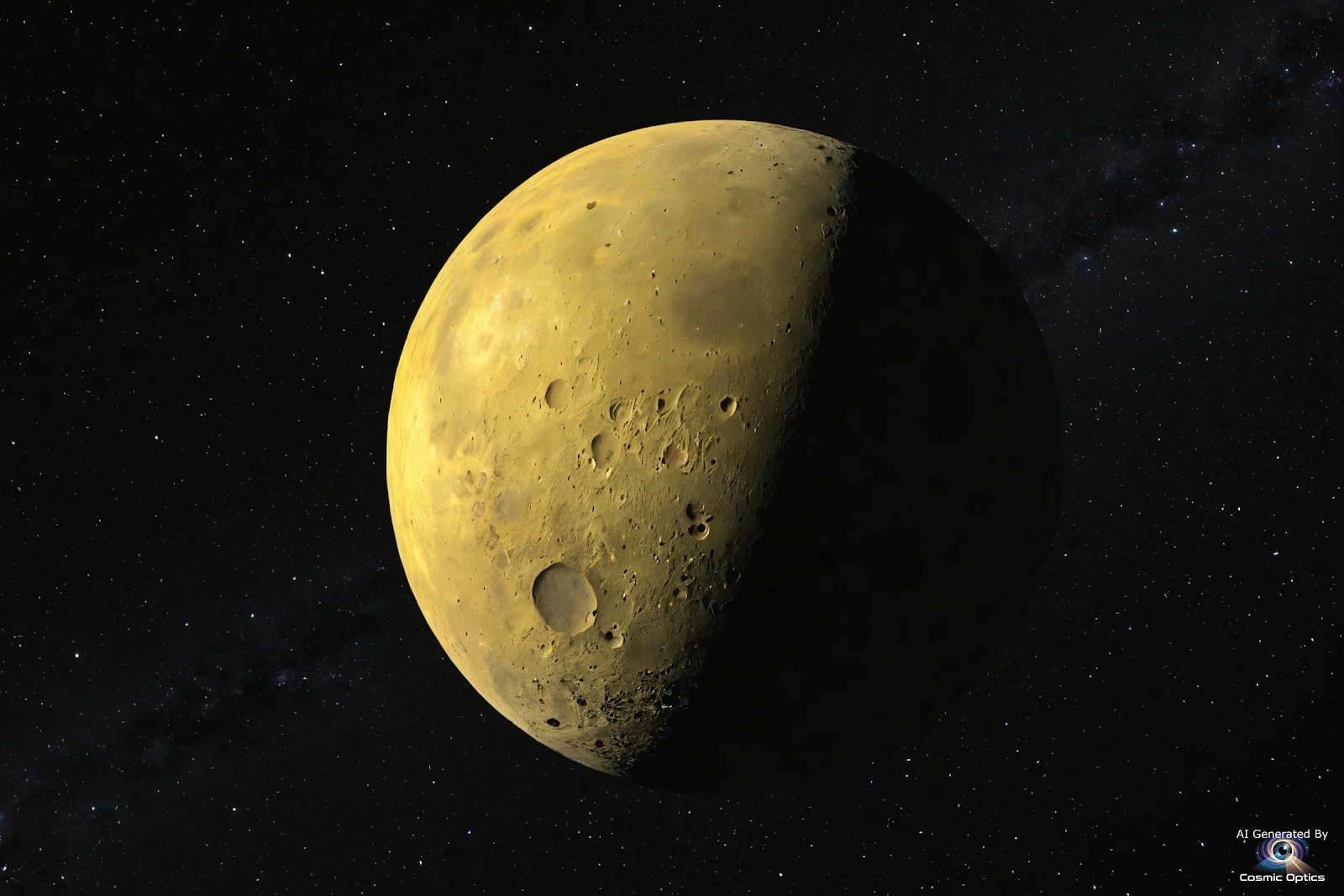
An authentic, standalone astrophotography snapshot of Jupiter's moon Io in deep space. A single, sol_00035
The reason for Io’s incredible restlessness lies not in its own internal heat left over from formation, but in a violent gravitational tug-of-war. Io is caught in a precarious position between the immense mass of Jupiter and the gravitational influence of its sister moons, Europa and Ganymede. This relationship is defined by a phenomenon known as orbital resonance. For every orbit Ganymede makes around Jupiter, Europa makes exactly two, and Io makes exactly four. This regular alignment means that Europa and Ganymede provide a rhythmic gravitational pull that prevents Io’s orbit from becoming a perfect circle. As Io moves closer to and further from Jupiter, the planet’s massive gravity stretches and squeezes the moon by as much as 100 meters. This constant "tidal flexing" generates a staggering amount of friction and heat within Io’s interior, effectively melting its mantle and powering its relentless volcanic activity.
Visually, Io is unlike any other moon. Often compared to a "moldy pizza" or a "giant sponge," its surface is a kaleidoscope of yellows, oranges, reds, and blacks. These colors are the result of various forms of sulfur and silicate rock. When sulfur is heated and cooled at different rates, it assumes different hues, creating a landscape that is perpetually being repainted by fresh volcanic deposits. Unlike the moon or Mercury, Io has almost no impact craters. The volcanic activity is so frequent and widespread that any new craters are quickly filled and buried by lava flows and ash, leaving the surface looking incredibly young and smooth in geological terms.
The scale of volcanism on Io is difficult to comprehend from an Earth-centric perspective. There are over 400 active volcanoes on its surface, some of which blast plumes of sulfur and sulfur dioxide more than 500 kilometers into space. These plumes are so powerful that they escape the moon's gravity and enter orbit around Jupiter. One of the most famous volcanic centers is Loki Patera, a massive volcanic depression that is actually a lake of molten lava, larger than many terrestrial seas. The heat emitted from these regions is so intense that telescopes on Earth can detect the infrared glow of Io’s hotspots even from hundreds of millions of miles away.
This volcanic output does more than just change the moon's appearance; it fundamentally alters the environment of the Jupiter system. As sulfur and oxygen atoms are stripped from Io’s thin atmosphere by Jupiter’s powerful magnetosphere, they become ionized and form a giant, donut-shaped cloud of radiation known as the Io Plasma Torus. This torus is a high-energy environment that glows in ultraviolet light and creates a powerful electrical connection between Io and Jupiter. This "flux tube" carries a current of millions of amperes, triggering permanent auroras in Jupiter’s polar regions. Io is, in essence, a giant electric generator that powers part of Jupiter’s spectacular light shows.
The exploration of Io has provided some of the most dramatic moments in the history of space science. When the Voyager 1 spacecraft flew by in 1979, scientists expected to see a cold, cratered world. Instead, they were stunned to discover active volcanic plumes rising above the horizon. This was the first time active volcanism had been seen on a world other than Earth, forever changing our understanding of planetary energy sources. Later, the Galileo mission spent years orbiting Jupiter, providing high-resolution data that revealed the extreme temperatures of Io's lava, which can exceed 1,300 degrees Celsius—hotter than most lava found on Earth today, reminiscent of the conditions on our own planet shortly after its birth.
Studying Io provides a unique window into the early history of our solar system and the evolution of terrestrial planets. The extreme tidal heating observed here is a process that likely occurs in many other star systems, particularly on exoplanets orbiting close to their parent stars. By understanding the mechanics of Io’s interior and its interaction with Jupiter’s magnetosphere, researchers can build better models for how energy is distributed in planetary systems. Io serves as a natural laboratory for studying extreme geophysics and the potential for life-sustaining energy in unexpected places, even if Io itself, with its devastating radiation and toxic atmosphere, is one of the most inhospitable places imaginable.
As we look to the future, new missions like the Juno spacecraft continue to provide glimpses of Io’s ever-changing face. With each flyby, we see new lava flows, disappearing mountains, and shifting plumes. There is even talk of future dedicated missions, such as the proposed Io Volcano Observer, which would aim to map the moon’s heat flow and determine if a global magma ocean exists beneath its crust. Io remains a testament to the dynamic and surprising nature of the cosmos—a reminder that even in the cold reaches of the outer solar system, there are worlds of fire and fury that continue to challenge our imagination and expand our scientific horizons.
The sheer resilience of Io’s landscape is a point of fascination for geologists. The mountains on Io are not formed by tectonic plates colliding as they do on Earth; instead, they are created by the crust fracturing under the immense pressure of global compression. These mountains can reach heights greater than Mount Everest, standing as jagged sentinels amidst the vast plains of sulfur. The interaction between the extreme cold of space and the intense heat of the volcanic vents creates a cycle of sublimation and frost, where sulfur dioxide snow falls back to the surface, coating the valleys in a pale, crystalline glaze. It is a world of impossible contrasts: fire and ice, radiation and rock, all dancing to the gravitational tune of the king of planets.
To contemplate Io is to contemplate the power of gravity as a creative and destructive force. It is a moon that refuses to be still, a celestial body that is literally inside-out, constantly vomiting its interior onto its exterior. For any enthusiast of the night sky, Io represents the peak of planetary excitement—a place where we can witness the raw, unfiltered processes that shape the universe in real-time. It remains one of the crown jewels of the Jovian system, a beacon of activity that draws our eyes and our curiosity toward the infinite wonders of deep space.


