
The Mathematical Ice Giant and the Violent Secrets of the Planet Neptune
Beyond the orbit of the ringed jewel Saturn and the tilted mystery of Uranus lies the true frontier of our solar system, a world of deep cobalt hues and unimaginable ferocity. This is the realm of the eighth planet, an ice giant that stands as a testament to the sheer scale and complexity of our celestial neighborhood. Far from being a static, frozen orb, this distant world is a powerhouse of atmospheric activity, driven by internal heat and governed by the laws of physics in their most extreme forms. To look upon its sapphire face is to glimpse the edge of the sun’s gravitational empire, where the light of our star is a mere fraction of what we experience on Earth, and where the secrets of planetary formation are still being unraveled by modern astronomy.
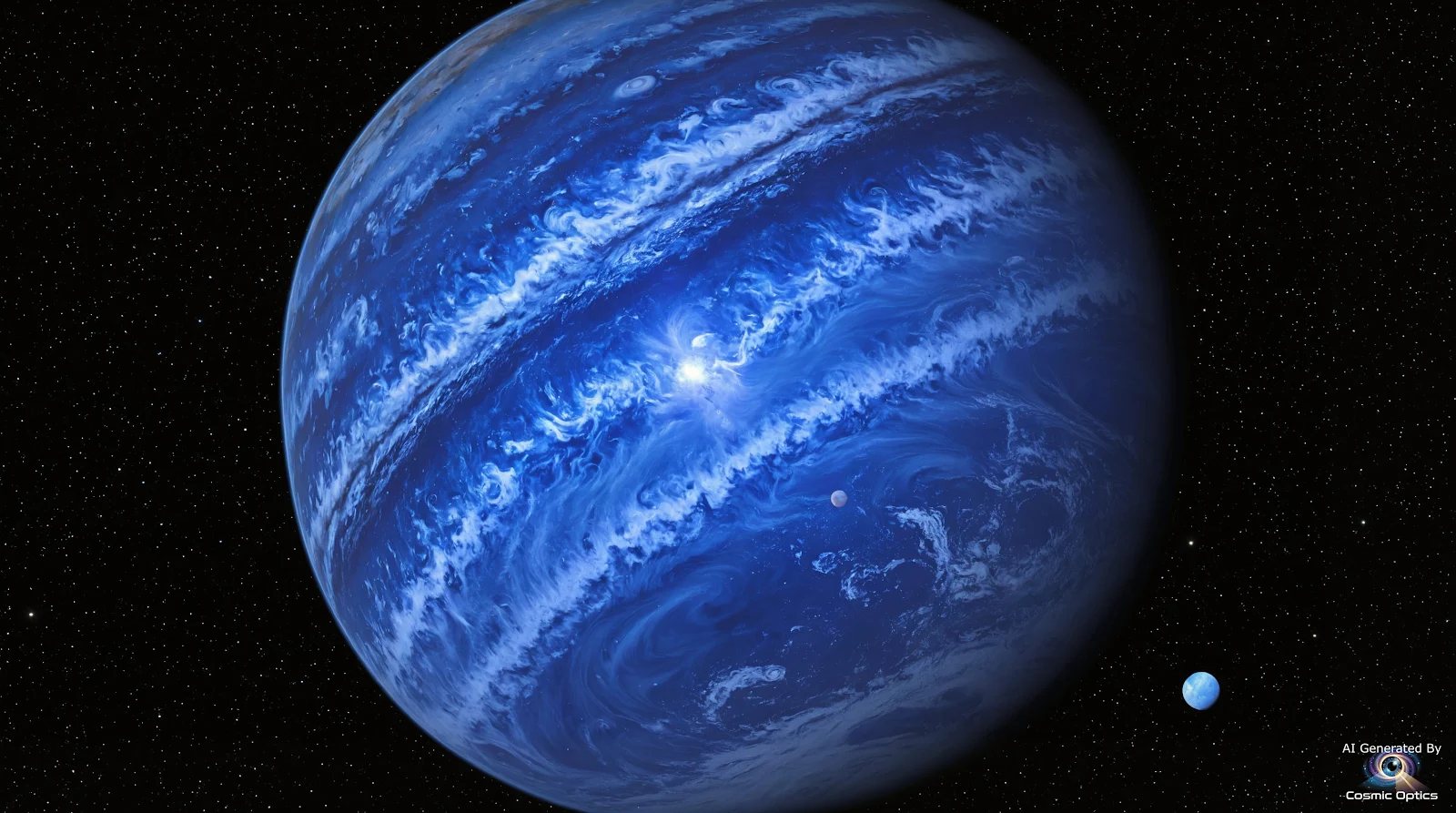
The story of this azure giant is unique because it was the first planet in history to be discovered not through the lens of a telescope, but through the precision of mathematics. In the mid-19th century, astronomers noticed that the orbit of Uranus was behaving erratically, deviating from the path predicted by Newton’s laws. It was as if an invisible ghost were tugging at it from further out in the dark. This led mathematicians Urbain Le Verrier and John Couch Adams to independently calculate the position of a hypothetical eighth planet. When German astronomer Johann Gottfried Galle pointed his telescope toward the predicted coordinates in 1846, he found the planet within just one degree of Le Verrier’s calculations. This triumph of celestial mechanics remains one of the most significant milestones in the history of science, proving that the universe operates on a predictable, logical framework that the human mind can decipher.
What makes this world so distinct from the gas giants Jupiter and Saturn is its classification as an "ice giant." While it is composed mostly of hydrogen and helium, its interior is rich in "ices"—a term astronomers use for volatile compounds like water, ammonia, and methane. Underneath the thick, swirling atmosphere lies a hot, dense fluid of these materials, surrounding a rocky core roughly the size of Earth. The vibrant blue color that defines its appearance is a result of methane in the upper atmosphere, which absorbs red light and reflects the blue wavelengths back into space. However, scientists are still investigating why this planet possesses a much deeper, more vivid blue than its cousin Uranus, which appears a paler cyan. This suggests an additional, yet-to-be-identified atmospheric component or a thinner layer of haze that allows the deeper colors to shine through.
The weather on this distant world is nothing short of legendary. Despite being nearly 2.8 billion miles from the Sun, where solar energy is 900 times weaker than on Earth, it hosts the fastest winds recorded anywhere in the solar system. Supersonic gusts can reach speeds of over 1,200 miles per hour, slicing through the atmosphere with terrifying efficiency. These winds are so powerful that they defy our traditional understanding of planetary meteorology; on Earth, weather is driven by solar energy, but here, the primary engine is the planet’s internal heat. It radiates more than twice the energy it receives from the Sun, creating a dynamic environment where massive storms—like the Great Dark Spot observed by Voyager 2 in 1989—can emerge and vanish within years, unlike the centuries-long persistence of Jupiter’s Great Red Spot.
Deep within the mantle of this planet, the pressure and temperature reach such extremes that carbon atoms are crushed into solid diamonds. Scientists theorize that it literally "rains diamonds" through the liquid layers of the interior, a glittering downpour that sinks toward the core. This phenomenon, recreated in high-pressure laboratory experiments on Earth, provides a glimpse into the exotic states of matter that exist in the outer reaches of our system. This internal pressure also contributes to a complex, lopsided magnetic field that is tilted significantly away from the planet’s rotational axis, creating a chaotic magnetosphere that interacts with the solar wind in ways unlike any other planet.
The moon system surrounding this blue giant is equally fascinating, dominated by the massive Triton. Triton is a rogue in every sense; it orbits the planet in a retrograde direction—the opposite of the planet’s rotation. This strongly suggests that Triton was once a dwarf planet in the Kuiper Belt, captured by the giant’s massive gravity billions of years ago. Triton is one of the few geologically active moons in our solar system, featuring cryovolcanoes that erupt nitrogen gas and dust into a thin atmosphere. As Triton orbits, it is slowly being spiraled inward by tidal forces; in about 3.6 billion years, it will likely be torn apart by gravity, potentially forming a spectacular ring system that would rival that of Saturn.
Our direct knowledge of this magnificent world remains tantalizingly limited. Only one spacecraft, Voyager 2, has ever made a close approach, flying past in 1989 and providing the high-resolution images and data that still form the basis of our understanding today. More recently, the James Webb Space Telescope has turned its infrared gaze toward the planet, revealing its delicate rings and high-altitude clouds with unprecedented clarity. These rings, comprised of dark, organic material and dust, are not the broad, bright bands seen elsewhere but are instead thin, fragile arcs that speak to the complex gravitational dance between the planet and its smaller inner moons.
As we look to the future, the scientific community is increasingly calling for a dedicated mission to the ice giants. Exploring this blue frontier is not just about understanding one planet; it is about understanding the most common type of planet found in the galaxy. Exoplanet surveys have revealed that "mini-Neptunes" are ubiquitous around other stars. By studying our own neighbor, we gain a blueprint for the billions of similar worlds scattered throughout the Milky Way. The eighth planet stands as a sentinel at the edge of the dark, a world of diamond rain, supersonic winds, and mathematical mystery that continues to inspire awe and curiosity in everyone who looks up at the stars.


