
The Violent Beauty and Geological Fury of Jupiter’s Volcanic Moon Io
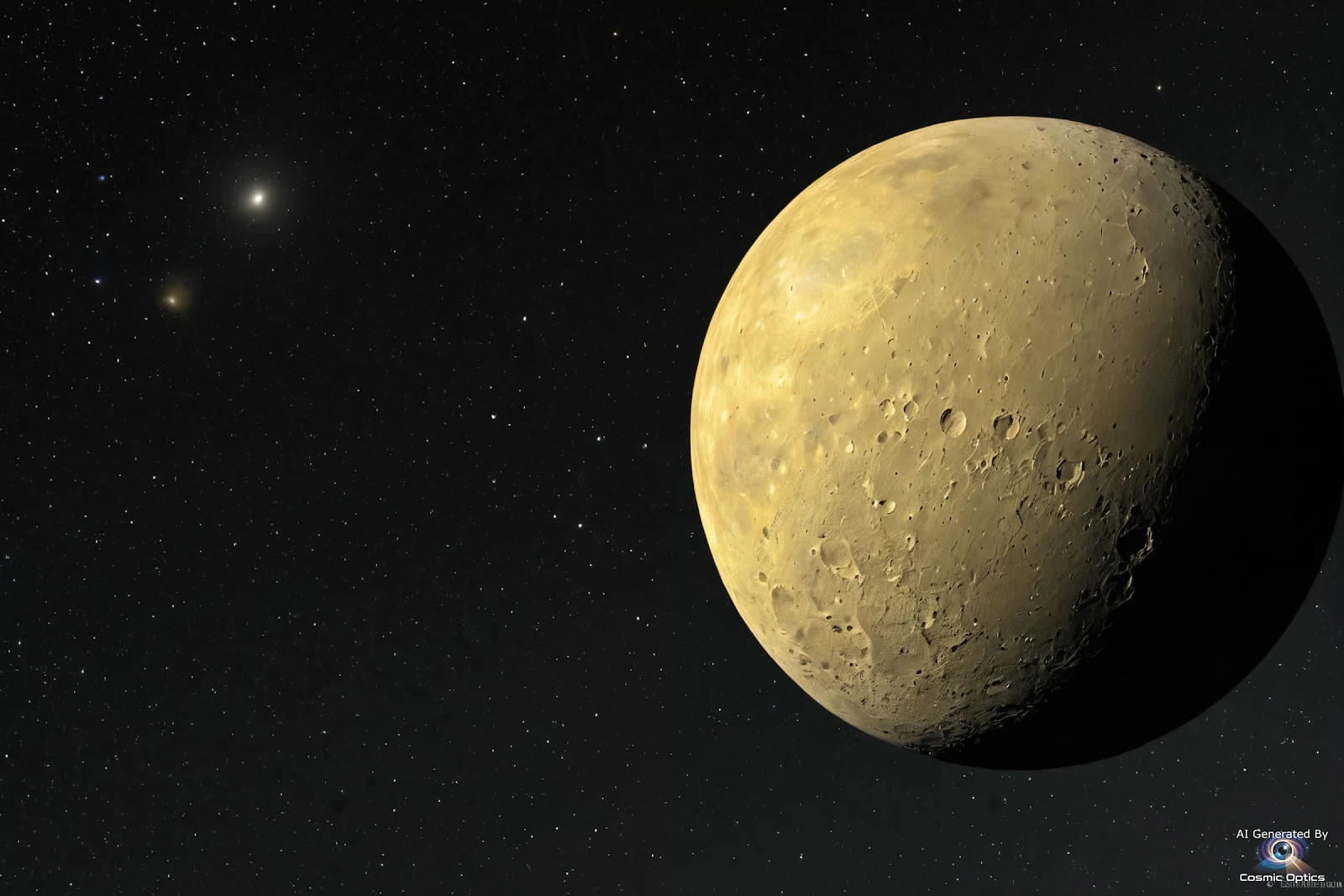
An authentic, standalone astrophotography snapshot of Jupiter's moon Io in deep space. A single, sol_00008
Deep within the colossal gravity well of Jupiter lies a world that defies every conventional expectation of a celestial body. Io, the innermost of the four Galilean moons, is not a frozen, silent relic of the early solar system. Instead, it is a chaotic, vibrant, and terrifyingly active powerhouse of geology. While most moons in our solar system are cold, crater-scarred spheres of ice and rock, Io is a blistering exception, characterized by a surface that is constantly being reshaped by the most intense volcanic activity known to humanity.
The sheer scale of Io's geological fury is difficult to comprehend. It hosts hundreds of volcanic centers, some of which erupt with such force that they send plumes of sulfur and sulfur dioxide hundreds of kilometers into the vacuum of space. These plumes are so massive they can be seen by passing spacecraft and even powerful Earth-based telescopes. This constant outpouring of material means that Io’s surface is among the youngest in the solar system. While our own Moon preserves a record of impacts from billions of years ago, Io effectively "erases" its history every few millennia, burying impact craters under fresh layers of lava and tectonic debris.
To understand why Io is so incredibly active, one must look at its neighborhood. Io is caught in a titanic gravitational "tug-of-war" between Jupiter and its sibling moons, Europa and Ganymede. This relationship, known as orbital resonance, forces Io into an elliptical orbit. As it moves closer to and then further from Jupiter, the planet’s immense gravity stretches and compresses the moon. This phenomenon, called tidal heating, generates an unimaginable amount of internal friction. Essentially, the solid rock of Io’s interior is being kneaded like dough, creating heat that must escape through the surface. The result is a world where the ground literally rises and falls by as much as 100 meters during a single orbital period.
The visual appearance of Io is as striking as its geology. Often described as looking like a giant "celestial pizza," its surface is a mottled tapestry of yellows, oranges, reds, and blacks. These colors are not the result of vegetation or water, but of various allotropes and compounds of sulfur. When molten sulfur is heated and then rapidly cooled, it changes color, providing a vivid map of the thermal history of the landscape. The white patches often seen on the surface are frost composed of sulfur dioxide, which freezes out of the thin atmosphere during the frigid nights or when a region falls into the shadow of Jupiter.
Beyond its surface, Io plays a critical role in the complex electromagnetic environment of the Jovian system. As Io orbits, it moves through Jupiter’s intense magnetic field, acting as a massive electric generator. This interaction strips approximately one ton of material from Io every second, creating a "plasma torus"—a giant, donut-shaped cloud of ionized gas that circles Jupiter. This material travels along Jupiter’s magnetic field lines, creating powerful auroras in the giant planet's polar regions and generating intense radio bursts that can be detected from Earth. Io is not just a moon; it is a vital organ in the electromagnetic body of Jupiter.
Exploring Io presents one of the greatest challenges in planetary science. The moon sits in the heart of Jupiter's radiation belts, where the intensity of charged particles is high enough to fry the electronics of most spacecraft within hours. Despite this, missions like Voyager, Galileo, and more recently, Juno, have braved the environment to capture data. We have discovered massive lava lakes, such as Loki Patera, which is a depression over 200 kilometers wide filled with a persistent lake of molten rock. These features suggest that Io’s crust may be floating on a global ocean of magma, a "magmasphere" that provides a window into the early, molten stages of Earth’s own formation.
The study of Io provides invaluable insights into the concept of habitability and planetary evolution. While Io itself is far too hostile for life as we know it, the tidal heating mechanism that powers its volcanoes is the same process that keeps the interior of its neighbor, Europa, warm enough to maintain a liquid water ocean. By understanding the extreme version of tidal heating on Io, scientists can better predict the conditions of subsurface oceans on other icy moons and even exoplanets orbiting distant stars. Io serves as a laboratory for the extremes of physics, showing us what happens when a world is pushed to its absolute geological limits.
As we look to the future of space exploration, Io remains a primary target for high-priority science. Future missions aim to study the composition of its lavas to determine the exact temperature of its interior, which could reach staggering levels. Every time we point our sensors toward this golden moon, we find new surprises—new mountains rising from tectonic shifts, new plumes shifting the chemistry of the Jovian clouds, and new evidence of a world that is very much alive. Io stands as a testament to the diversity of the cosmos, a place where fire and ice collide in the dark expanse of deep space.


