
Unveiling the Mysteries of Our Sun: A Multi-Layered Masterpiece of Physics and Energy
The star at the center of our solar system is a roiling, tempestuous masterpiece of physics that defies the imagination. While it appears as a steady, golden disc from our vantage point on Earth, the Sun is actually a complex, multi-layered nuclear furnace that sustains nearly all life as we know it. To look closely at the Sun is to witness the raw power of the cosmos in its most concentrated form. It is a world of plasma, magnetic fields, and unimaginable temperatures, where the very fabric of matter is stripped of its electrons and whipped into a frenzy by forces that reach far across the vacuum of space.
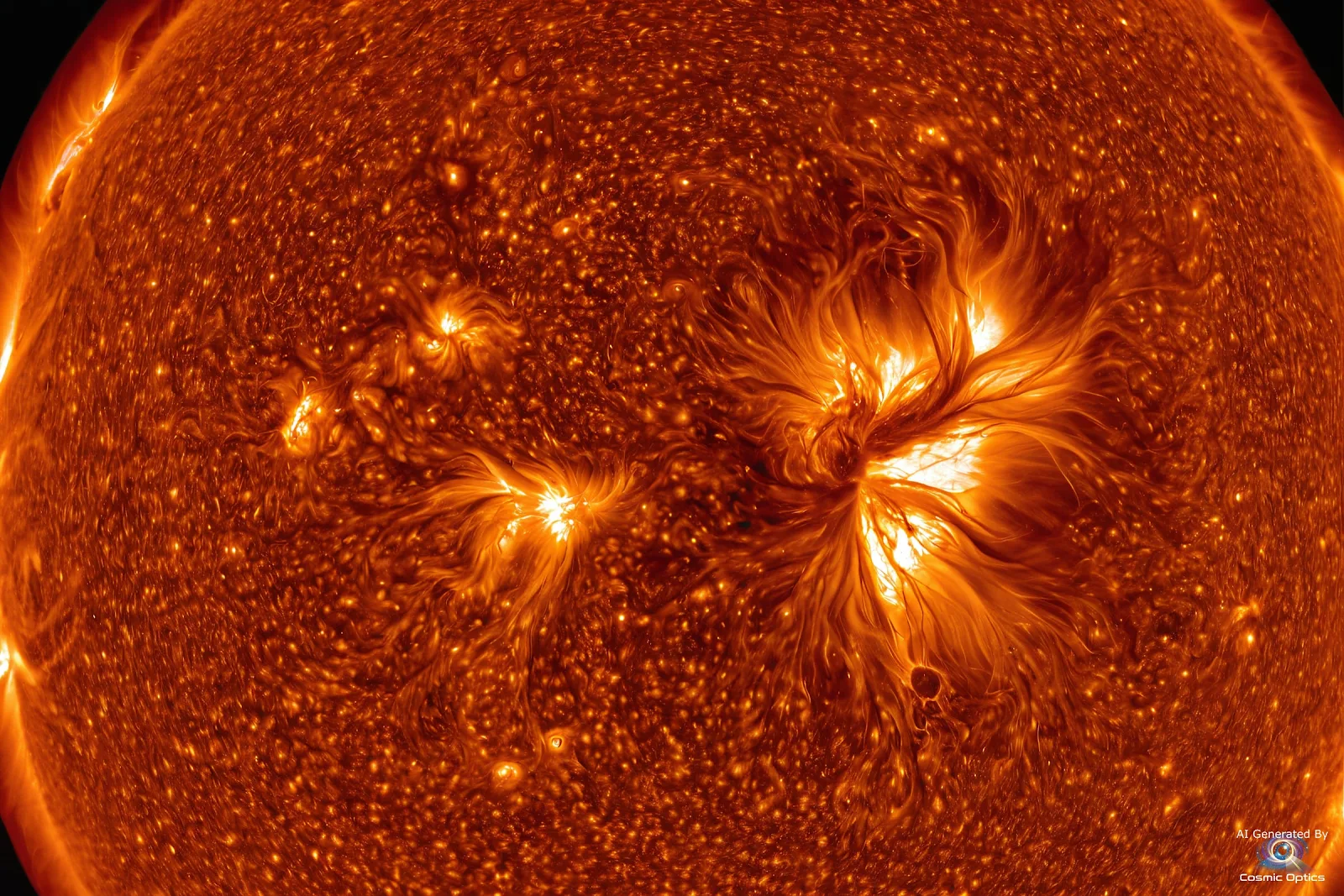
An authentic, photorealistic close-up orbital view of the Sun's atmosphere, captured by an extreme u_00005
Understanding the Sun requires us to look beyond the visible light that reaches our eyes. Much of the most vital activity occurs in the extreme ultraviolet and X-ray spectrums, where the Sun’s outer atmosphere, the corona, reveals its intricate secrets. For decades, solar physicists were baffled by a fundamental mystery: why is the Sun’s outer atmosphere significantly hotter than its surface? While the visible surface, or photosphere, sits at a relatively modest 5,500 degrees Celsius, the corona—the wispy outer layer—soars to temperatures exceeding one million degrees. This inverse temperature gradient is akin to walking away from a campfire and feeling the heat increase the further you go. Current research suggests that "nanoflares" and magnetic waves, known as Alfvén waves, act as cosmic conduits, transporting energy from the turbulent interior directly into the upper atmosphere, creating the brilliant displays of light and heat we observe through specialized instrumentation.
The engine driving this entire spectacle is the solar core. Deep within the heart of the Sun, gravity exerts such immense pressure that hydrogen atoms are crushed together to form helium in a process known as nuclear fusion. Every single second, the Sun fuses approximately 600 million tons of hydrogen, converting it into energy that eventually radiates outward. However, this journey is not a quick one. A photon created in the core must navigate the "radiative zone," a region so dense that the light particle bounces from atom to atom in a chaotic "random walk." It can take upwards of 170,000 years for a single photon to finally reach the convective zone, where it is carried to the surface by rising currents of plasma, much like the bubbles in a boiling pot of water.
Once energy reaches the surface, the Sun becomes an architect of magnetism. The Sun is not a solid object; its various latitudes rotate at different speeds. This differential rotation twists and tangles the solar magnetic field lines like a ball of yarn. When these magnetic lines become too tightly wound, they snap and reconnect in a process called magnetic reconnection. This sudden release of energy is what triggers solar flares and Coronal Mass Ejections (CMEs). These events are the most powerful explosions in the solar system, capable of releasing as much energy as millions of hydrogen bombs detonating simultaneously. When these solar storms are directed toward Earth, they interact with our planet’s magnetic field, creating the ethereal beauty of the auroras while also posing risks to our modern satellite and power infrastructure.
The study of the Sun’s atmosphere has been revolutionized by a new era of spacecraft. Missions like the Parker Solar Probe and the Solar Orbiter are currently venturing closer to the Sun than any human-made objects in history. By flying through the corona itself, these probes are providing unprecedented data on the solar wind—the constant stream of charged particles that flows outward from the Sun and fills the solar system. This solar wind carves out a protective bubble around our planetary neighborhood known as the heliosphere, shielding us from much of the high-energy cosmic radiation from the rest of the galaxy. Understanding the nuances of this wind is not just a matter of curiosity; it is essential for the future of human space exploration as we look toward establishing bases on the Moon and Mars.
Looking at the Sun through the lens of modern science reveals a dynamic, living entity. It is a star in its middle age, roughly 4.6 billion years old, with enough fuel to continue its current state for another five billion years. Yet, even in its "quiet" phases, it is a hive of activity. Features like sunspots—cooler, magnetically intense regions—and solar prominences—looping structures of plasma that dwarf the Earth in size—remind us of the sheer scale of the celestial neighborhood we inhabit. Every ripple on the solar surface and every filament of plasma suspended in the atmosphere is a testament to the complex interplay of gravity, electromagnetism, and fluid dynamics.
The Sun is the ultimate source of nearly all energy on Earth. It drives our weather, fuels our plants through photosynthesis, and provides the warmth necessary for water to exist in liquid form. Beyond its practical utility, the Sun serves as a cosmic laboratory. It is the only star we can study in such exquisite detail, allowing us to apply the lessons learned here to the trillions of other stars in the universe. When we observe the delicate structures of its atmosphere and the violent outbursts of its magnetic field, we are not just looking at a star; we are looking at the fundamental processes that govern the luminous matter of the entire cosmos. It is a breathtaking reminder of our place in a vast, energetic, and awe-inspiring universe.


