
Astonishing Worlds: Exploring the Diversity of Our Solar System
Gaze out into the boundless expanse of the cosmos, and you're met not with empty void, but with a tapestry of astonishing worlds, each a testament to the universe's incredible capacity for diversity and wonder. From the familiar glow of our own Moon to the distant glimmers of icy satellites orbiting colossal gas giants, every speck of light holds a story, a symphony of geological and atmospheric processes that defy terrestrial expectations. It is a realm where the ordinary is extraordinary, and where our understanding of what constitutes a "world" is constantly being stretched and redefined by new discoveries.
Consider, for a moment, the enigmatic allure of distant, icy moons, particularly those nestled within the gravitational embrace of our solar system's colossal gas giants. Worlds like Europa, one of Jupiter's magnificent Galilean moons, present an intriguing paradox. Though its surface is a frozen expanse, crisscrossed with fissures and cracks, scientists believe that beneath this icy shell lies a vast, global ocean of liquid water, potentially twice the volume of all of Earth's oceans combined. This subsurface sea is not kept warm by sunlight, which barely penetrates this far from the Sun, but by the relentless tug-of-war exerted by Jupiter's immense gravity. As Europa orbits, it is constantly stretched and squeezed, generating internal friction and heat through a process known as tidal heating. This energy is enough to maintain a liquid ocean, possibly even hosting hydrothermal vents on its seafloor, similar to those that teem with life in Earth's deepest trenches. The very thought of a hidden, sunless ocean, warm and potentially nurturing conditions for life, makes Europa one of the most compelling targets in our search for extraterrestrial biology.
But Europa is not alone in its icy grandeur. Saturn's moon Enceladus offers an equally captivating spectacle. From fissures near its south pole, colossal plumes of water vapor and ice particles erupt into space, a dramatic display visible to passing spacecraft. These geysers are direct evidence of another subsurface ocean, one that is actively venting its contents into the vacuum, creating a faint ring of material around Saturn. The presence of organic molecules and salts within these plumes further fuels the excitement, suggesting a complex chemistry at play within Enceladus's watery depths. Neptune’s largest moon, Triton, adds another layer to this icy mosaic with its unique retrograde orbit and active cryovolcanism, where nitrogen ice and gas erupt from its frigid surface, propelled by internal heat. These icy worlds, far from being inert chunks of rock and ice, are dynamic, geologically active environments, pushing the boundaries of what we once thought possible for moons in the outer solar system.
These moons, however, are merely satellites to the true behemoths of our solar system: the gas and ice giants themselves. Jupiter, a swirling vortex of hydrogen and helium, dwarfs all other planets. Its iconic Great Red Spot, a storm larger than Earth, has raged for centuries, a testament to the planet's powerful atmospheric dynamics. Its immense magnetic field creates auroras hundreds of times more energetic than Earth's. Saturn, with its breathtakingly intricate system of rings – an ethereal ballet of countless ice particles and rocky fragments – is another magnificent spectacle. These rings, each particle following its own precise orbit, stretch for hundreds of thousands of kilometers but are incredibly thin, often only tens of meters thick. Uranus and Neptune, the ice giants, add further to this diversity with their deep blue hues, frigid temperatures, and unique atmospheric compositions, featuring distinct weather patterns and incredibly fast winds. These colossal planets and their vast families of moons represent entire mini-solar systems, each a laboratory of extreme physics and chemistry.
Beyond these planetary systems, our solar system continues to surprise with its sheer range of environments. Consider Venus, shrouded in a thick, toxic atmosphere of carbon dioxide, where a runaway greenhouse effect has created surface temperatures hot enough to melt lead. The atmospheric pressure at its surface is equivalent to diving nearly a kilometer deep in Earth's oceans. Then there's Mars, a dusty, rust-colored world bearing scars of ancient rivers and vast canyons, hinting at a wetter past that may have supported life. Even the dwarf planet Pluto, far out in the Kuiper Belt, has revealed itself to be a geologically active world with vast plains of nitrogen ice, towering mountains, and even a diffuse atmosphere that collapses and expands as it orbits the Sun. Each celestial body, whether a blazing inferno, a frozen desert, or a distant icy ocean, offers a profound lesson in the diverse ways that matter and energy can arrange themselves across the cosmos.
The intricate dance of gravitational forces orchestrates much of this cosmic ballet. Jupiter's immense mass, for instance, doesn't just hold its moons in orbit; it actively sculpts them. The tidal forces it exerts on Europa are crucial to maintaining its subsurface ocean, demonstrating how gravity can be a source of life-sustaining energy. Similarly, the gravitational interactions between Saturn's moons and the planet itself play a vital role in shaping the exquisite structure of its rings, creating gaps, ripples, and shepherd effects that maintain their delicate beauty. These fundamental forces, combined with the initial conditions of formation and the ongoing bombardment from space, contribute to the unique evolutionary path of each world, creating a celestial tapestry where no two threads are quite alike.
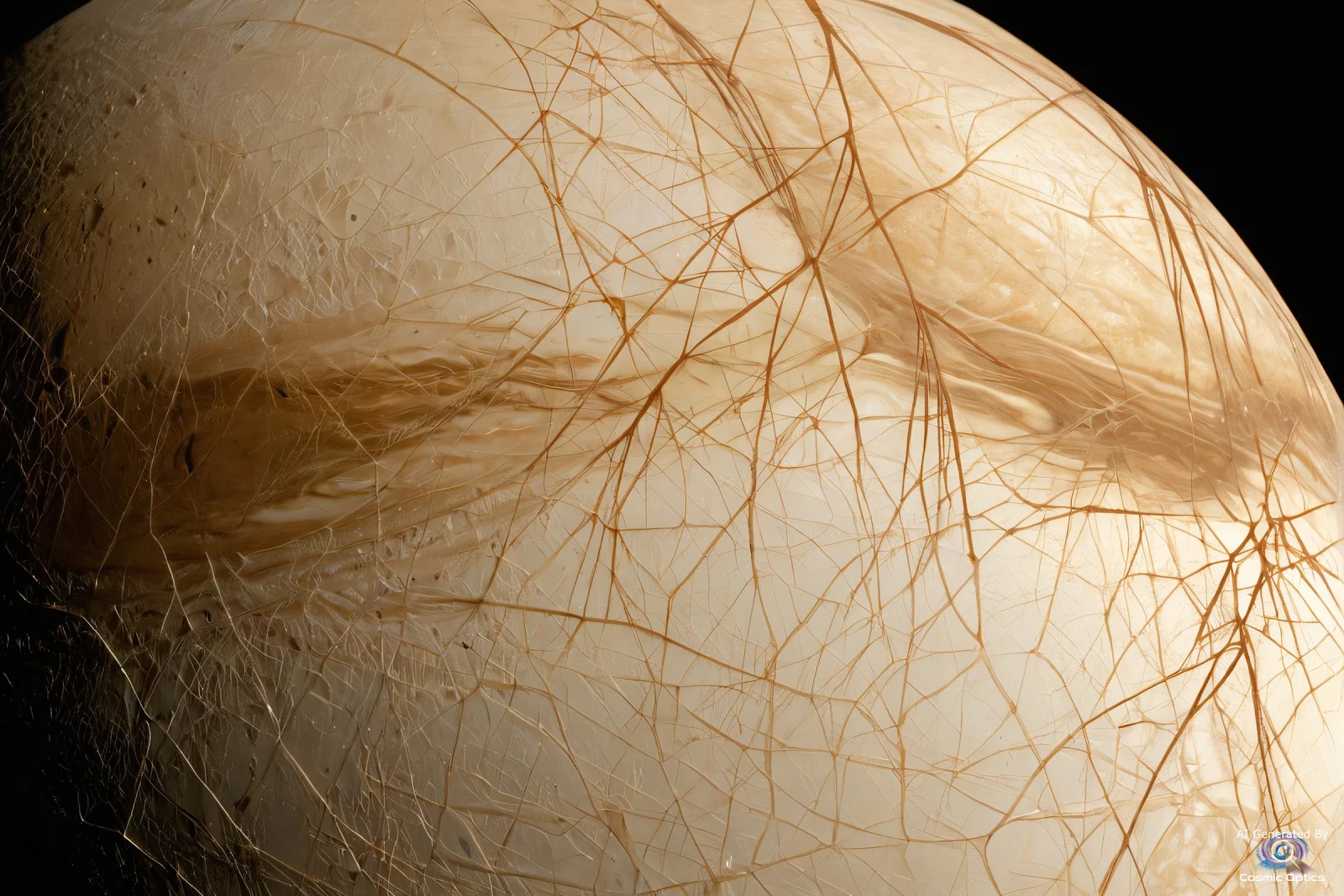
An authentic, photorealistic astronomical photograph of Jupiter's moon Europa in deep space.
Humanity’s relentless curiosity and ingenuity have been the keys to unlocking these cosmic secrets. Through generations of dedicated scientists, engineers, and astronomers, we have developed powerful telescopes that peer across unimaginable distances, capturing the faint light of distant galaxies and the subtle movements of exoplanets. Our robotic probes, like NASA’s Voyager spacecraft, have journeyed to the furthest reaches of our solar system, sending back invaluable data and breathtaking images. More recently, missions like the James Webb Space Telescope are revolutionizing our understanding of planetary atmospheres and star formation across the universe. These sophisticated instruments are extensions of our senses, allowing us to touch, measure, and analyze worlds that are forever beyond our direct reach, turning abstract points of light into places of scientific wonder and profound discovery.
The ongoing exploration of space is more than just a scientific endeavor; it is a profound journey of self-discovery. Each new fact we uncover about a distant moon or planet subtly shifts our perspective on our own blue marble. It reminds us of Earth's unique place as a cradle of life, yet also expands our imagination about where else life might emerge under vastly different conditions. The universe is a grand library, and we are only just beginning to read its first chapters. The wonders it holds are endless, inviting us to forever question, to explore, and to marvel at the extraordinary beauty and complexity that surrounds us in the vast, awe-inspiring cosmos.


