
Beneath the Ice: Exploring the Habitability and Subsurface Ocean of Jupiter's Moon Europa
Deep within the orbital dance of the Jovian system lies a world so compelling that it has shifted the focus of modern astrobiology. Europa, the smallest of the four Galilean moons orbiting Jupiter, is no longer viewed merely as a frozen relic of the early solar system. Instead, it is recognized as one of the most promising candidates for harboring life beyond Earth. While its surface is a frigid, radiation-blasted wasteland of water ice, the secrets locked beneath that crust represent the next great frontier in human exploration.
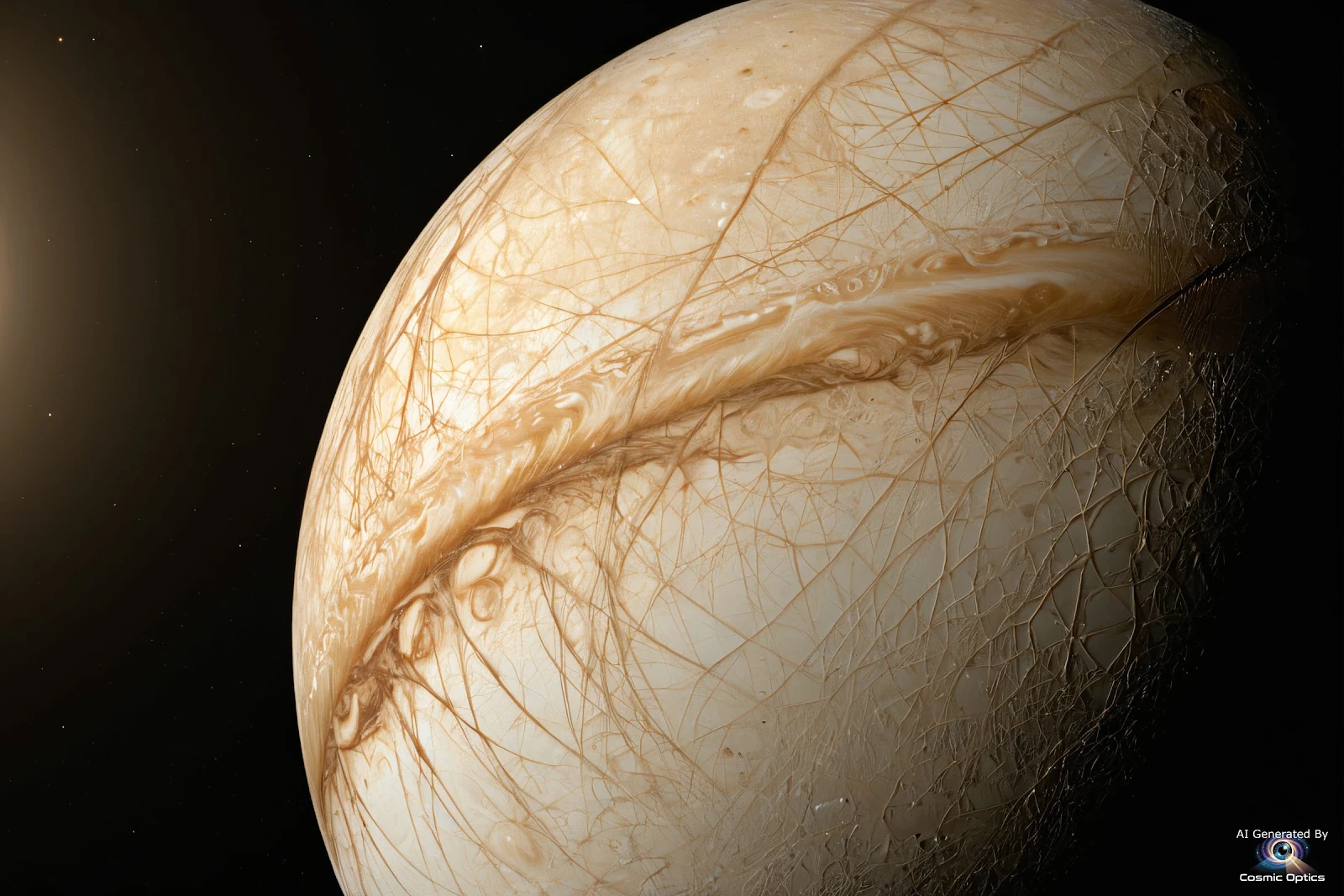
The visual appearance of Europa is unlike any other body in the solar system. It lacks the crater-scarred face of the Moon or Callisto, suggesting a surface that is geologically "young" and constantly being recycled. Instead of impact basins, Europa is crisscrossed by a complex web of dark streaks known as lineae. These features are essentially massive cracks in the ice, some stretching for thousands of kilometers. Scientists believe these fissures are caused by the immense gravitational pull of Jupiter, which creates tidal forces so powerful they literally stretch and flex the moon’s interior. This "tidal heating" is the engine that drives Europa’s internal activity, preventing its subsurface water from freezing solid despite being nearly half a billion miles from the Sun.
What makes Europa truly extraordinary is the global ocean that lies beneath its icy shell. Evidence gathered by the Galileo spacecraft in the 1990s and reinforced by more recent observations from the Juno mission suggests that this ocean is in direct contact with the moon's rocky mantle. This is a critical distinction from other icy moons like Ganymede or Callisto, where layers of high-pressure ice likely sandwich the water between frozen barriers. In Europa's case, the interaction between water and rock allows for the leaching of minerals and nutrients, creating a chemical "soup" that could potentially support microbial life. Estimates suggest that this hidden ocean could contain twice as much water as all of Earth's oceans combined, reaching depths of 60 to 150 kilometers.
The search for life on Europa centers on three fundamental requirements: liquid water, essential chemical elements, and an energy source. While the water and chemistry are largely accounted for by the moon's composition, the energy source remains a subject of intense scientific debate. Without sunlight to drive photosynthesis, life on Europa would likely rely on chemosynthesis. This process would involve organisms deriving energy from chemical reactions, perhaps occurring near hydrothermal vents on the seafloor. On Earth, such vents support thriving ecosystems in the darkest reaches of the deep sea, independent of solar energy. If Europa’s rocky core is geologically active, it could provide the thermal energy and chemical gradients necessary to spark and sustain a biological revolution in total darkness.
The surface of the moon also offers clues to its interior through what is known as "chaos terrain." These are regions where the ice appears to have broken into giant plates, drifted, and then refrozen in a jumbled mess. This suggests that the ice shell may not be a single, solid block, but rather a dynamic system where warmer ice or even liquid water rises from below to melt through the crust. Observations by the Hubble Space Telescope have even detected evidence of transient water vapor plumes erupting from the surface. If these plumes are indeed originating from the subsurface ocean, they offer a tantalizing opportunity for future spacecraft to sample the internal chemistry of the moon without ever having to land or drill through kilometers of ice.
However, exploring Europa is a monumental challenge due to the harsh environment created by Jupiter’s massive magnetic field. The moon sits deep within a belt of intense radiation that can fry conventional electronics in a matter of days. Any mission to the surface must be heavily shielded and strategically designed. This is why the upcoming Europa Clipper mission is such a significant leap forward. Instead of orbiting the moon and remaining in the radiation "kill zone," the spacecraft will orbit Jupiter and perform dozens of close flybys of Europa. This strategy allows the probe to gather high-resolution data on the moon’s composition, ice thickness, and potential habitability while minimizing its exposure to the Jovian radiation belts.
The implications of finding even the simplest microbial life in Europa’s dark ocean would be profound. It would suggest that life is not a fluke of the Earth’s specific conditions, but a common occurrence in the universe whenever the right ingredients are present. Europa challenges our definition of the "habitable zone," proving that warmth and energy do not always have to come from a star. As we peer closer at this pale, veined orb, we are not just looking at a moon; we are looking at a mirror that might reflect our own biological origins in the most unexpected of places. The journey to Europa is more than a mission of discovery; it is a quest to understand our place in the cosmic hierarchy, moving us one step closer to answering the eternal question: Are we alone?


