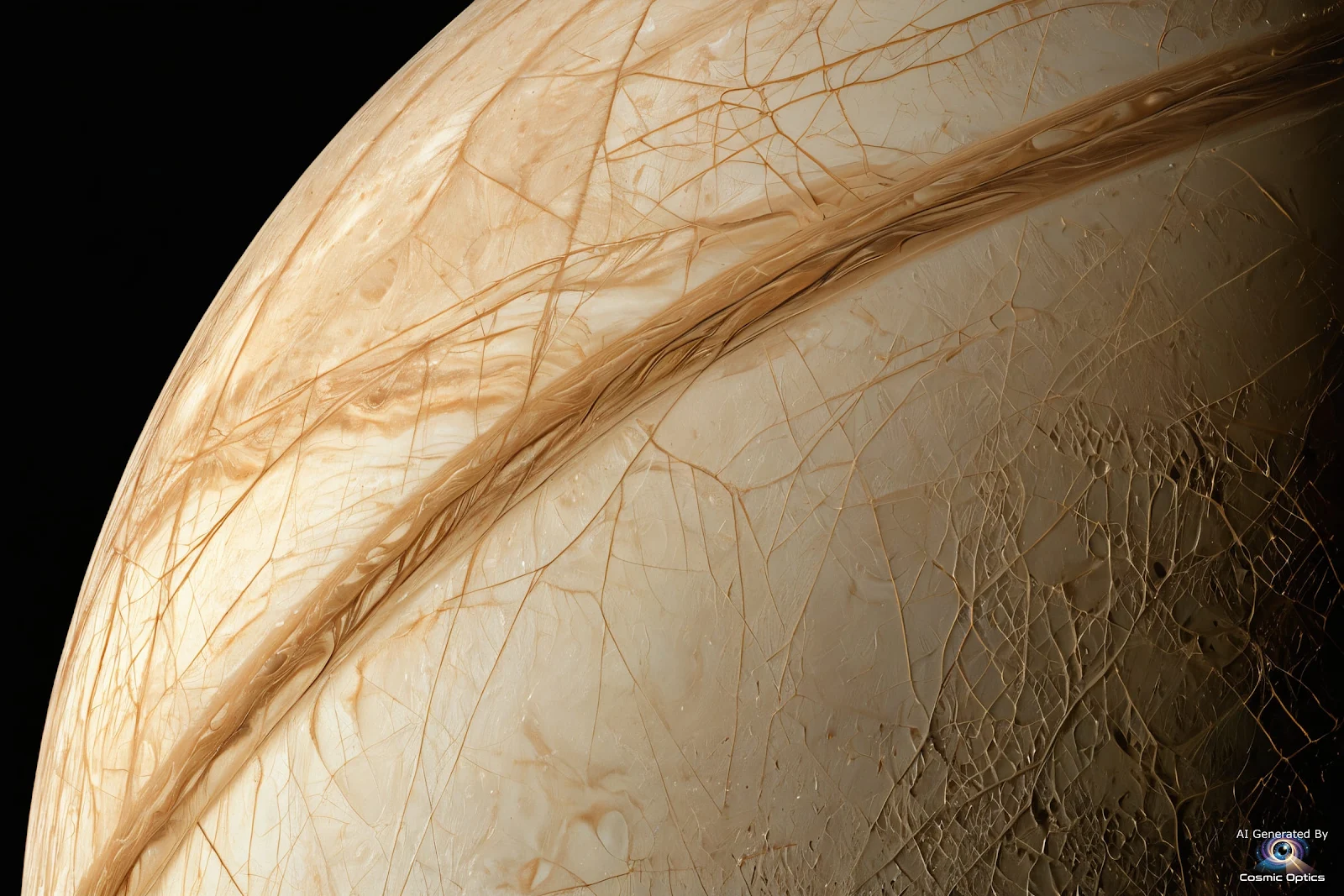
An authentic, photorealistic astronomical photograph of Jupiter's moon Europa in deep space.
Prepare to have your perception of our solar system utterly transformed, for nestled in the swirling embrace of Jupiter lies a world that continuously captivates and mystifies scientists and dreamers alike: Europa. This isn't just another barren rock in space; it's a dynamic, icy marvel, shimmering with the promise of secrets yet to be unveiled, a veritable beacon in the quest for life beyond Earth. With its smooth, fractured surface hinting at a profound hidden world, Europa stands as one of the most compelling astrobiological targets we know.
At first glance, Europa might appear as a gleaming, featureless sphere of ice, roughly the size of Earth's Moon. But look closer, and its true complexity emerges. Its entire surface is a magnificent tapestry of cracks, ridges, and bands, often referred to as lineae, stretching for thousands of kilometers. These intricate patterns aren't random; they are scars of a restless world, constantly shaped by powerful tidal forces exerted by its colossal parent planet, Jupiter. These immense gravitational tugs knead Europa's interior, generating enough heat to maintain a truly astonishing feature: a vast, global ocean of liquid water, hidden beneath miles of ice.
This subsurface ocean is the crown jewel of Europa’s scientific intrigue. Evidence for its existence is compelling, built up over decades of observations from missions like Voyager and Galileo. Magnetic field measurements, surface geology, and even theoretical models of tidal heating all point to the unmistakable presence of a deep, salty ocean, potentially twice the volume of all of Earth's oceans combined. Imagine, a liquid water world, not on a temperate planet bathed in sunshine, but deep beneath an icy crust, millions of miles from our sun. This radical concept redefines our understanding of where life might originate and thrive.
The real excitement escalates when we consider the potential for life within this hidden ocean. On Earth, life flourishes in the most extreme environments, often drawing energy from chemical reactions rather than sunlight. Deep-sea hydrothermal vents, for instance, support entire ecosystems teeming with exotic organisms, utterly independent of the sun's energy. Scientists hypothesize that similar hydrothermal activity could be occurring on Europa's seafloor. If volcanic activity or serpentinization (a chemical reaction between water and rock) is taking place on Europa's rocky core, it could provide the necessary chemical energy and nutrients to sustain a vibrant biosphere, much like those found in Earth’s abyssal depths. The ingredients for life as we know it—liquid water, a source of energy, and essential chemical building blocks—all appear to be present or highly probable on Europa.
Our quest to understand Europa is not merely speculative; it is actively being pursued with cutting-edge missions. NASA’s Europa Clipper mission, set to launch soon, is specifically designed to conduct detailed reconnaissance of this enigmatic moon. Equipped with a suite of advanced instruments, Clipper will perform numerous close flybys, peering through the ice with radar, sniffing for plumes of water vapor that might erupt from the surface, and mapping the moon's surface composition with unprecedented detail. Its objectives include confirming the ocean's existence and characteristics, searching for potential life-sustaining environments, and identifying future landing sites. Simultaneously, the European Space Agency’s JUpiter ICy moons Explorer (JUICE) will also study Europa, alongside Ganymede and Callisto, offering complementary insights into the ocean worlds of the outer solar system.
These missions are not without their challenges. Europa orbits within Jupiter's incredibly intense radiation belts, posing significant engineering hurdles for spacecraft design. Furthermore, confirming the presence of life would likely require a future lander that could penetrate the thick ice shell and directly sample the ocean, an undertaking of immense complexity and expense. Yet, the potential rewards are immeasurable. Discovering even microbial life on Europa would revolutionize astrobiology, proving that life is not unique to Earth but a cosmic phenomenon, potentially widespread throughout the universe. It would reshape our philosophical understanding of our place in the cosmos, reminding us that the universe is far richer and more diverse than we ever dared to imagine.
Europa is more than just an astronomical object; it is a symbol of humanity's insatiable curiosity and our relentless pursuit of answers to life's biggest questions. It beckons us with its icy allure, promising revelations that could fundamentally alter our understanding of existence. As our robotic emissaries venture forth, charting courses through the void, we stand on the precipice of discoveries that could forever change the narrative of life in the universe. The future of exploration is bright, and Europa remains a glittering testament to the boundless wonders awaiting us beyond our terrestrial confines.


