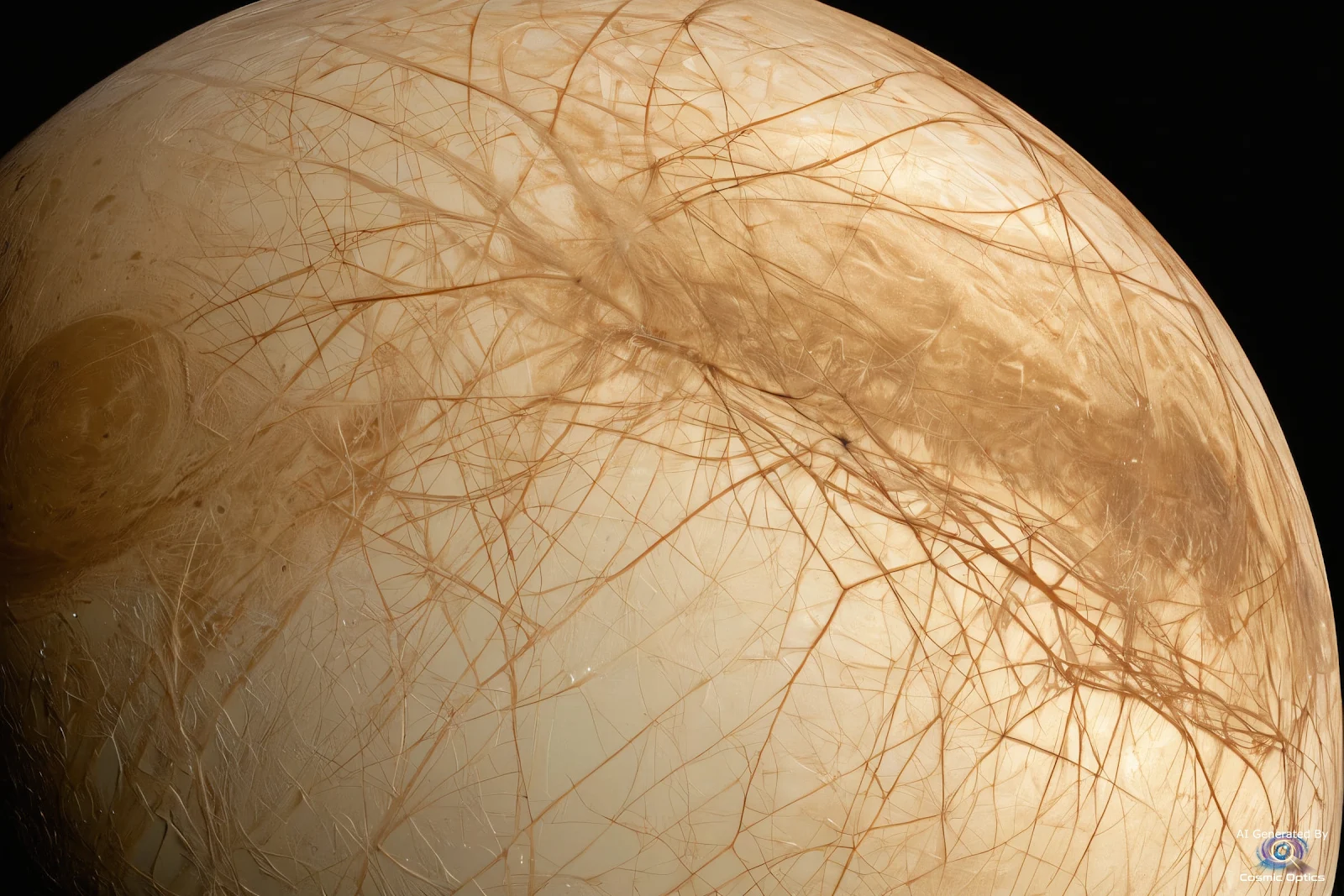
Prepare to embark on an awe-inspiring journey to one of the most enigmatic and captivating worlds in our solar system: Europa! This Jovian moon, a jewel orbiting the gas giant Jupiter, has captivated scientists and space enthusiasts alike with its tantalizing secrets, holding perhaps the greatest promise for extraterrestrial life within our cosmic neighborhood. Europa isn't just another barren rock in space; it's a dynamic, icy sphere hinting at a vibrant, hidden world beneath its frozen crust.
Discovered by Galileo Galilei in 1610, Europa is the smallest of Jupiter's four Galilean moons, yet what it lacks in size, it more than makes up for in intrigue. From a distance, it appears as a smooth, almost featureless sphere, glistening with a pearly white sheen. But closer inspection, thanks to intrepid spacecraft like Voyager and Galileo, reveals a breathtaking landscape of crisscrossing lines, ridges, and chaotic terrain that tell a remarkable story of geological activity driven by colossal tidal forces. These fractures, known as lineae, stretch for thousands of kilometers across its surface, suggesting immense stresses within the moon's crust. The sheer lack of impact craters, compared to heavily pockmarked worlds like Earth's Moon or Mercury, is a colossal clue: Europa's surface is remarkably young, constantly being resurfaced, erasing the scars of cosmic bombardment. This ongoing rejuvenation points to a powerful internal engine.
And what an engine it is! The prevailing theory, supported by a wealth of evidence, posits that beneath Europa's icy shell lies a vast, global ocean of liquid water. Imagine that: a deep, saltwater ocean, possibly more than 100 kilometers deep, hidden beneath a crust of ice estimated to be between 10 to 30 kilometers thick. This incredible reservoir could hold more than twice the volume of all the oceans on Earth combined! The energy to maintain this liquid state comes from the relentless gravitational tug-of-war between Europa, its neighboring Galilean moons (Io and Ganymede), and the colossal mass of Jupiter itself. This perpetual dance creates immense tidal forces that knead Europa's interior, generating frictional heat in a process known as tidal flexing. This heat prevents the subsurface ocean from freezing solid and may even power hydrothermal activity on its seafloor.
The evidence for this hidden ocean is compelling. Observations from the Galileo spacecraft in the late 1990s revealed that Europa interacts with Jupiter's powerful magnetic field in a way that suggests the presence of a vast, electrically conductive layer beneath its surface – precisely what a salty ocean would be. Furthermore, studies of Europa's surface topography show features like "chaos terrains" – regions where blocks of ice appear to have broken apart, rotated, and refrozen in new positions, much like ice floes on Earth's Arctic. This kind of movement strongly implies a liquid layer beneath to lubricate the motion. Even more thrilling are the tantalizing hints of water vapor plumes erupting from Europa's southern polar region, potentially observed by the Hubble Space Telescope. If confirmed and characterized, these plumes could offer a precious opportunity to sample the ocean's composition without needing to drill through kilometers of ice.
This deep, dark, and potentially warm ocean is precisely why Europa stands out as a prime candidate in the search for life beyond Earth. On our own planet, wherever there's liquid water, energy, and the right chemical ingredients, life thrives – often in the most extreme environments imaginable, such as the abyssal depths around hydrothermal vents. These "black smokers" on Earth's ocean floor spew superheated, mineral-rich water, creating vibrant ecosystems entirely independent of sunlight, based on chemosynthesis. Could a similar scenario exist on Europa? If its rocky core is in contact with the subsurface ocean, then tidal heating could drive hydrothermal circulation, creating ideal conditions for the emergence and sustenance of life. The ice shell, while a barrier, also acts as a shield, protecting any potential life from the harsh radiation bombarding Europa's surface.
The potential implications of discovering life on Europa are nothing short of monumental. It would fundamentally reshape our understanding of life's prevalence in the cosmos, demonstrating that Earth may not be unique in fostering biological complexity. It would ignite a new era of astrobiological exploration, inspiring future missions to directly probe Europa's ocean. Thankfully, the scientific community is not merely speculating; ambitious missions are already underway or in development. NASA's Europa Clipper, set to launch in the coming years, will conduct dozens of close flybys of the moon, equipped with sophisticated instruments to characterize the ice shell, the ocean, and any potential plumes. Similarly, the European Space Agency's Jupiter Icy Moons Explorer (JUICE) will also study Europa, along with Ganymede and Callisto, providing complementary data and enhancing our understanding of this fascinating system.
Europa beckons us to peer deeper into the mysteries of our universe. Its shimmering, cracked surface, a testament to immense forces at play, guards a secret ocean that could harbor life. As we prepare to send our robotic emissaries to this distant world, the excitement is palpable. The answers Europa holds could redefine our place in the cosmos, turning the question of "Are we alone?" into a resounding, "We are not." The exploration of Europa is not just a scientific endeavor; it's a profound journey into the very essence of existence, a quest that promises to unveil wonders beyond our wildest dreams.