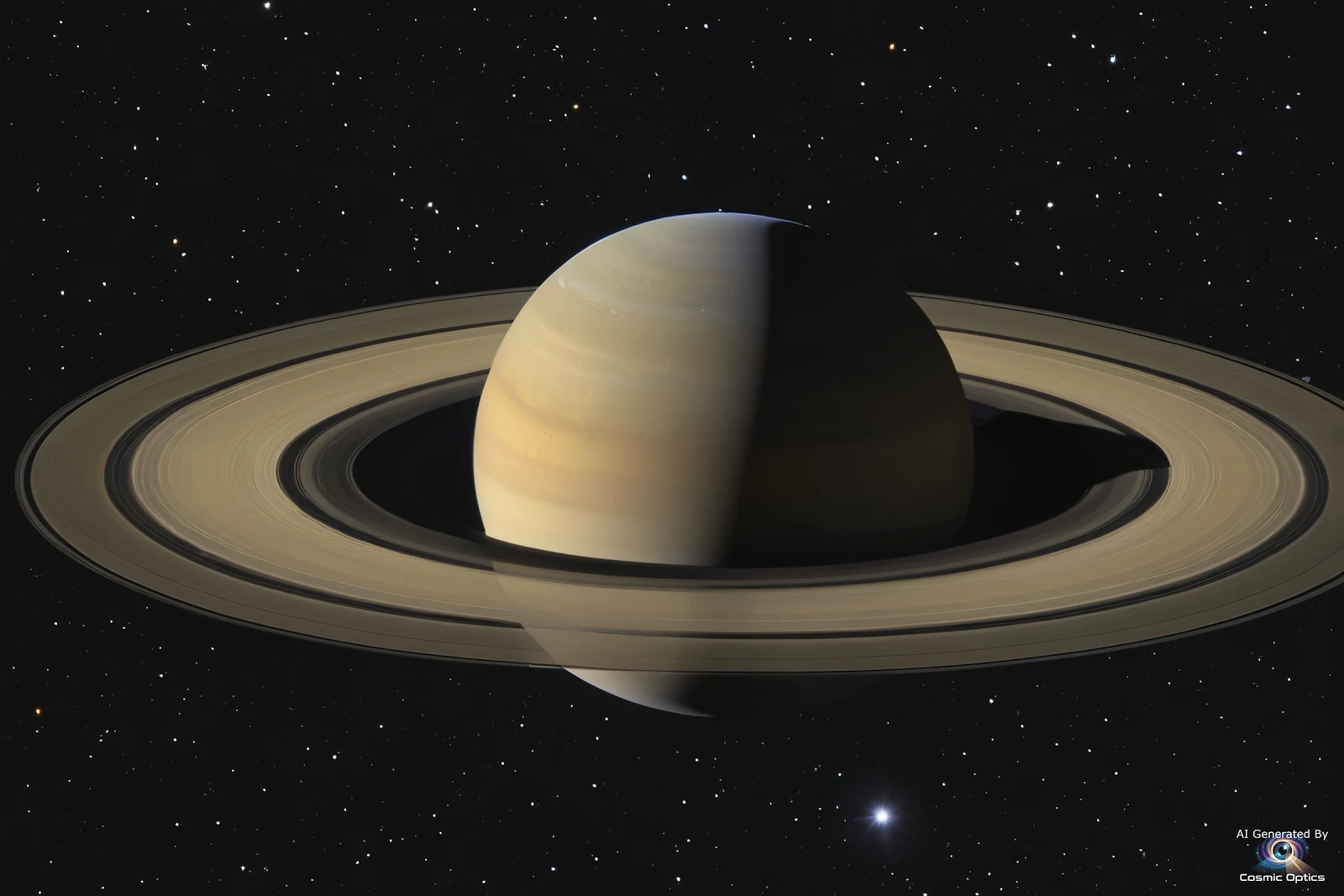
An authentic astrophotography shot of the planet Saturn in deep space. The large, smooth, pale beige_00011
Prepare to embark on an incredible journey to one of the most breathtaking jewels of our solar system: Saturn! From its majestic rings to its enigmatic moons, this gas giant is a celestial masterpiece, captivating astronomers and space enthusiasts for centuries. It's not just a planet; it's a dynamic, complex system that continues to unravel mysteries with every passing observation, pushing the boundaries of our understanding of planetary formation and the potential for life beyond Earth.
At the heart of Saturn's allure are its magnificent rings, a spectacle unparalleled in the cosmos. These aren't solid, shimmering bands, but rather billions upon billions of icy particles, ranging in size from microscopic dust grains to colossal boulders, each orbiting Saturn independently. Stretching hundreds of thousands of kilometers across but astonishingly thin—in some places no thicker than a kilometer—they form an intricate, braided tapestry. The sheer scale and delicate structure of these rings are mind-boggling, a celestial ballet choreographed by gravity and the subtle influences of Saturn's numerous moons. We've identified distinct ring systems, like the prominent A, B, and C rings, separated by gaps such as the famous Cassini Division, which itself is larger than the planet Earth! These gaps and divisions are not empty spaces but are often cleared and maintained by the gravitational nudges of tiny "shepherd moons" that orbit within or near the rings, herding particles into place and sculpting the ethereal arches we observe. The origin of these rings remains a topic of active research, with theories ranging from the breakup of a larger icy moon to the capture of a comet that fragmented upon approaching Saturn. Whatever their genesis, they are a transient marvel, slowly evolving and perhaps destined to dissipate over astronomical timescales, making our current view of them all the more precious.
Beyond its iconic rings, Saturn boasts a family of over 80 confirmed moons, each a world unto itself, presenting a diverse array of geological features and intriguing possibilities. Foremost among them is Titan, the second-largest moon in the entire solar system, surpassing even the planet Mercury in size. Titan is unique for its dense, hazy atmosphere, primarily composed of nitrogen, reminiscent of early Earth. Beneath this orange shroud lies a cryogenic landscape where methane and ethane replace water, forming vast lakes, rivers, and even rain cycles. The Cassini-Huygens mission provided an unprecedented look at this distant world, with the Huygens probe successfully landing on Titan's surface in 2005, sending back images of a surreal, frosty landscape carved by liquid methane. The discovery of cryovolcanoes, erupting water and ammonia, suggests active geological processes beneath its frigid exterior, hinting at a dynamic interior that continues to reshape its surface. The possibility of complex organic chemistry occurring in Titan's unique environment makes it a prime candidate for astrobiological study.
Equally compelling is Enceladus, a relatively small moon that has astounded scientists with its dramatic plumes of water vapor and ice particles erupting from its south pole. These geysers, first observed by the Cassini spacecraft, are evidence of a vast subsurface ocean of liquid water, warmed by tidal forces from Saturn. This ocean, nestled beneath a thick icy shell, is thought to contain salts and organic molecules—ingredients considered crucial for life. The sustained presence of liquid water, along with heat and chemical ingredients, makes Enceladus one of the most promising locations in our solar system to search for extraterrestrial microbial life. Future missions are already being envisioned to further explore these plumes and sample the ocean directly, a testament to the profound potential held within this icy satellite.
Other moons add to Saturn's incredible diversity. There's Mimas, famous for its enormous Herschel crater, which bears an uncanny resemblance to the "Death Star" from science fiction. Then there's Iapetus, a moon of stark contrasts, with one hemisphere as dark as soot and the other as bright as snow, divided by a mysterious equatorial ridge that runs for thousands of kilometers. Each moon is a cosmic puzzle, offering clues about the formation and evolution of planetary systems.
The planet Saturn itself is a marvel, a colossal gas giant primarily composed of hydrogen and helium, with traces of methane and ammonia. It is famously less dense than water, meaning that if you could find a bathtub large enough, Saturn would float! Its rapid rotation (a "day" on Saturn lasts only about 10.7 Earth hours) causes it to bulge at its equator and flatten at its poles, creating its characteristic oblate shape. The atmosphere is a tempestuous realm, marked by powerful winds that can reach speeds of 1,800 kilometers per hour. One of its most bizarre features is the massive, hexagonal storm at its north pole, a persistent, geometrically perfect weather pattern that has baffled scientists since its discovery. This unique atmospheric phenomenon is a stark reminder of the incredible forces at play within gas giants, shaping weather patterns on scales vastly different from anything we experience on Earth.
Our understanding of Saturn and its system has been monumentally advanced by robotic explorers. Missions like Pioneer 11 and the Voyager probes provided our first close-up glimpses, revealing details that were unimaginable through ground-based telescopes. However, it was the magnificent Cassini-Huygens mission, a collaborative effort by NASA, ESA, and ASI, that truly revolutionized our knowledge. Orbiting Saturn for over 13 years, from 2004 to 2017, Cassini delivered an unprecedented trove of data and stunning imagery, transforming our perception of this ringed world. Its grand finale, a series of daring dives between the planet and its innermost rings before plunging into Saturn's atmosphere, marked a spectacular end to an era of groundbreaking discovery.
Saturn is more than just a distant world; it's a testament to the endless wonders of the universe. Its spectacular rings, its diverse and potentially life-bearing moons, and its dynamic planetary atmosphere combine to create a system of unparalleled beauty and scientific intrigue. Every image, every piece of data, unravels new secrets, fueling our curiosity and inspiring future generations to look up and ponder the incredible tapestry of our cosmos. As we continue to gaze upon this magnificent celestial body, we are reminded of the vastness of space and the infinite possibilities that lie waiting to be discovered.


