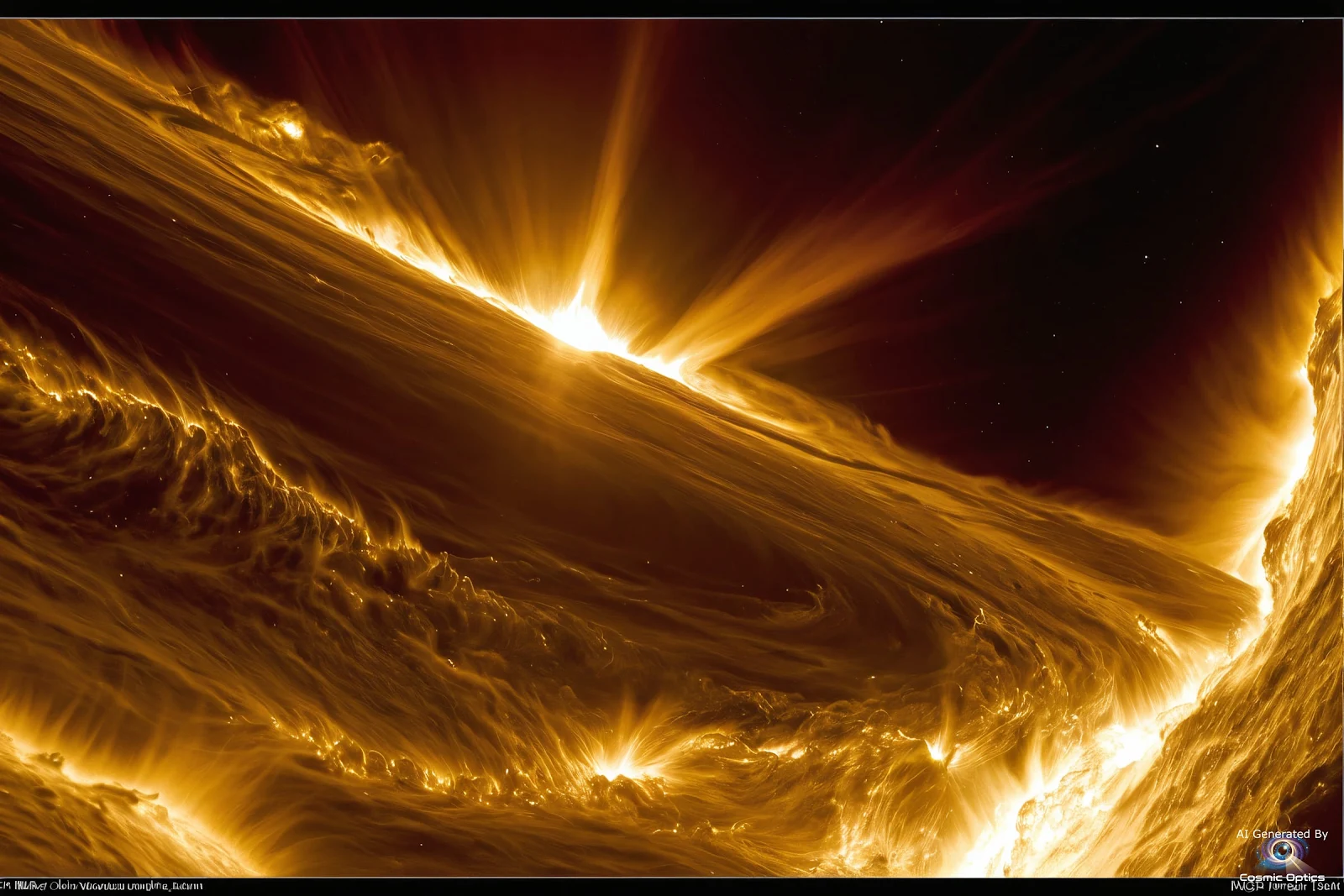
Imagine a sunset. What colors come to mind? Fiery reds, deep oranges, soft purples, perhaps a hint of gold. On Earth, these familiar hues paint the sky as our star dips below the horizon, a daily spectacle that has captivated humanity for millennia. But what if I told you that across the vastness of our solar system, this quintessential celestial farewell takes on an entirely different palette? Prepare to have your perceptions challenged, because the universe is a canvas of unexpected wonders, and the truth behind planetary sunsets is far more colorful and complex than you might ever have imagined.
To truly appreciate these alien skies, we must first delve into the mesmerizing physics of light. The seemingly simple act of sunlight passing through an atmosphere is a grand dance of photons and particles. Our star emits light across the electromagnetic spectrum, but it's the visible wavelengths – the colors of the rainbow – that create the visual magic. When this light encounters gases and dust particles in a planet's atmosphere, it scatters. The way it scatters depends critically on the wavelength of the light and the size of the particles it encounters. This phenomenon, primarily governed by Rayleigh scattering for smaller particles (like gas molecules) and Mie scattering for larger particles (like dust), is the grand architect behind every planetary sky and sunset. Shorter wavelengths, like blue and violet, scatter much more efficiently than longer wavelengths, like red and orange, when interacting with particles smaller than the light's wavelength.
On our home planet, Earth's atmosphere is a rich mixture of nitrogen and oxygen molecules. During the day, as sunlight enters our atmosphere, the abundant blue light is scattered in all directions by these tiny molecules, making our sky appear blue. But as the Sun sinks low in the sky at sunset, its light has to travel through a much greater thickness of atmosphere to reach our eyes. Most of the blue and green light has already been scattered away, leaving the longer-wavelength reds, oranges, and yellows to dominate the horizon. This is why Earth's sunsets are a warm, fiery embrace – a testament to our planet's dense, life-sustaining air. It’s a daily reminder of the intricate interplay between solar energy and our protective atmospheric blanket, a phenomenon so common yet so profoundly beautiful that it rarely fails to inspire awe.
Now, prepare for a vivid contrast. On the desolate, ruddy plains of Mars, the atmospheric ballet performs a stunning inversion. Imagine a dusty, thin atmosphere, primarily composed of carbon dioxide, but crucially, filled with fine dust particles – iron oxides, essentially rust, which give the planet its distinctive red hue. These dust particles are larger than the gas molecules in Earth's sky, and they scatter light differently, primarily through Mie scattering. During the Martian day, these dust particles scatter red light quite efficiently, giving the Martian sky a butterscotch or yellowish-brown tint, often with a reddish cast near the horizon. But at sunset, as the Sun dips below the Martian horizon, something truly extraordinary happens. The dust particles preferentially scatter the red light *away* from the direct path of the sun's rays, allowing the blue light to penetrate more directly through the atmosphere towards the observer. Consequently, the area immediately around the setting Martian Sun appears a striking, ethereal blue, often fringed with green and purple. It's a breathtaking, alien spectacle that challenges our terrestrial notions of a "sunset" and stands as a vibrant testament to the unique physics at play on the Red Planet.
The cosmic tapestry of sunsets doesn't end with Earth and Mars. Consider Venus, shrouded in thick, dense clouds of sulfuric acid. While we can't directly observe a "sunset" on its surface due to the perpetual cloud cover, the sky, if one could see it, would likely be a diffuse, yellowish-orange haze, with the Sun appearing as a mere brighter spot. Then there are the gas giants – Jupiter, Saturn, Uranus, and Neptune – with their colossal, turbulent atmospheres. Imagine peering through the upper clouds of Jupiter, where ammonia ice crystals and complex organic molecules might scatter light in myriad ways, potentially producing a kaleidoscope of colors unlike anything we've ever witnessed. Or consider Titan, Saturn's largest moon, with its thick, nitrogen-rich atmosphere laced with hydrocarbon hazes. Sunsets on Titan are thought to be a deep, dark orange or even reddish-brown, often cloaked in twilight due to the immense distance from the Sun and the pervasive haze. Each celestial body, with its unique atmospheric cocktail, promises a unique visual symphony, a grand performance orchestrated by light, matter, and distance.
These dazzling visual phenomena are far more than just pretty sights; they are invaluable scientific data points. By studying the precise colors of skies and sunsets on other planets, scientists can deduce critical information about their atmospheric composition, density, and the size and distribution of particles within them. A blue sunset on Mars, for instance, confirms the presence of fine dust suspended high in its atmosphere and helps us understand Martian weather patterns, dust storms, and climate history. Changes in atmospheric color over time could even indicate shifts in planetary climate or volcanic activity. This spectral analysis allows us to build detailed models of planetary atmospheres, predict their behavior, and even assess their potential to harbor life, as atmospheric conditions are fundamental to habitability. Every hue, every glimmer, every subtle shift in light is a whisper from another world, providing clues to its deepest secrets.
There's an undeniable, profound connection we feel to the grandeur of the cosmos, and planetary sunsets are a perfect embodiment of this. They remind us that while our experiences on Earth are unique and cherished, they are merely one chapter in an infinitely varied cosmic story. The very existence of a blue sunset on Mars expands our imagination, inviting us to contemplate what other wonders await discovery. It's a humbling thought, recognizing that the universe is not just vast in space, but also incredibly diverse in its fundamental expressions of light and matter. These celestial spectacles fuel our curiosity, push the boundaries of our exploration, and reinforce a universal sense of wonder that transcends our terrestrial confines. They are vivid postcards from distant worlds, beckoning us to look up, to dream, and to continue our quest to understand the incredible cosmos we inhabit.
From the familiar crimson farewells on Earth to the startling azure glow on Mars, and the myriad potential displays across our solar system, the science of light scattering paints a vivid picture of planetary individuality. Each sunset is a unique blend of a star's light, a planet's atmospheric chemistry, and the intricate dance of physics. These aren't just pretty pictures; they are profound insights into the mechanics of other worlds, offering glimpses into their very nature. So, the next time you witness a sunset, allow your mind to wander beyond our own sky. Imagine the spectrum of colors painting horizons across the galaxy, each one a testament to the endless beauty and scientific intrigue woven into the fabric of the universe. The cosmos truly is a breathtaking masterpiece, and its sunsets are among its most spectacular brushstrokes.