
Haumea The Fast Spinning Ellipsoid Dwarf Planet With Rings And A Violent Past
Deep within the frozen reaches of the Kuiper Belt, far beyond the orbit of Neptune, lies one of the most enigmatic and physically striking members of our solar system. This celestial body, known as Haumea, challenges our traditional understanding of what a planet—or even a dwarf planet—should look like. While most large objects in space tend toward a spherical shape due to the relentless pull of their own gravity, Haumea stands out as a shimmering, elongated ellipsoid, resembling a giant cosmic football or a smoothed river stone spinning wildly in the dark. This extraordinary shape is not a mere quirk of nature but a testament to a violent, high-energy past and a rotational speed that pushes the boundaries of celestial mechanics.
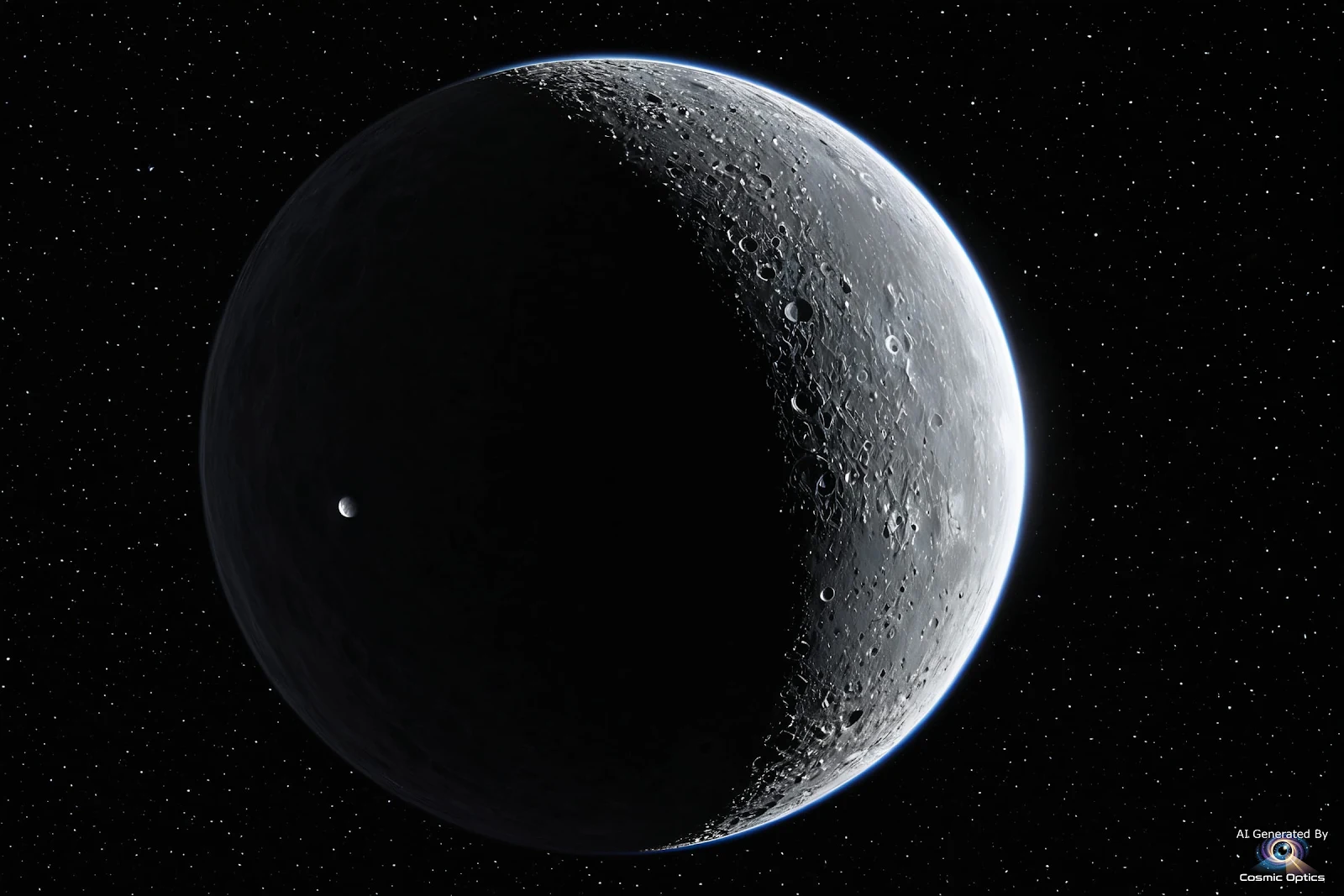
An authentic, photorealistic astronomical photograph of the dwarf planet Haumea floating in the abso_00050
The secret to Haumea’s bizarre appearance lies in its staggering rate of rotation. It completes a full turn on its axis in just under four hours, making it one of the fastest-rotating large objects in our solar system. If it were to spin any faster, the centrifugal force acting upon its mass would likely overcome its gravitational pull, causing the dwarf planet to break apart. This rapid spin has stretched the body into an elongated triaxial ellipsoid. Despite its distorted shape, Haumea is massive enough—comparable in mass to one-third of Pluto—to have reached hydrostatic equilibrium, a key requirement for its classification as a dwarf planet. The sheer physics involved in maintaining such a shape while hurtling through the vacuum of space is a marvel of planetary science.
Haumea’s discovery in the mid-2000s sparked significant interest not only for its shape but for its complex environmental system. Unlike many of its neighbors in the outer solar system, Haumea is not a solitary wanderer. It is accompanied by two moons, Hiʻiaka and Namaka, named after the daughters of the Hawaiian goddess of childbirth and fertility. These moons are believed to be fragments of Haumea itself, blasted off during a massive collision billions of years ago. This theory is supported by the existence of the "Haumea collisional family," a group of several other small, icy objects in similar orbits that share the same unique spectral signature as the dwarf planet. This suggests that a cataclysmic impact once shattered a much larger ancestral body, leaving behind the Haumea we see today along with its retinue of satellites and debris.
One of the most surprising revelations about Haumea came in 2017, when astronomers observed the dwarf planet passing in front of a distant star—an event known as an occultation. This observation revealed that Haumea possesses its own ring system. While rings are common among the giant gas planets like Saturn and Uranus, finding them around a small, rocky body in the Kuiper Belt was unprecedented. The ring, which is approximately 70 kilometers wide and has a radius of about 2,287 kilometers, sits in the same plane as Haumea’s equator and the orbit of its outer moon, Hiʻiaka. The presence of this ring further cements Haumea’s status as a complex geological world, suggesting that rings might be a far more common feature in the outer solar system than previously hypothesized.
The surface of Haumea is another point of intense scientific fascination. Most objects in the Kuiper Belt are covered in a dark, reddish organic sludge known as tholins, created by the processing of methane and ethane by cosmic rays. However, Haumea is different. It is exceptionally bright, with a surface composed almost entirely of crystalline water ice. This is a scientific puzzle, as the intense radiation from space should have turned that ice into an amorphous, disordered state over millions of years. The presence of crystalline ice suggests that some form of internal heat or geological activity—perhaps tidal heating from its moons or the decay of radioactive elements—is constantly refreshing the surface. This brilliant, white exterior makes Haumea one of the most reflective objects in the solar system, gleaming like a polished diamond in the dim light of the distant Sun.
Exploring Haumea provides a window into the early history of our solar system. Its composition—mostly rock with a thin veneer of ice—differs from many other Kuiper Belt objects, which tend to have a much higher ice-to-rock ratio. This suggests that the original body was large enough to have differentiated, with the heavier rock sinking to the core and the lighter ice forming a mantle. The massive impact that created the collisional family likely stripped away much of the outer ice, leaving behind the dense, rocky core we observe today. By studying Haumea, scientists are essentially performing a form of celestial archaeology, piecing together the violent processes that shaped the outer reaches of our planetary neighborhood.
The naming of Haumea and its moons is deeply significant, reflecting a departure from traditional Greco-Roman nomenclature. By choosing the Hawaiian goddess of fertility and childbirth, the International Astronomical Union acknowledged the "birth" of the collisional family from the parent body. Hiʻiaka, the patron goddess of Hawaii and hula dancers, and Namaka, a spirit of the sea, represent the fragments of this cosmic lineage. This cultural connection reminds us that the study of the heavens is a global human endeavor, bridging ancient mythology with modern astrophysics.
As we look to the future, Haumea remains a high-priority target for long-term space exploration. While no missions are currently scheduled to visit this distant world, the data gathered from ground-based telescopes and the Hubble Space Telescope continue to refine our models. Every new piece of information—whether it’s the precise measurement of its ring or the chemical analysis of its moons—challenges our preconceptions. Haumea is not just a cold rock in the dark; it is a dynamic, ringing, spinning laboratory of physics that tells a story of survival, transformation, and the enduring beauty of the cosmos. It stands as a reminder that the further we look into the shadows of our solar system, the more wonders we are destined to find, proving that even the smallest worlds can have the biggest stories to tell.


