
Haumea: The Rapidly Rotating Icy Enigma and Ringed Marvel of the Kuiper Belt
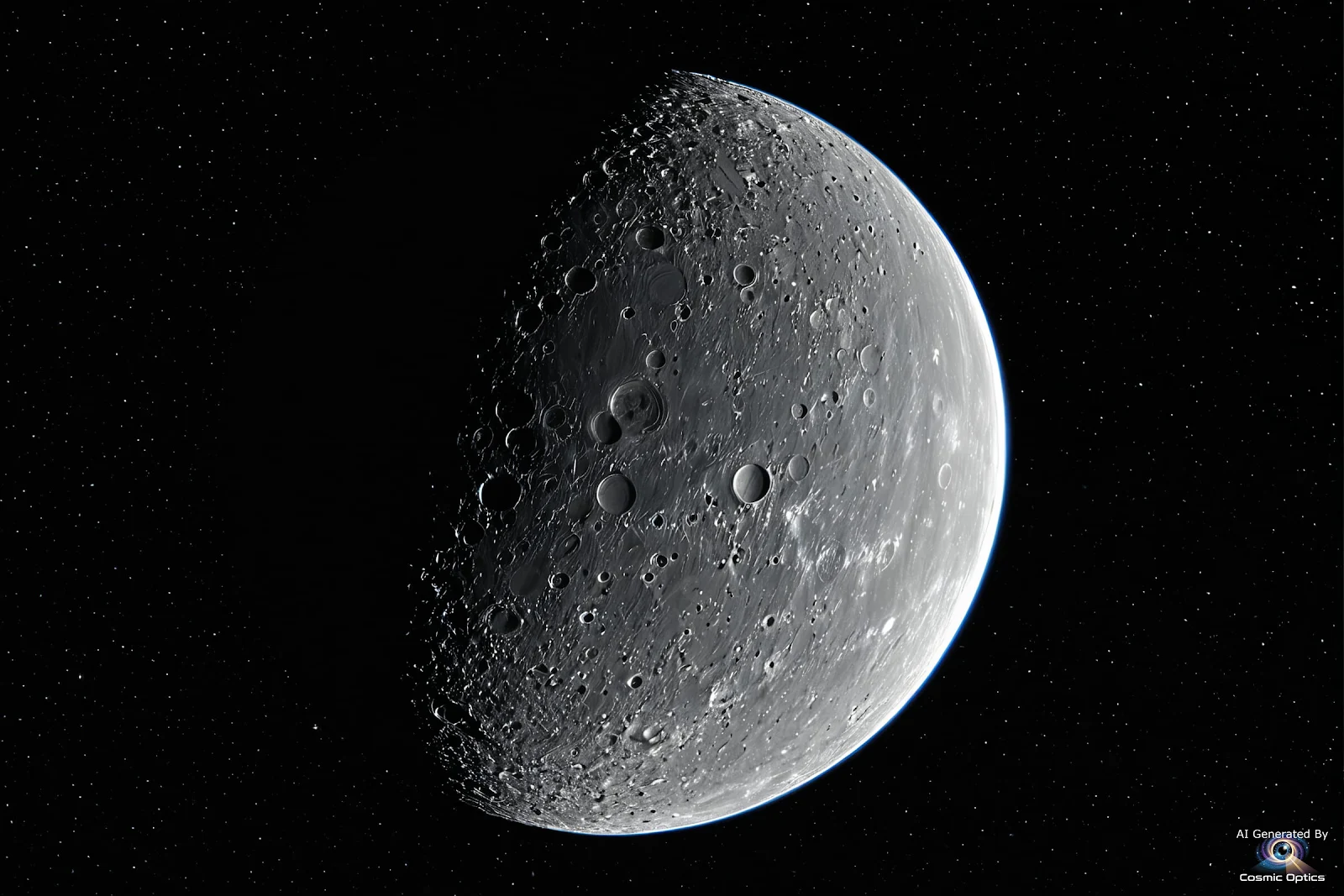
An authentic, photorealistic astronomical photograph of the dwarf planet Haumea floating in the abso_00041
Deep within the frozen reaches of our solar system, far beyond the orbit of Neptune, lies a realm of twilight and mystery known as the Kuiper Belt. In this vast graveyard of icy remnants from the dawn of creation, one celestial body stands out as an absolute marvel of physics and cosmic history. This is Haumea, a dwarf planet so peculiar and dynamic that it challenges our understanding of how planetary bodies evolve in the cold isolation of the outer solar system. While the silence of space may seem empty, Haumea tells a thunderous story of ancient collisions, rapid motion, and unexpected complexity.
Haumea is not your typical spherical world. While most planets and dwarf planets have been pulled into neat globes by the relentless force of gravity, Haumea possesses a startling, elongated shape often compared to a giant, cosmic football or a smoothed-out river stone. This bizarre morphology is a direct consequence of its dizzying rotational speed. Haumea completes a full turn on its axis in just under four hours, making it one of the fastest-rotating large objects in our solar system. If it were to spin any faster, the centrifugal forces might actually tear the dwarf planet apart. Instead, it has stretched out into a triaxial ellipsoid, a testament to the incredible forces at play in the vacuum of the deep void.
The origin of this frantic spin is widely believed to be the result of a cataclysmic impact billions of years ago. Imagine a time when the early solar system was a chaotic shooting gallery; a massive object likely slammed into Haumea, stripping away much of its outer ice and sending it into a wild, permanent pirouette. This collision did more than just change Haumea’s shape; it created an entire "collisional family." Astronomers have identified a group of smaller, icy bodies sharing similar orbital paths and spectral signatures, all of which are thought to be fragments of Haumea’s original crust, blasted into space during that ancient encounter. This makes Haumea the only dwarf planet known to head such a lineage, providing scientists with a rare "laboratory" to study the aftermath of giant impacts.
Adding to its allure, Haumea is not a solitary traveler. It is accompanied by two distinct moons, Hiʻiaka and Namaka, named after the daughters of the Hawaiian goddess of fertility and childbirth. These moons are fascinating worlds in their own right. Hiʻiaka, the larger and outer moon, has a surface covered in nearly pure water ice, while the smaller Namaka orbits closer to the parent body, influenced by the dwarf planet's irregular gravitational field. The presence of these moons is more than just a scenic detail; by studying their orbits, astronomers have been able to calculate the mass and density of Haumea with high precision, revealing a world that is surprisingly rocky beneath its brilliant, icy veneer.
In 2017, the scientific community was stunned by another discovery: Haumea has a ring. This was the first time a ring system was found around a trans-Neptunian object, shattering the long-held belief that only the giant gas planets—and perhaps a few minor planets like Chariklo—could possess such features. The ring, which spans about 70 kilometers in width, circles the dwarf planet’s equator at a distance of approximately 2,287 kilometers. Its existence suggests that rings might be far more common in the outer solar system than we ever dared to imagine, perhaps forming from the debris of the same impacts that shaped the planet and birthed its moons.
The surface of Haumea is equally captivating. Spectroscopic analysis reveals that it is coated in crystalline water ice. This is a scientific puzzle, as the intense radiation from the sun and cosmic rays usually turns ice into an amorphous, disordered state over long periods. The presence of crystalline ice suggests that some internal heat source—perhaps tidal heating from its moons or the decay of radioactive elements—is keeping the surface "fresh" or that recent geologic activity is refreshing the icy coating. This brilliance makes Haumea one of the most reflective objects in the solar system, shining like a beacon in the darkness of the Kuiper Belt.
Studying Haumea is a masterclass in modern astronomy. Because it is so distant—averaging about 43 times the distance from the Earth to the Sun—it appears only as a tiny point of light even through our most powerful telescopes. Researchers must rely on "stellar occultations," observing the dwarf planet as it passes in front of distant stars. By watching how the starlight blinks out and returns, scientists can map the planet’s silhouette, detect the presence of rings, and even probe for a thin atmosphere. It is a delicate, precise dance of observation that turns a speck of light into a multidimensional world of ice and stone.
The significance of Haumea extends far beyond its own physical quirks. It serves as a vital piece of the puzzle in understanding the migration of the giant planets. The current architecture of the Kuiper Belt was shaped by the movement of Jupiter, Saturn, Uranus, and Neptune billions of years ago. By analyzing the orbits and compositions of objects like Haumea, we can reconstruct the history of our solar system, learning how material was tossed about during the formative years of our planetary neighborhood. Haumea is a survivor, a witness to the violent history that eventually led to the stable solar system we inhabit today.
As we look to the future, Haumea remains a prime candidate for further exploration. While no spacecraft has yet visited this distant world, mission concepts are frequently discussed by space agencies. A flyby mission, similar to New Horizons’ historic visit to Pluto, would provide us with high-resolution imagery of its elongated surface, its mysterious ring, and the rugged terrain of its moons. Until then, we must be content with the data we gather from afar, piecing together the story of this rapid-spinning, ring-bearing, icy enigma. In the silent, frozen depths of space, Haumea continues its frantic dance, a shimmering reminder of the endless wonders waiting to be discovered on the frontiers of our cosmic backyard.


