Far beyond the familiar glow of our sun, nestled within the immense gravitational embrace of Jupiter, lies a world of profound mystery and breathtaking potential: Europa. This isn't just another icy moon; it's a cosmic enigma, a celestial body that might hold the most exciting secret in our solar system—a vast, hidden ocean, potentially teeming with life. From its strikingly smooth, fractured surface to the tantalizing hints of warmth beneath, Europa beckons us to explore its depths and unravel its profound secrets.
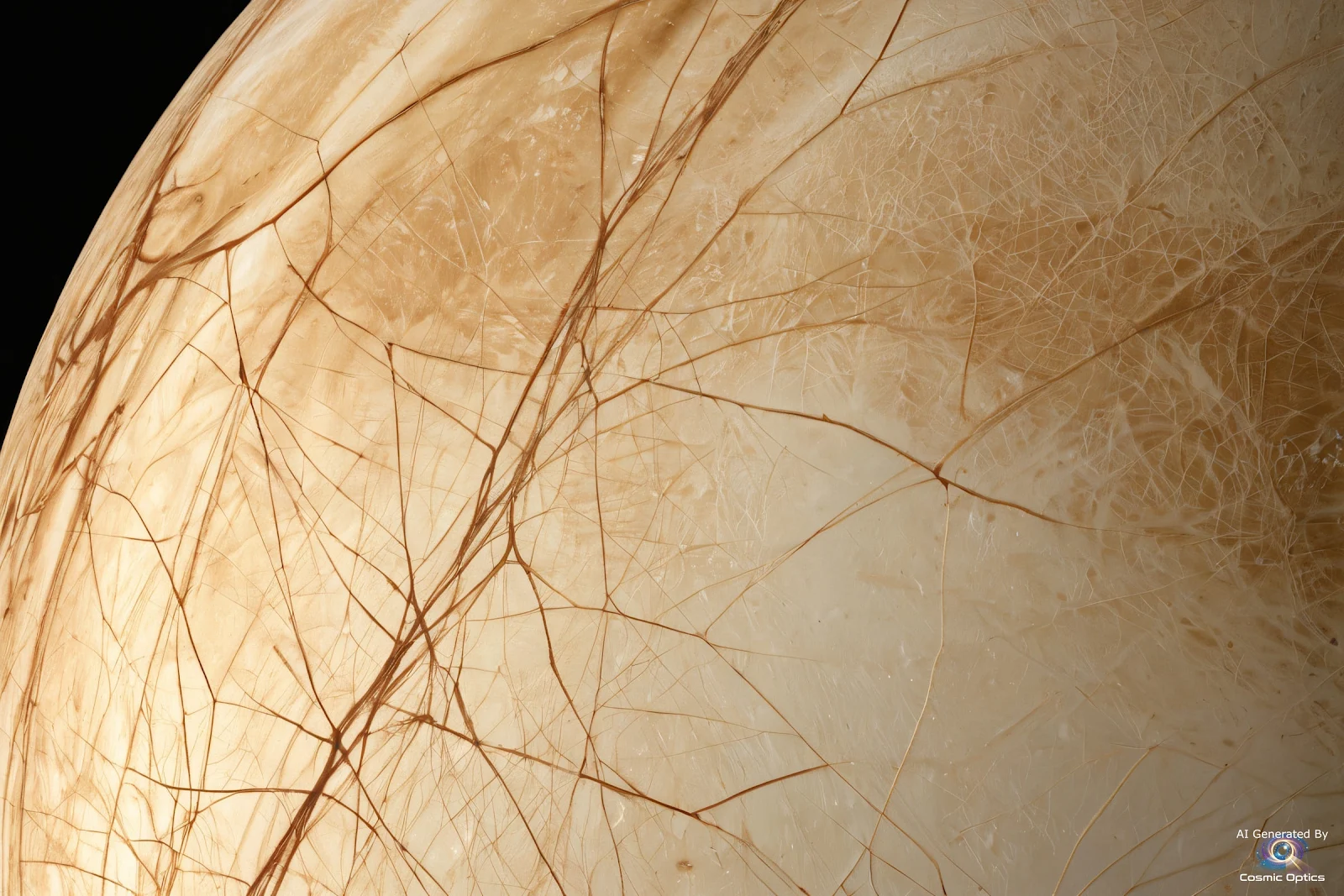
Imagine a world gleaming like a pearl in the dark canvas of space, its surface a mesmerizing tapestry of cracks, ridges, and faint reddish-brown stains. This is Europa, one of Jupiter's four largest Galilean moons, slightly smaller than Earth's Moon but vastly different in composition and character. Its most striking feature is its incredibly smooth, almost crater-free icy crust, hinting at a geologically active interior that constantly resurfaces the moon, erasing the scars of ancient impacts. The crisscrossing linear features, often referred to as "lineae," are thought to be fractures where warmer ice has welled up from below, creating a unique visual signature that makes Europa instantly recognizable.
But the true allure of Europa lies not on its surface, but beneath it. Decades of scientific observation, primarily from NASA's Voyager and Galileo missions, have provided compelling evidence for a liquid water ocean lurking beneath Europa's thick icy shell. Gravitational measurements, magnetic field data, and the way the moon flexes as it orbits Jupiter all strongly suggest the presence of a global ocean, possibly hundreds of kilometers deep, containing more water than all of Earth's oceans combined. This isn't just a puddle; it's a colossal body of liquid water, kept from freezing solid by the constant tug-and-pull of Jupiter's immense gravity.
This gravitational interaction is key to Europa's potential habitability. As Europa orbits its gas giant parent, it experiences intense tidal forces. Jupiter's gravity stretches and squeezes Europa, generating internal friction and heat, much like repeatedly bending a paperclip warms it up. This tidal heating is believed to be the engine that keeps Europa's deep ocean liquid, preventing it from freezing solid despite its distance from the sun. Furthermore, this energy could drive hydrothermal activity on Europa's seafloor, similar to the "black smoker" vents found on Earth's ocean floors. These hydrothermal vents, powered by geothermal energy, support vibrant ecosystems on Earth, completely independent of sunlight. The possibility of such an energy source on Europa immediately raises the question: could life exist there?
The conditions necessary for life as we know it—liquid water, a source of energy, and the right chemical building blocks—all appear to be present or potentially present on Europa. The rocky core of Europa, much like Earth's, is believed to be in direct contact with the subsurface ocean. This interaction could provide the necessary minerals and chemical nutrients, while the tidal heating supplies the energy. It’s a compelling recipe for astrobiological interest, making Europa arguably the most promising place in our solar system to search for extant extraterrestrial life. The challenge, of course, is getting there and piercing through miles of ice to sample the ocean directly.
The quest to understand Europa better is an ongoing saga of human ingenuity and scientific ambition. The Voyager spacecraft provided humanity's first close-up glimpses in the late 1970s, revealing its stark, icy beauty. Then came Galileo, which orbited Jupiter from 1995 to 2003, performing multiple flybys of Europa and gathering the crucial data that cemented the ocean hypothesis. Galileo's instruments detected an induced magnetic field, a strong indicator of a salty, electrically conductive ocean beneath the ice. Its images also showed chaotic "chaos terrains" – areas where blocks of ice appear to have been jumbled and refrozen, suggesting convection and movement within the ice shell or even interactions with the underlying ocean.
Now, the next chapter in Europa's exploration is already being written. NASA's Europa Clipper mission, set to launch in the coming years, will conduct dozens of close flybys of the moon. Equipped with a sophisticated suite of instruments, including ice-penetrating radar, a magnetometer, and various spectrometers, Clipper will precisely measure the thickness of the ice shell, search for plumes of water vapor erupting from the surface (which would offer a tantalizing direct sample of the ocean), and characterize the ocean's depth and salinity. The data from Europa Clipper will be invaluable, providing unprecedented detail about the moon's ocean, geology, and potential habitability. Looking even further ahead, concepts for a Europa Lander are being developed, designed to touch down on the surface and potentially deploy a probe to melt through the ice and explore the ocean directly. This would be one of the most ambitious and scientifically groundbreaking missions ever conceived.
Exploring Europa is not merely an academic exercise; it's a journey to redefine our understanding of where life can thrive. If life is discovered in Europa's hidden ocean, it would fundamentally change our perception of life's prevalence in the universe. It would suggest that life is not an improbable fluke unique to Earth, but rather a robust phenomenon capable of arising in diverse and unexpected environments. Such a discovery would inspire generations and ignite new waves of exploration and scientific inquiry.
Europa stands as a beacon of cosmic potential, a captivating world that challenges our assumptions and fuels our imagination. Its gleaming surface hides secrets that could reshape our understanding of life itself. Every ridge, every fracture, every whisper of a plume from its depths calls out to us, inviting us on a grand adventure into the unknown. The prospect of what lies beneath its icy exterior is truly one of the most thrilling frontiers in all of space exploration, and humanity is poised on the brink of unlocking its most profound mysteries.