
Jupiter’s Moon Io: A Violent World of Constant Volcanism and Intense Tidal Heating
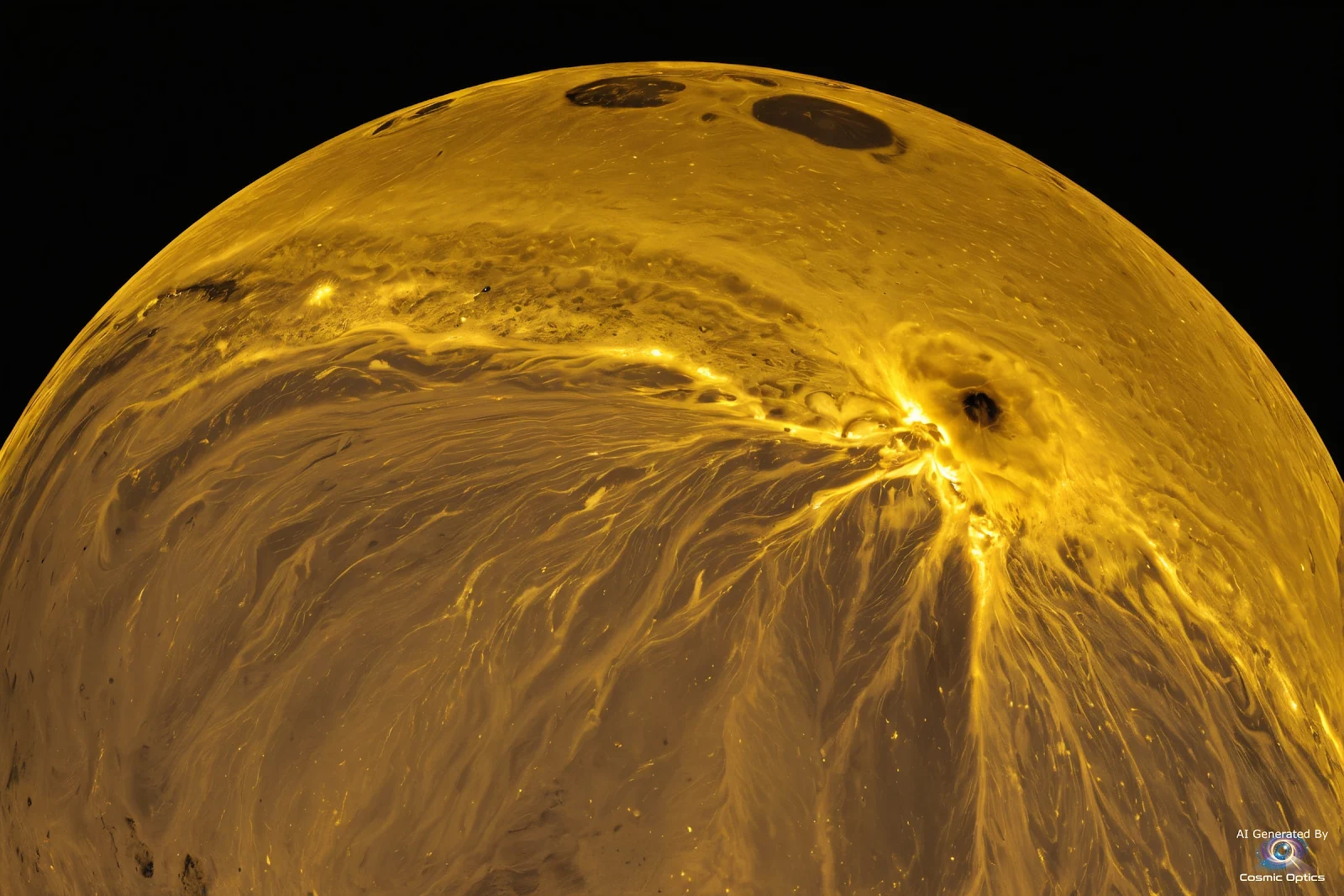
An authentic, photorealistic astronomical photograph of Jupiter's volcanic moon Io in deep space. A _00030
Deep within the gravitational embrace of the solar system’s largest planet lies a world so violent, so vibrant, and so physically impossible by earthly standards that it continues to defy the expectations of planetary scientists decades after its first close-up. Io, the innermost of the four Galilean moons of Jupiter, is a celestial body caught in a perpetual state of self-destruction and rebirth. While its siblings Europa and Ganymede are celebrated for their icy crusts and the potential for subsurface oceans, Io is a hellscape of fire and brimstone, boasting the title of the most volcanically active object in our entire solar system. To look upon Io is to see a world that is being literally turned inside out by the invisible forces of gravity.
The visual appearance of Io is a startling departure from the cratered, grey surfaces of most moons. Instead, it presents a chaotic palette of yellows, oranges, reds, and blacks—a color scheme that led early mission scientists to jokingly compare it to a giant pepperoni pizza. These colors are not the result of vegetation or traditional rock, but rather a thick coating of various allotropes of sulfur and sulfur dioxide frost. This chemical makeup is a direct consequence of the moon's relentless internal heat. Unlike Earth, where volcanic activity is primarily driven by the decay of radioactive isotopes in the core, Io’s heat source is mechanical. It is a victim of a cosmic tug-of-war known as tidal heating.
This phenomenal heating occurs because Io is locked in a gravitational resonance with its neighbor moons, Europa and Ganymede. For every two orbits Europa completes, and every four orbits Ganymede completes, Io completes exactly one. This regular alignment creates a rhythmic gravitational pull that tugs Io’s orbit into an elliptical shape. As Io moves closer to and then further away from Jupiter’s massive bulk, the planet’s immense gravity stretches and squeezes the moon. The surface of Io can actually bulge up and down by as much as 100 meters during this process. This constant friction generates an incredible amount of internal heat, melting the silicate crust and creating a subsurface ocean of magma that must find a way to the surface.
The result of this internal pressure is a landscape defined by hundreds of active volcanic centers and "paterae"—depressions that serve as calderas for molten lakes. Some of these volcanoes, such as Loki Patera, are so massive and energetic that they can be monitored by infrared telescopes right here on Earth. The sheer scale of the eruptions is difficult to fathom; plumes of sulfur dioxide gas and dust have been observed shooting over 500 kilometers into space, reaching altitudes that would be considered high-earth orbit if they occurred on our planet. These plumes are so powerful that the material they eject does not always fall back to the surface; instead, much of it escapes into space, fueling a massive donut-shaped cloud of charged particles around Jupiter known as the Io Plasma Torus.
This interaction between Io and Jupiter’s magnetosphere creates one of the most complex electromagnetic environments in the solar system. As Io moves through Jupiter’s intense magnetic field, it acts as a massive electrical generator, developing a potential of 400,000 volts across its surface and creating an electric current of millions of amperes. This current flows along Jupiter’s magnetic field lines, creating powerful auroras in the giant planet’s polar regions and driving a constant exchange of ions that strips away a ton of material from Io every single second. This makes Io not just a geological wonder, but a critical component of the Jovian system’s broader physics.
One of the most fascinating aspects of Io’s geology is the youth of its surface. When the Voyager probes first sped past in 1979, scientists were shocked to find a complete absence of impact craters. In a solar system where most bodies are scarred by billions of years of asteroid bombardment, Io’s surface is practically brand new. The volcanic activity is so frequent and widespread that the entire moon is effectively resurfaced every few million years. Lava flows and ash falls bury any craters as quickly as they are formed, making Io the ultimate example of planetary renewal. The topography is further diversified by "non-volcanic" mountains, some of which are taller than Mount Everest, formed by the immense compression of the crust as it is forced to adapt to the moon's shrinking interior and shifting plates.
Studying Io provides a unique window into the early history of the terrestrial planets. Scientists believe that Earth, Venus, and Mars may have gone through a similar phase of intense tidal heating and extreme volcanism shortly after their formation. By observing the processes currently at work on Io, researchers can model how heat is dissipated in young, rocky worlds and how a planet’s atmosphere can be shaped by extreme outgassing. While the environment on Io—with its radiation-blasted surface and sulfur-choked atmosphere—is the furthest thing from habitable, it is a laboratory of fundamental planetary physics that exists nowhere else in our reach.
The legacy of Io is one of constant surprise. From the initial discovery of its volcanoes by Linda Morabito during the Voyager 1 mission to the high-resolution infrared mapping provided by the Juno spacecraft today, every look at this moon reveals something new. We see lava lakes that cycle through cooling and overturning phases, mountains that collapse under their own weight, and a thin atmosphere that freezes and collapses every time the moon passes into Jupiter's shadow. Io remains a testament to the power of gravity and the sheer diversity of the worlds that orbit our sun. It is a reminder that even in the cold, dark reaches of the outer solar system, there is a world that burns with an intensity that rivals the sun itself.
As we look toward the future of space exploration, missions like the Europa Clipper and potentially dedicated Io observers will continue to peel back the layers of this sulfurous enigma. Each data point collected helps us understand not just one moon, but the mechanics of tidal forces that likely govern the behavior of countless exoplanets orbiting distant stars. Io is more than just a moon; it is a beacon of dynamic energy, a vibrant, violent, and endlessly fascinating member of the cosmic family that continues to capture the imagination of everyone who looks up and wonders what secrets the giants of our system are keeping.


