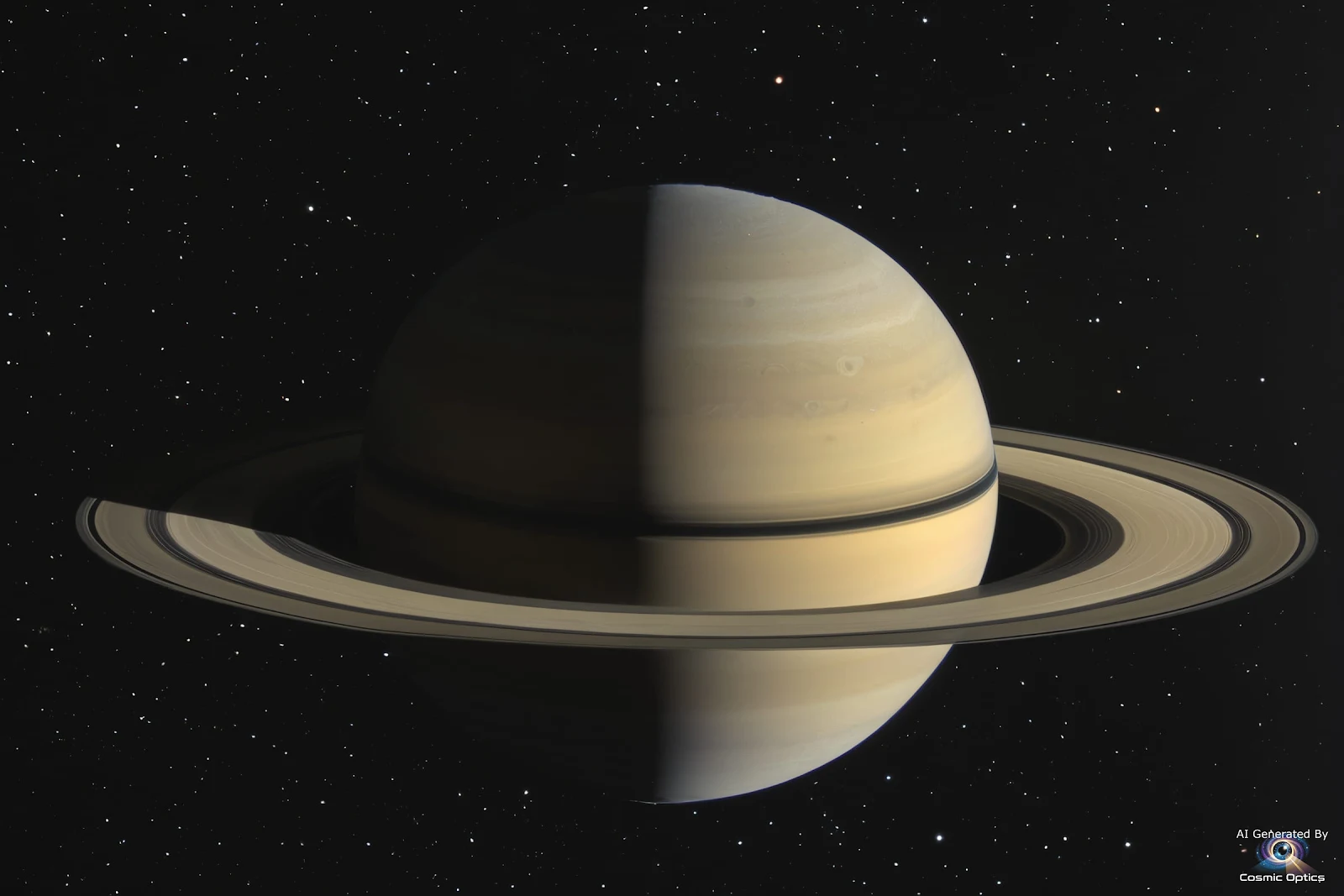
Journey with us to the outer reaches of our solar system, to a world of unparalleled beauty and profound mystery. There, suspended in the cosmic void, hangs a celestial titan adorned with a halo of shimmering light: Saturn. Often hailed as the "Jewel of the Solar System," its iconic ring system has captivated humanity for centuries, inspiring awe and wonder in every glance, whether through a humble backyard telescope or the sophisticated eyes of interplanetary probes. It is a world that continuously challenges our understanding of planetary formation and evolution, beckoning us to delve deeper into its enigmatic embrace.
At the heart of Saturn's allure are its magnificent rings. Not solid structures, but an intricate cosmic dance of countless ice particles and rocky fragments, ranging in size from mere dust grains to small mountains. Spanning hundreds of thousands of kilometers across, these rings would stretch from the Earth to the Moon if laid out, yet they are incredibly thin – in most places, no more than ten meters from top to bottom. This astonishing disparity in scale makes them seem impossibly delicate, like a cosmic silk scarf draped around the planet's equator. From Earth, we distinguish several main groups, designated A, B, and C, separated by gaps such as the prominent Cassini Division, each a testament to the complex gravitational interplay within the system. Scientists continue to unravel the precise mechanisms that maintain such an intricate and dynamic structure, pondering whether they are remnants of a shattered moon or the icy debris of comets torn apart by Saturn's immense gravity.
Beneath this spectacular celestial adornment lies Saturn itself, a colossal gas giant, the second largest planet in our solar system after Jupiter. Composed primarily of hydrogen and helium, it lacks a solid surface as we know it. Instead, its atmosphere gradually thickens and condenses into liquid layers under immense pressure. Its average density is so low that, remarkably, if you could find a bathtub large enough, Saturn would float on water! This colossal world spins incredibly fast, completing a rotation in just over ten and a half Earth hours, a speed that causes it to noticeably bulge at its equator and flatten at its poles, a subtle but significant departure from a perfect sphere. Its turbulent atmosphere is a realm of perpetual motion, featuring ferocious winds that can reach speeds of 1,800 kilometers per hour, alongside enduring storm systems, including the famous hexagonal cloud pattern at its north pole – a bizarre, six-sided atmospheric vortex unlike anything seen elsewhere in the solar system.
But Saturn is not alone in its grand cosmic ballet. It is attended by a retinue of moons, more than 145 confirmed to date, each a world unto itself with its own unique characteristics and stories. Among them, Titan stands out as a true marvel. Larger than the planet Mercury, Titan is the only moon in our solar system known to possess a dense, hazy atmosphere, rich in nitrogen, reminiscent of early Earth. Beneath this orange shroud, the Cassini-Huygens mission revealed a landscape sculpted by liquid methane and ethane, with vast lakes, rivers, and even rainfall creating an exotic hydrological cycle. The prospect of unique, non-water-based life forms existing in Titan's frigid environment fuels intense scientific curiosity and ongoing research.
Equally compelling is Enceladus, a smaller, icy moon that has emerged as one of the most promising candidates for extraterrestrial life within our solar system. Observations by Cassini revealed active geysers erupting from its south polar region, spewing plumes of water vapor and ice particles into space. These geysers are evidence of a vast, salty subsurface ocean warmed by hydrothermal vents on its seafloor, a combination of conditions remarkably similar to those believed to have fostered life on early Earth. The discovery of complex organic molecules within these plumes further tantalizes scientists, making Enceladus a prime target for future missions focused on astrobiology. Other moons, like Mimas with its striking "Death Star" crater, and Iapetus, a two-toned enigma with a mysterious equatorial ridge, add further layers of fascination to this sprawling satellite system.
Our understanding of Saturn and its entourage has been profoundly shaped by intrepid robotic explorers. Missions like Pioneer 11 and the Voyager probes offered humanity its first close-up glimpses, revolutionizing our perspective on this distant realm. However, it was the Cassini-Huygens mission, a joint endeavor by NASA, ESA, and ASI, that truly unveiled the intricate secrets of the Saturnian system. Orbiting Saturn for over 13 years, from 2004 to 2017, Cassini provided an unprecedented wealth of data, imagery, and groundbreaking discoveries. It meticulously mapped the rings, delved into the complexities of Saturn's atmosphere, and revolutionized our understanding of Titan and Enceladus, culminating in its dramatic "Grand Finale," a controlled plunge into Saturn's atmosphere to protect its potentially habitable moons from contamination.
Saturn is more than just a distant gas giant; it is a magnificent testament to the boundless wonders of the cosmos. Its rings offer a natural laboratory for studying the fundamental processes of gravitational dynamics and planetary formation. Its diverse moons, especially Titan and Enceladus, challenge our preconceptions about where and how life might arise, expanding the horizons of astrobiological exploration. Each image, each data point, each new discovery from this distant world deepens our cosmic perspective and fuels our innate drive to explore. Saturn stands as a radiant beacon, inviting us to ponder the universe's grand design and inspiring future generations to continue the extraordinary quest for knowledge among the stars.