
The High Speed Elongated Dwarf Planet Haumea and the Secrets of the Kuiper Belt
Venturing deep into the frozen reaches of our solar system, far beyond the orbit of Neptune, lies a realm of shadow and ice known as the Kuiper Belt. While most people are familiar with the iconic profile of Pluto, the outer frontier is home to a collection of celestial bodies that are arguably even more bizarre and captivating. Among these stands Haumea, a dwarf planet that defies our traditional expectations of planetary physics. It is a world defined by extreme speed, a peculiar elongated shape, and a violent history that has left its mark across the entire trans-Neptunian region. Haumea is not merely a frozen rock; it is a dynamic relic of the early solar system’s chaotic formation.
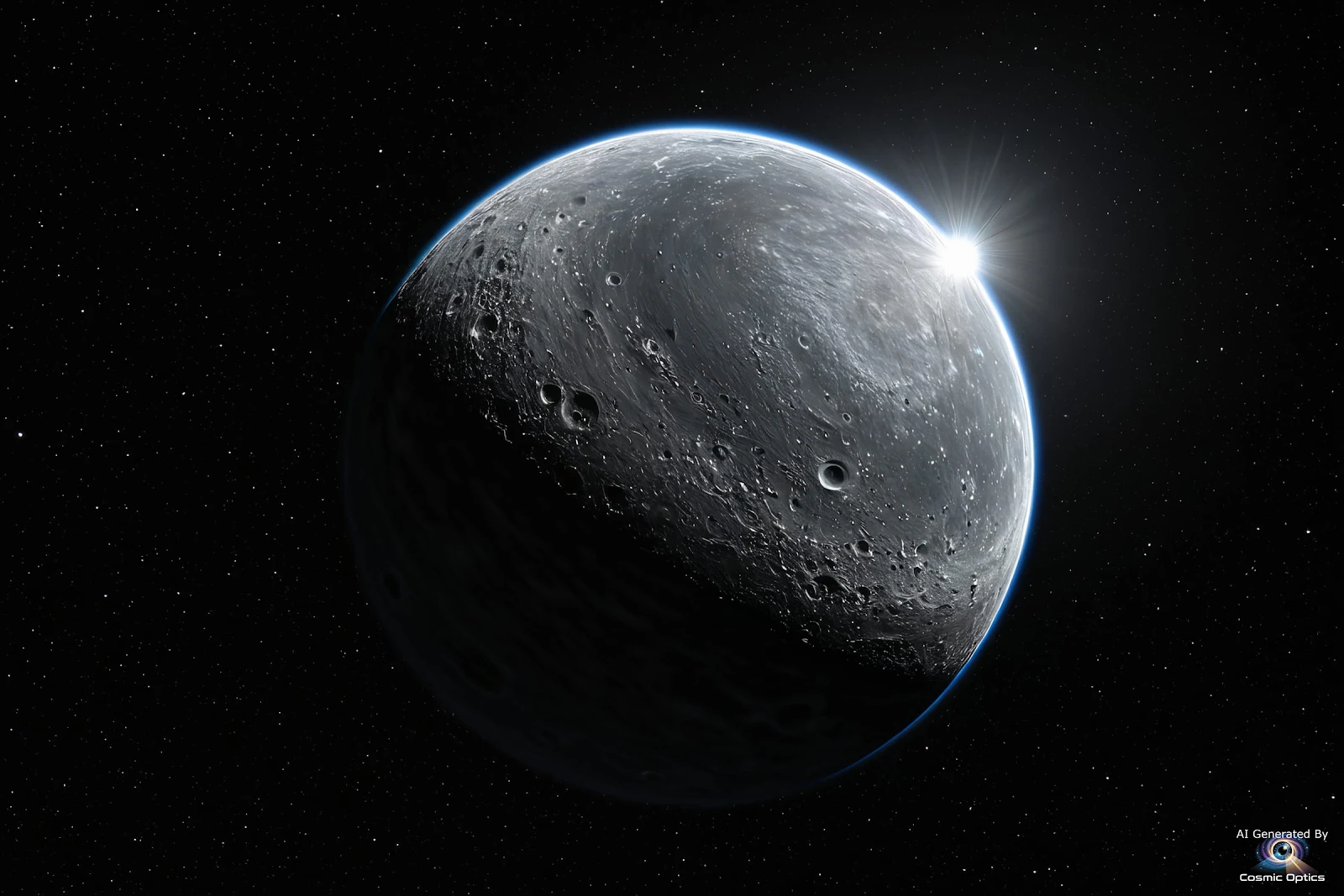
An authentic, photorealistic astronomical photograph of the dwarf planet Haumea floating in the abso_00049
One of the most striking characteristics of Haumea is its dizzying rotational speed. It completes a full rotation on its axis in just under four hours. This makes it the fastest-rotating large object in our solar system. If you were standing on its surface, the sun would appear to race across the sky at an incredible pace. This rapid spin is not just a statistical curiosity; it is the primary force that dictates Haumea’s physical form. While most planets and dwarf planets are roughly spherical due to the pull of their own gravity, Haumea’s centripetal forces are so powerful that they have stretched the planet into a triaxial ellipsoid. Often compared to a rugby ball or a cigar, Haumea is roughly twice as long as it is wide, making it one of the most uniquely shaped objects in our cosmic neighborhood.
The origins of this extreme rotation and unusual shape point toward a dramatic past. Planetary scientists believe that billions of years ago, Haumea was involved in a massive collision with another large object. This impact would have been catastrophic, spinning Haumea up to its current velocity and stripping away a significant portion of its outer layers. This theory is supported by the existence of the "Haumean collisional family." Researchers have identified a group of smaller icy bodies in similar orbits that share the same unique spectral signature as Haumea. These objects are essentially the "shards" of the original planet, blasted into space during that ancient encounter. This makes Haumea the only dwarf planet known to have a recognized family of related fragments, providing a rare window into the collisional history of the outer solar system.
Despite its distance from the sun—roughly 43 times further away than Earth—Haumea is remarkably bright. Its surface is coated in a layer of nearly pure water ice. What is particularly fascinating to astronomers is that much of this ice is crystalline rather than amorphous. In the extreme cold of the Kuiper Belt, ice usually exists in a disordered, amorphous state because there isn't enough thermal energy to organize molecules into a crystal lattice. The presence of crystalline ice on Haumea suggests that some internal heat source or constant resurfacing mechanism is at work. Whether this is driven by the decay of radioactive elements or tidal forces from its moons, the shimmering white brilliance of Haumea makes it a jewel in the dark expanse of the outer belt.
Haumea is not a solitary traveler; it is accompanied by two distinct moons, Hiʻiaka and Namaka. These satellites were named after the daughters of the Hawaiian goddess Haumea, and they add another layer of complexity to the system. Hiʻiaka, the larger and outer moon, has a surface of pure water ice, further supporting the theory that it formed from the debris of the original collision. Namaka, the inner moon, follows a more perturbed orbit, likely influenced by the gravity of its larger sibling. The interaction between these moons and Haumea itself provides vital data for scientists trying to calculate the dwarf planet’s mass and density, helping us understand what lies beneath its icy crust.
In 2017, astronomers made a discovery that elevated Haumea’s status even further: it has a ring. By observing Haumea as it passed in front of a distant star—an event known as an occultation—researchers noticed the star’s light flickering just before and after the dwarf planet moved into view. This revealed a narrow, dense ring approximately 70 kilometers wide orbiting the planet’s equator. This was a groundbreaking revelation, as rings were previously thought to be the exclusive domain of giant planets like Saturn or small, specific bodies like the centaur Chariklo. The presence of a ring around Haumea suggests that such features may be far more common in the deep solar system than we ever dared to imagine.
Studying Haumea is a challenge due to its immense distance, but every new piece of data gathered by ground-based telescopes and space observatories paints a picture of a world that is vibrant and full of surprises. It challenges our definitions of what a planet should look like and how it should behave. Haumea stands as a testament to the resilience and complexity of planetary bodies, proving that even in the coldest, darkest corners of our solar system, the laws of physics are busy sculpting wonders that are as beautiful as they are bizarre. As our technology advances, we may one day send a robotic explorer to these distant reaches, finally getting a close-up view of the high-speed, elongated world that continues to fascinate the scientific community.


