
The Profound Silence of Space: Unveiling the Universe's Unspoken Symphony
Imagine floating freely amongst the stars, the Earth a distant blue marble, and the sun a brilliant, unwavering beacon. What would you hear? The answer, for anyone truly immersed in the vastness beyond our atmosphere, is profoundly, absolutely nothing. Space, in its truest, most encompassing sense, is a realm of absolute silence. It’s a concept that might initially feel counterintuitive, given the explosive power of supernovae or the gravitational ballet of galaxies, but it’s a fundamental truth dictated by the laws of physics that govern our universe.
The reason for this profound quietude lies in the very nature of sound. Sound, as we perceive it, is a mechanical wave – a vibration that travels through a medium, such as air, water, or solid matter. These vibrations push and pull the particles of the medium, transmitting energy from one point to another. In the near-perfect vacuum of space, however, there are virtually no particles to transmit these vibrations. The density of matter is so incredibly low that sound waves simply have no medium to propagate through. A cosmic explosion, no matter how powerful, would unleash light and other forms of radiation, but its thunderous roar would forever remain unheard by any ear.
Yet, to mistake this auditory silence for inactivity would be a grave oversight. While our ears are rendered useless, the cosmos is a vibrant, dynamic arena, constantly broadcasting an incredible symphony of information through other channels. The universe communicates not through sound, but through the universal language of electromagnetic radiation. This grand spectrum includes everything from visible light, which paints our skies with the ethereal glow of nebulae and the distant twinkle of stars, to radio waves, microwaves, infrared, ultraviolet, X-rays, and gamma rays. Each of these wavelengths carries a unique story, a silent whisper from the farthest reaches of time and space, revealing the birth of stars, the violent deaths of galaxies, and the mysterious dance of black holes.
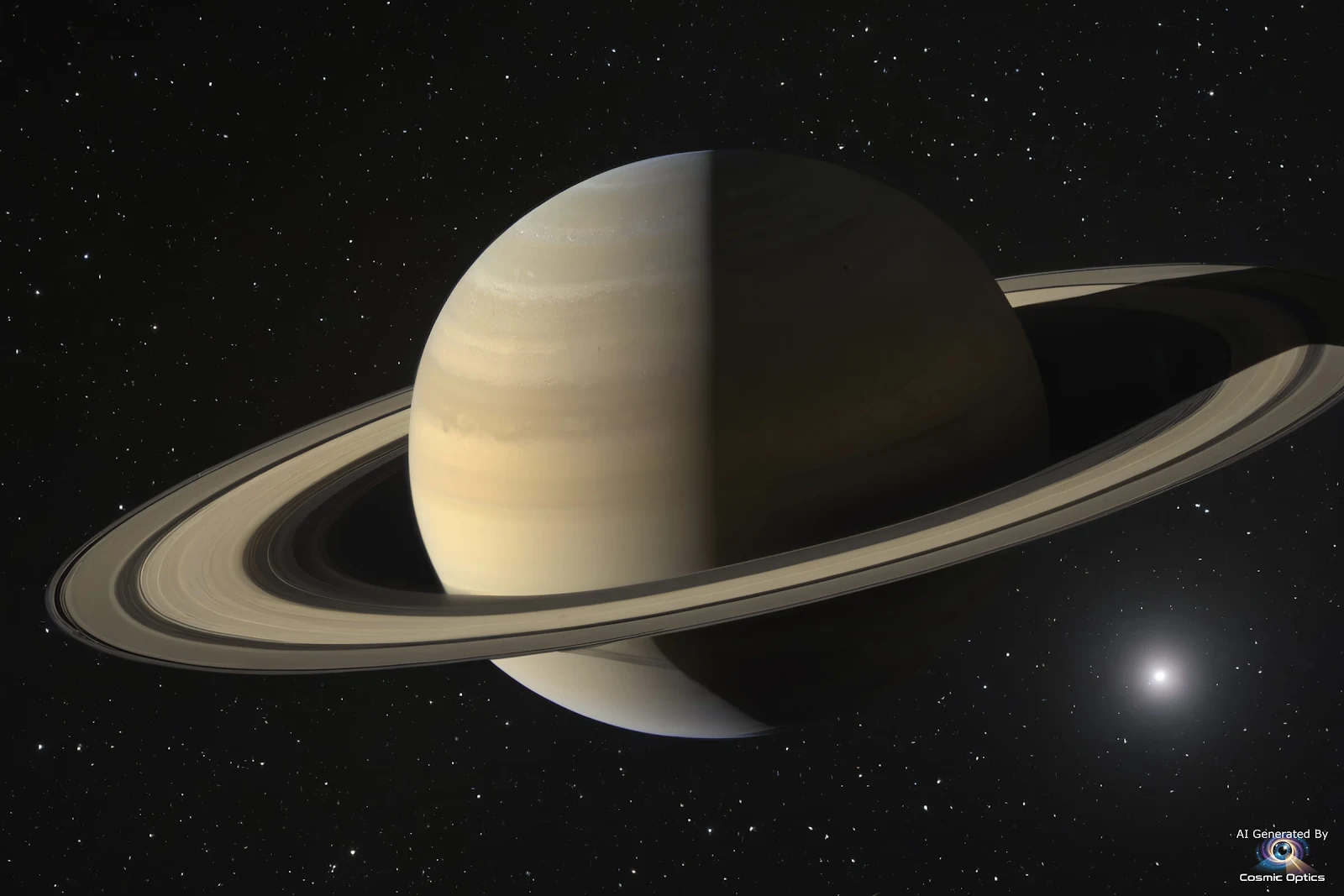
Consider the image before you – a breathtaking glimpse of a gas giant, majestically orbiting in the cosmic void. We see its swirling clouds, its iconic rings, illuminated by the distant sun. This visual spectacle is a testament to the electromagnetic spectrum's visible light component. But beyond what our eyes can perceive, there are countless other silent signals. Radio telescopes on Earth might capture radio emissions from its magnetic field, revealing insights into its internal dynamics and interaction with the solar wind. Infrared sensors could detect the warmth emanating from its depths, mapping its atmospheric temperatures. Even X-ray observatories might pick up faint emissions caused by energetic particles interacting with its upper atmosphere. These are not sounds, but they are energetic phenomena that we translate into data, allowing us to "listen" to the universe with entirely different senses.
Moreover, space isn't entirely devoid of *any* kind of wave or particle interaction that, under different circumstances, might produce sound. Plasma waves, for instance, generated by the interactions between charged particles and magnetic fields, are abundant in the solar wind and planetary magnetospheres. While these aren't traditional sound waves, instruments on spacecraft like Voyager have recorded the fluctuating electric and magnetic fields of these plasma waves and converted them into audible frequencies for human understanding. These "sounds" are not what you would hear if you were there, but rather a fascinating translation, giving us a unique auditory window into the invisible, energetic processes at play.
Then there are the truly profound vibrations of spacetime itself: gravitational waves. These ripples, predicted by Einstein over a century ago and directly detected only recently, are generated by the most cataclysmic events in the universe – colliding black holes, merging neutron stars, or exploding supernovae. Gravitational waves travel at the speed of light, carrying immense energy, yet they are an entirely different breed from sound. They don't require a medium; they are distortions in the very fabric of reality. Their detection marks a revolutionary new way to "hear" the universe, allowing us to perceive events that are otherwise utterly silent and invisible, providing an unprecedented view into the universe's most violent cosmic ballet.
The paradox of space's silence is that it intensifies its grandeur. Without the distractions of ambient noise, our focus is drawn to the visual splendor, the intricate details, and the sheer scale of cosmic phenomena. The silence becomes a canvas upon which the universe paints its most magnificent masterpieces, compelling us to observe, to analyze, and to ponder the profound mysteries it holds. It forces us to develop ingenious ways to perceive and interpret its non-auditory signals, pushing the boundaries of technology and human ingenuity.
From the earliest astronomers who gazed skyward, translating the dance of planets into predictive models, to modern astrophysicists who decode the faint echoes of the Big Bang through microwave radiation, humanity has continuously striven to comprehend this silent realm. Our telescopes, both terrestrial and orbital, are not just eyes but also sophisticated ears, picking up frequencies far beyond our natural capabilities and transforming them into understandable data. The journey to understand the universe is an ongoing testament to human curiosity – a relentless quest to 'listen' to the silent stories written across the stars.
So, the next time you gaze up at the night sky, remember that while it appears tranquil and still, it is a realm of incredible energy and dynamic processes, all unfolding in profound, breathtaking silence. It's a silence that isn't empty, but full – full of light, radiation, particles, and the very fabric of spacetime vibrating with the echoes of creation and destruction. It’s a reminder that sometimes, the most powerful truths are whispered without a sound.


