
The Red Planet: A Scientific Mirror Reflecting Earth’s Past and Our Future Horizons
Mars has long served as a mirror to humanity’s most profound curiosities. For centuries, this crimson orb has beckoned to us from the velvet expanse of the night sky, a solitary wanderer that represents both our past and our potential future. To look at Mars is to look at a world that, at one point in the deep history of our solar system, might have been a twin to Earth. Today, however, it remains a frozen desert, a place of extreme geological violence and hauntingly beautiful stillness. The more we learn about the Red Planet, the more we realize that its story is inextricably linked to our own understanding of life’s place in the universe. It is a world of incredible extremes, where the geography is gargantuan and the history is written in the very dust that covers its plains.
The striking hue of the Martian surface, which earns it its evocative nickname, is the result of iron oxide—essentially rust—permeating the planet's regolith. This fine, powdery dust covers almost the entire surface, creating a monochromatic landscape that is frequently whipped into planet-wide storms by the thin, carbon dioxide-rich atmosphere. These storms are not merely local weather events; they can escalate into global phenomena, obscuring the entire planet for months and providing a stark reminder of the dynamic, often hostile nature of the environment. Despite this, there is a profound sense of majesty in the Martian landscape, a terrain that features some of the most spectacular geographical landmarks ever discovered by human science, each one telling a story of a world that was once far more active than it appears today.
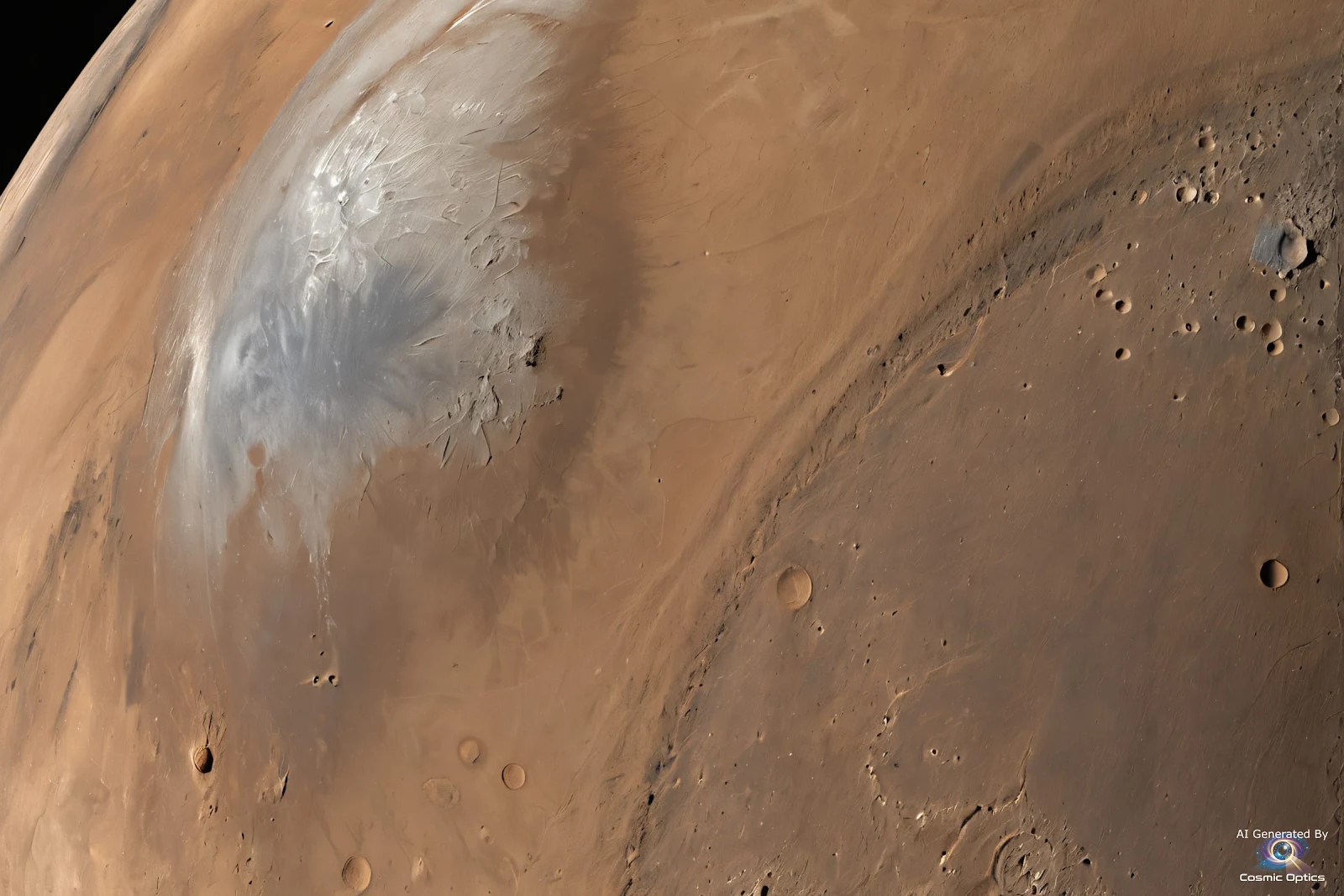
The scientific allure of Mars lies in its accessibility and its secrets. Unlike the gas giants of the outer solar system or the scorched, high-pressure surface of Venus, Mars offers a solid, reachable surface where we can trace the history of our cosmic neighborhood. The planet’s diameter is roughly half that of Earth, and its mass is only about ten percent of our own, resulting in a gravity that is approximately 38 percent of Earth’s. This lower gravity has profound implications for everything from the height of its mountains to the potential physiology of future human settlers. It is a world where an explorer could jump significantly higher and carry heavier loads, yet it is also a world that lacks the protective magnetic field and thick atmosphere that make life on Earth so effortless and secure.
One cannot discuss the geography of Mars without marveling at the sheer scale of its features, most notably Olympus Mons. This massive shield volcano stands as a monumental testament to the planet’s volcanic past. Towering nearly three times the height of Mount Everest, it is the largest volcano in the entire solar system. Its base is so vast that it would cover an area roughly the size of the state of Arizona. Because Mars lacks the tectonic plate movement found on Earth, volcanic hotspots remained fixed under the same spot on the crust for millions of years, allowing Olympus Mons to grow to its current, gargantuan proportions. It is a silent giant, a relic of an era when the planet’s interior was molten and active, shaping the surface through sheer thermal force and creating a silhouette that is visible even from the furthest reaches of Martian orbit.
Equally impressive is the Valles Marineris, a canyon system that dwarfs Earth’s Grand Canyon in every conceivable metric. Stretching over 4,000 kilometers—roughly the width of the United States—and reaching depths of up to seven kilometers, this vast gash in the Martian crust offers a window into the planet’s tectonic and erosional history. Scientists believe that Valles Marineris was formed by the crust pulling apart as the planet cooled, a process likely influenced by the weight of the nearby Tharsis volcanic plateau. The sheer scale of these features challenges our earthly perspectives on geology, reminding us that Mars is a world where nature operates on a scale far grander than our own, carving landscapes that are as terrifying as they are beautiful.
The search for liquid water remains the central pillar of Martian exploration and the primary driver of our scientific missions. While the surface today is too cold and the atmospheric pressure too low for liquid water to exist stably, the evidence of its historical presence is written into the very stone of the planet. We see ancient riverbeds, sprawling deltas, and vast floodplains carved by torrents of water that once flowed freely across the surface billions of years ago. Missions like the Curiosity and Perseverance rovers have confirmed the presence of minerals that only form in the presence of water, such as clays and sulfates. These discoveries suggest that ancient Mars was once a much warmer, wetter world—a world that might have possessed the necessary conditions to support microbial life before its atmosphere began to leak into space.
Modern exploration has shifted its focus from simply finding water to finding evidence of past habitability and "biosignatures"—chemical traces that indicate life once thrived in the Martian soil. The Jezero Crater, where the Perseverance rover is currently operating, was once the site of a flourishing lake and river delta. By collecting rock cores from this site for future return to Earth, humanity is on the threshold of potentially answering one of the most fundamental questions of existence: are we alone? The prospect of finding even the simplest fossilized bacteria on Mars would revolutionize our understanding of biology, suggesting that life is a natural consequence of the right chemical conditions throughout the cosmos rather than a freak occurrence unique to our home world. It would transform our understanding of our place in the universe and ignite a new era of biological research.
The atmosphere of Mars, though thin, is a complex system that continues to surprise researchers with its seasonal dynamics. Composed mostly of carbon dioxide, it creates a weak greenhouse effect, though not enough to prevent temperatures from plummeting to -125 degrees Celsius during the polar winters. The polar ice caps, made of both water ice and frozen carbon dioxide, or "dry ice," expand and contract with the seasons. During the summer, the dry ice sublimates directly into gas, causing massive shifts in atmospheric pressure and driving the fierce winds that sculpt the dunes across the plains. This seasonal cycle gives the planet a "pulse," a rhythmic change that hints at a world that is still very much alive in a meteorological sense, constantly reshaping its surface through wind, frost, and the subtle dance of gas and ice.
Looking forward, the prospect of human footprints on the Martian dust is no longer the stuff of pure science fiction; it is an impending reality. Organizations like NASA and various private aerospace companies are working tirelessly to overcome the immense hurdles of long-duration space travel, radiation protection, and life support systems. A mission to Mars would be the greatest technical achievement in human history, requiring a journey of months through deep space followed by a harrowing descent through the thin atmosphere. The goal is not just to visit, but to establish a sustainable presence. Mars could serve as a second home for humanity, a backup for our civilization, and a primary base for further exploration of the outer solar system, forcing us to master the art of living off the land in an alien environment.
The challenges are formidable, but the rewards of reaching the Red Planet are incalculable. Mars forces us to innovate, to think beyond our terrestrial boundaries, and to collaborate as a global species. Each rover landing, each high-resolution image, and each atmospheric sample brings us closer to understanding this mysterious world. As we gaze upon the high-definition vistas provided by our mechanical emissaries, we are reminded that Mars is more than a destination; it is a mirror reflecting our own ingenuity, our curiosity, and our unyielding desire to explore the unknown. It stands as a testament to what we can achieve when we look upward and dare to dream of worlds beyond our own, ultimately proving that the human spirit is as vast and resilient as the space it seeks to conquer.


