
The Secrets of Europa and the Search for Life in Jupiter's Hidden Oceans
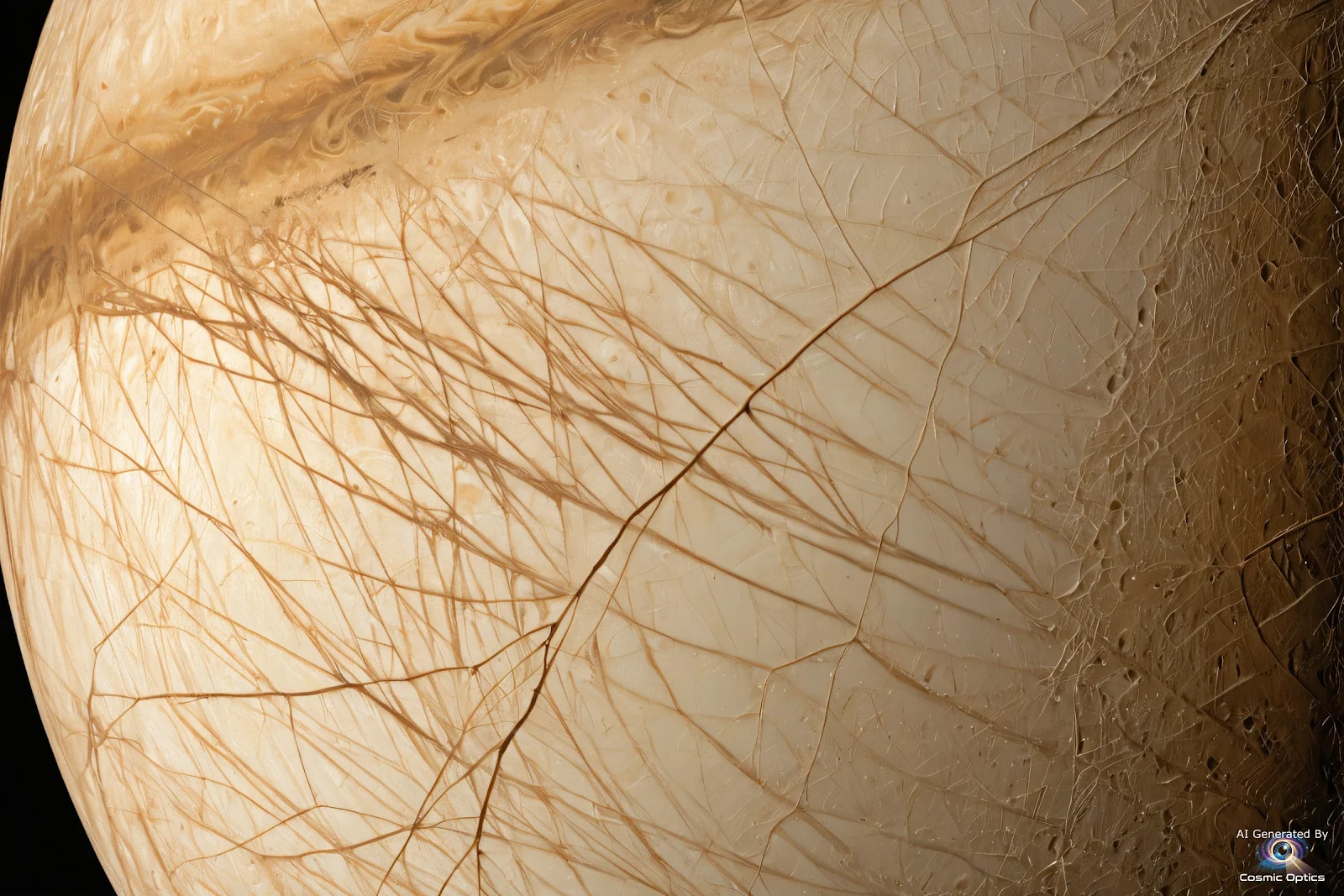
The Jovian system serves as a miniature solar system in its own right, a complex celestial dance where dozens of moons orbit the most massive planet in our local neighborhood. Among these satellites, one stands out not for its size or its volcanic fury, but for its quiet, icy potential to rewrite the history of biology. Europa, the smallest of the four Galilean moons, is a world of stark contrasts and profound mysteries. While its surface is a frozen wasteland of water ice, crisscrossed by strange reddish streaks and fractured ridges, what lies beneath that shell makes it one of the most compelling targets in the search for extraterrestrial life.
For decades, astronomers have been captivated by Europa’s remarkably smooth appearance. Unlike our own Moon or the neighboring Callisto, Europa is almost entirely devoid of impact craters. In the violent environment of the outer solar system, where cosmic debris is common, such a pristine surface suggests a world that is geologically "young" and constantly renewing itself. This resurfacing is the first clue to a dynamic interior. The crisscrossing lines, known as lineae, are vast fractures in the ice, some stretching for thousands of kilometers. They suggest that the moon’s icy crust is floating on something much more fluid, moving and cracking under the immense gravitational influence of Jupiter.
The primary driver of Europa’s internal activity is a process known as tidal heating. As Europa orbits Jupiter in an eccentric path, the planet’s colossal gravity stretches and compresses the moon. This constant mechanical flexing generates friction within Europa’s core and mantle, producing heat. This is the same principle that powers the extreme volcanism on Io, but in Europa’s case, the heat is just enough to maintain a massive subsurface ocean of liquid water. Scientists estimate that this hidden sea could be up to 100 kilometers deep, containing more than twice the amount of water found in all of Earth’s oceans combined. The prospect of a vast, dark, salty ocean existing hundreds of millions of miles from the Sun challenges our traditional definition of a "habitable zone."
What makes Europa truly extraordinary, however, is not just the presence of water, but the potential for the chemical ingredients necessary for life. On Earth, life thrives around hydrothermal vents on the dark seafloor, far from the reach of sunlight. These ecosystems rely on chemical energy from the planet’s interior rather than photosynthesis. If Europa’s ocean is in direct contact with its rocky mantle—which evidence suggests it is—then the same type of hydrothermal activity could be occurring there. These vents could provide the essential building blocks—carbon, nitrogen, phosphorus, and sulfur—alongside a steady source of energy to power biological processes.
The chemistry of the surface also plays a vital role. Jupiter’s intense radiation belt constantly peppers Europa’s icy exterior with high-energy particles. While this radiation is lethal to known life, it actually performs a useful service by breaking down water molecules and other chemicals on the surface to create oxygen and oxidants. If these materials are transported downward through the cracks in the ice via a process similar to plate tectonics, they could "fuel" the ocean below. This cycle would create a chemical battery, providing the necessary oxidation-reduction reactions that life as we know it requires to survive.
In the coming years, our understanding of this icy world is set to expand exponentially. Missions like NASA’s Europa Clipper and the European Space Agency’s JUICE (JUpiter ICy moons Explorer) are designed to peer through the ice using sophisticated radar and spectrometers. These spacecraft will not land, but they will perform dozens of close flybys, mapping the composition of the surface and measuring the thickness of the ice shell. They will look for plumes of water vapor venting into space—a phenomenon previously hinted at by the Hubble Space Telescope—which could allow us to sample the ocean's chemistry without even touching the ground.
The exploration of Europa represents a shift in the human perspective. For centuries, we looked at the stars and wondered if other suns had planets. Now, we know they do, and we are looking closer to home at the moons of giant planets, realizing that the "Goldilocks" conditions for life might be more common than we ever dared to imagine. Europa is a beacon for astrobiology, a testament to the idea that where there is water and energy, there is hope for discovery. Whether Europa is a silent, sterile ice ball or a world teeming with microbial life remains one of the greatest unanswered questions of modern science.
As we stand on the precipice of these new missions, the anticipation within the scientific community is palpable. Europa reminds us that the universe is often more creative than we are. It is a world where the oceans are hidden, where the heat comes from gravity rather than light, and where the next great chapter in our understanding of life may be written in the dark, pressurized depths of a moon five hundred million miles away. The study of this icy enigma is more than just a search for life; it is a search for our place in a vast, diverse, and surprisingly watery cosmos.


