
Titan: Saturn’s Enigmatic Moon Where Methane Rains and Alien Life Might Thrive
Deep within the outer reaches of our solar system, orbiting the ringed giant Saturn, lies a world so enigmatic and complex that it challenges our very understanding of planetary science. This is Titan, a celestial body that stands as a hauntingly beautiful mirror to our own Earth, yet operates under a chemistry so alien that it feels like a fever dream of a science fiction author. While most moons in our neighborhood are airless, cratered rocks frozen in time, Titan is a dynamic, living world with a thick atmosphere, weather patterns, and standing bodies of liquid on its surface.
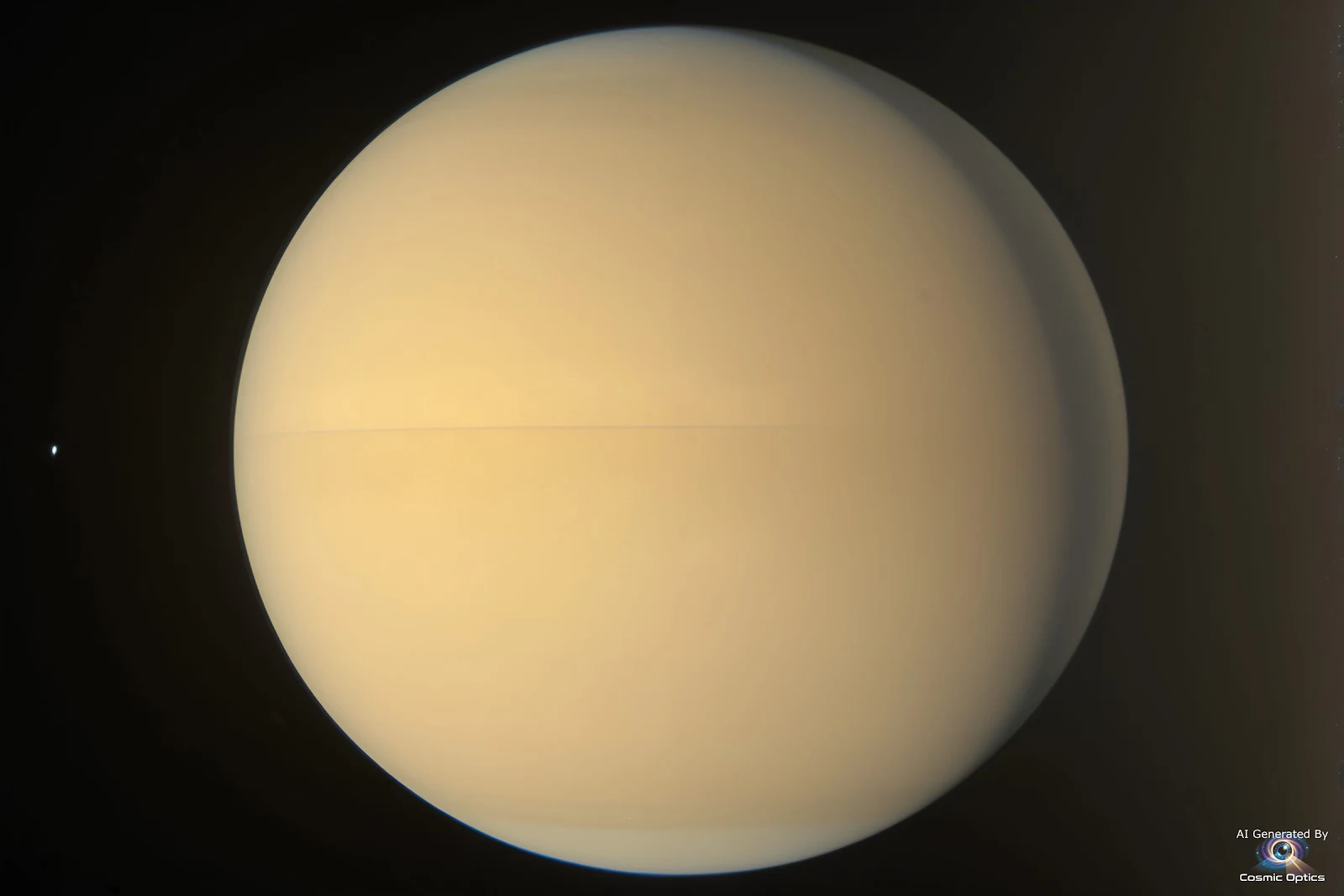
An authentic, photorealistic astronomical photograph of Saturn's largest moon Titan in deep space. T_00011
The first thing that strikes any observer of Titan is its distinctive orange hue. This isn't merely a surface color; it is the result of a dense, nitrogen-rich atmosphere—the only substantial atmosphere on any moon in the solar system. This golden shroud is roughly 95% nitrogen and 5% methane, creating a surface pressure about 50% higher than Earth's. However, the true magic happens in the upper layers of this atmosphere. High-altitude solar radiation and high-energy particles from Saturn's magnetosphere break apart methane and nitrogen molecules, triggering a cascade of complex chemical reactions. These reactions form "tholins"—organic aerosols that rain down upon the surface, coating the moon in a rich, organic soot that scientists believe may resemble the prebiotic chemistry of a young Earth before life took hold.
To walk on the surface of Titan—if one could endure the bone-chilling temperature of minus 290 degrees Fahrenheit—would be to witness a landscape both familiar and utterly bizarre. Thanks to data from the Cassini-Huygens mission, we know that Titan possesses a full "hydrological" cycle, though water plays no part in its liquid form. At these temperatures, water ice is as hard as granite, forming the very bedrock of the moon. Instead, the "water" of Titan is liquid methane and ethane. This moon is the only other place in the known universe where we have found stable bodies of liquid on the surface. There are vast northern seas like Kraken Mare and Ligeia Mare, fed by rivers that carve intricate drainage patterns through the icy crust. There are clouds that drift through the hazy sky, occasionally releasing torrential downpours of liquid methane that replenish the lakes and carve the landscape over geological epochs.
Beyond the surface liquids, Titan’s topography is a masterclass in planetary diversity. Vast equatorial dune fields, composed not of silicate sand but of dark organic grains, stretch for hundreds of miles, shaped by the moon’s sluggish but persistent winds. There are mountains and valleys, and even evidence of cryovolcanoes—ice volcanoes that erupt with a slushy mixture of water, ammonia, and methane rather than molten rock. This geological activity suggests that Titan is far from a dead world; it is internally active, possessing a heat source that likely keeps a deep, subsurface ocean of liquid water and ammonia from freezing solid.
The existence of this subsurface ocean elevates Titan from a geological curiosity to a primary target in the search for extraterrestrial life. Astrobiologists are captivated by the "double-layered" potential of this moon. On one hand, you have the liquid methane lakes on the surface, which could theoretically host life using a completely different chemistry than our own—perhaps utilizing hydrocarbons as a solvent instead of water. On the other hand, deep beneath the icy crust lies a warm, salty ocean that could provide a habitat for life more akin to the organisms found in Earth’s deep-sea hydrothermal vents. The presence of complex organic molecules—the building blocks of life—swirling in the atmosphere and resting on the surface makes Titan a massive natural laboratory for the study of the origins of life.
Our understanding of this world was fundamentally transformed in 2005 when the Huygens probe, a masterpiece of human engineering, detached from the Cassini spacecraft and descended through Titan’s thick haze. As it drifted down, it captured images of drainage channels that looked remarkably like Earth's coastlines. Upon landing, it sent back a photograph of a flat plain littered with rounded cobbles of water ice, smoothed by the flow of liquid hydrocarbons just as pebbles in a terrestrial stream are smoothed by water. It was a groundbreaking moment that confirmed Titan as a world of active, erosion-based geology.
Looking forward, the next great frontier in Titan exploration is the Dragonfly mission. Scheduled to launch in the late 2020s, this revolutionary rotorcraft lander will take advantage of Titan’s dense atmosphere and low gravity—where flight is much easier than on Earth—to hop from one location to another. Dragonfly will travel tens of miles across the surface, sampling various environments to investigate the moon's habitability and search for chemical signatures that could indicate the presence of past or current life. By visiting different sites, from the dunes to the floor of an impact crater where liquid water and organics may have mixed for thousands of years, Dragonfly aims to answer the fundamental question of whether the chemistry of life is a universal constant.
Titan remains a beacon of wonder in the dark of the outer solar system. It reminds us that the "Goldilocks Zone" is not the only place where interesting things happen. It is a world where the sky is orange, the rain is fuel, the rocks are made of ice, and the potential for discovery is infinite. As we continue to peel back the layers of its thick atmosphere, we aren't just looking at a moon; we are looking at a window into our own past, and perhaps, a glimpse into a very different kind of future. The study of Titan is more than just astronomy; it is an exploration of the possibilities of the universe itself, proving that nature’s imagination far exceeds our own.


