
Titan: Saturn's Golden Moon and the Frozen Mirror of Early Earth
Deep within the outer reaches of our solar system, nestled among the ringed majesty of Saturn, lies a world so alien yet so strangely familiar that it has captivated the imagination of astronomers for centuries. This is Titan, the largest moon of Saturn and a celestial body that stands as one of the most complex and intriguing environments ever discovered. Shrouded in a thick, golden haze, Titan is far more than just a moon; it is a planetary-scale laboratory that offers a window into the prebiotic chemistry of a young Earth, albeit frozen in a deep, hydrocarbon-rich chill.
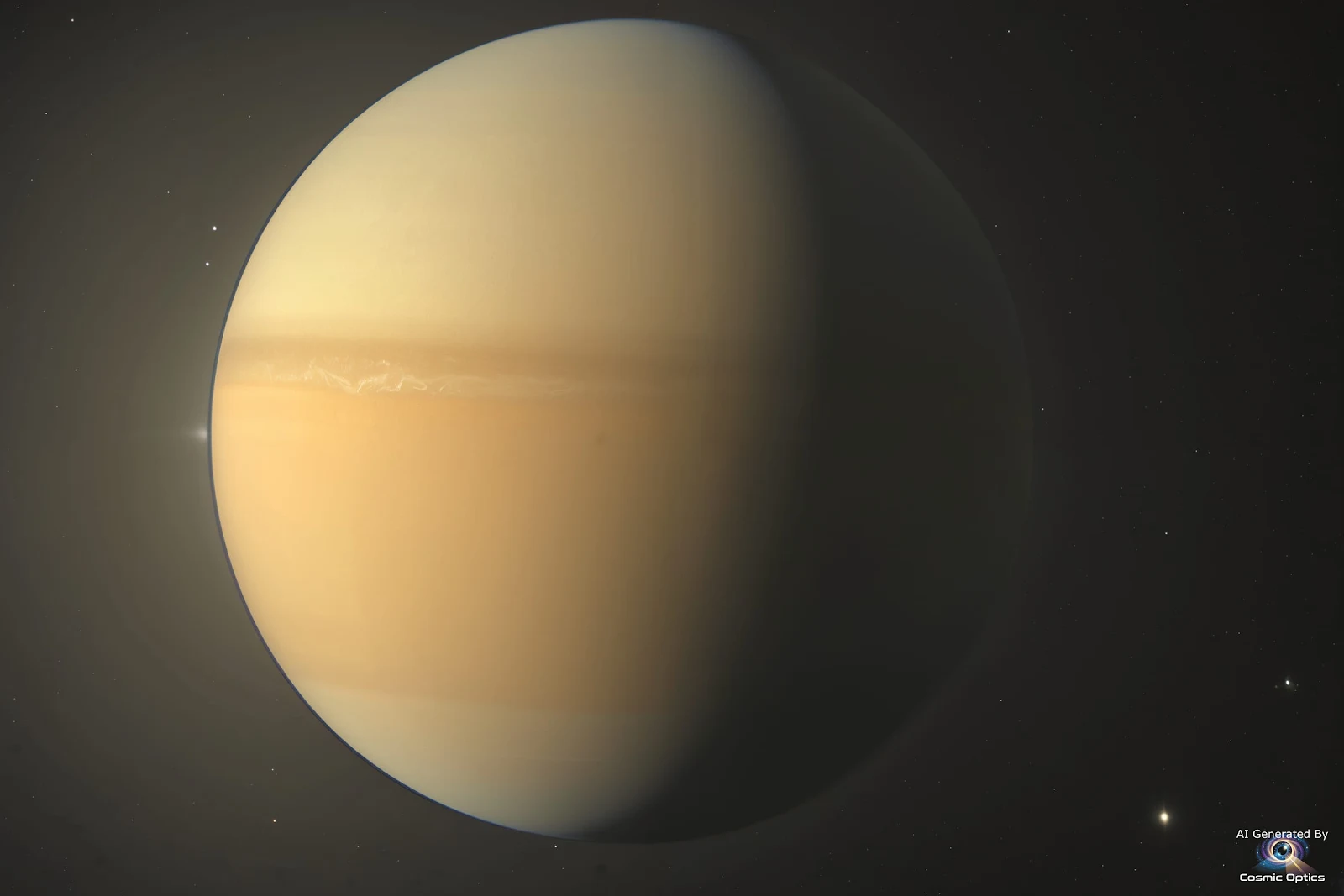
An authentic, photorealistic astronomical photograph of Saturn's largest moon Titan in deep space. T_00008
What sets Titan apart from every other moon in our solar system is its substantial atmosphere. While most moons are airless, crater-scarred husks of rock and ice, Titan boasts an atmospheric pressure about 50 percent higher than that of Earth. This dense shroud is composed primarily of nitrogen, much like our own air, but it is laced with methane and other organic compounds that create a complex smog. This orange veil was so impenetrable that for decades, the surface of Titan remained a total mystery, hidden from the prying eyes of the most powerful telescopes. It wasn't until the arrival of the Cassini-Huygens mission that we finally pulled back the curtain on this extraordinary world.
The revelation of Titan’s surface was nothing short of revolutionary. Instead of a desolate wasteland, scientists discovered a landscape sculpted by familiar geological processes but executed with exotic materials. On Earth, we have a hydrological cycle based on water; on Titan, there is a "methanological" cycle. It is the only other place in the known universe where we have found stable bodies of liquid on the surface. However, at a staggering minus 290 degrees Fahrenheit, this liquid isn't water. It is liquid methane and ethane, flowing through river valleys and collecting in vast, mirror-like polar seas. These lakes, such as Kraken Mare and Ligeia Mare, are gargantuan features that mirror the coastlines of Earth’s own Mediterranean or Caspian seas.
The geological diversity of Titan is breathtaking. High-resolution radar mapping has revealed vast fields of longitudinal dunes that wrap around the moon's equatorial regions. These dunes, which can reach heights of hundreds of feet, are not made of silicate sand like those in the Sahara. Instead, they are composed of "organic sand"—particles of complex hydrocarbons that have rained down from the atmosphere and been swept into massive ridges by the moon's slow, heavy winds. This suggests a dynamic environment where weather and geology are inextricably linked, creating a world that is constantly being reshaped by the elements.
In January 2005, the European Space Agency’s Huygens probe performed a feat that remains one of the greatest achievements in space exploration: it landed on the surface of Titan. As it descended through the thick atmosphere, it captured images of drainage channels that looked remarkably like river deltas. Upon touchdown, it revealed a flood plain littered with rounded cobbles. Again, the chemistry provided a twist: those "rocks" were actually made of water ice, frozen so hard that they behaved like granite. The soil beneath the probe had the consistency of wet sand or crème brûlée, suggesting that the surface was damp with liquid hydrocarbons. This historic landing provided our first ground-level look at a world that feels like a distorted, frozen mirror of our own planet.
Beyond its surface beauty, Titan is a prime candidate in the search for extraterrestrial life, though perhaps not life as we know it. The moon is a "double-ocean" world. While the surface features lakes of methane, evidence from the Cassini spacecraft suggests that a massive, global ocean of liquid water and ammonia exists deep beneath the icy crust. This creates a fascinating possibility: could there be life in the subsurface water ocean, similar to what we hypothesize for Europa or Enceladus? Or, more radically, could there be "weird" life on the surface that utilizes liquid methane as a solvent instead of water? The presence of complex organic molecules—the building blocks of life—showering down from the atmosphere makes Titan a top-tier destination for astrobiology.
The chemistry occurring in Titan's upper atmosphere is a subject of intense study. Solar radiation and high-energy particles from Saturn's magnetosphere break apart methane and nitrogen molecules, which then recombine into long-chain hydrocarbons and nitriles. These substances, known as tholins, create the characteristic orange haze and eventually settle onto the surface. Scientists believe that these chemical reactions may be similar to those that occurred on the primordial Earth before life emerged and oxygenated our atmosphere. By studying Titan, we are essentially looking back in time to the very beginnings of organic chemistry in our solar system.
The future of Titan exploration is incredibly bright. NASA is currently developing the Dragonfly mission, a revolutionary "octocopter" that will soar through Titan's thick atmosphere in the mid-2030s. Because the atmosphere is so dense and the gravity is so low (about one-seventh of Earth's), flight is significantly easier on Titan than on any other world. Dragonfly will hop from one site to another, covering tens of miles in a single flight to sample the surface and atmosphere in various locations. This mission promises to answer fundamental questions about the habitability of Titan and whether the chemical precursors to life have ever taken the next step toward biology.
Titan remains a testament to the sheer variety and wonder of the cosmos. It challenges our definitions of "planet-like" and "moon-like," proving that even in the cold, dark reaches of the outer solar system, nature can find a way to create complex, active, and potentially life-bearing environments. Each piece of data we retrieve from this golden moon brings us closer to understanding our place in the universe and the diverse ways in which worlds can evolve. Titan is not just a moon of Saturn; it is a frontier of discovery, a relic of the past, and a beacon for the future of human exploration.


