
Mars: From Ancient Oceans to Human Footprints, a Cosmic Journey
From our vantage point on Earth, the universe stretches out in an almost unfathomable tapestry of stars, galaxies, and cosmic wonders. Yet, among the countless celestial bodies that populate the night sky, one world has captured humanity's imagination with a unique intensity: Mars. The Red Planet, our enigmatic next-door neighbor, beckons with a promise of discovery that has fueled scientific endeavor and inspired countless dreams of exploration. It is a world that feels both familiar and alien, a stark landscape that holds secrets to its own past and perhaps, clues to our future.
There's an undeniable thrill in witnessing the surface of another planet, in seeing the rugged terrain and the distant horizon of a world beyond our own. The sheer scale of geological forces at play, the subtle hues of dust and rock, and the stark, airless beauty evoke a profound sense of awe. Such vistas aren't just pretty pictures; they are invaluable windows into planetary evolution, offering tangible evidence of ancient processes that have sculpted a world over billions of years. Each image relayed back to Earth from our robotic explorers adds another piece to the grand puzzle, building an ever-clearer picture of Mars's tumultuous history.
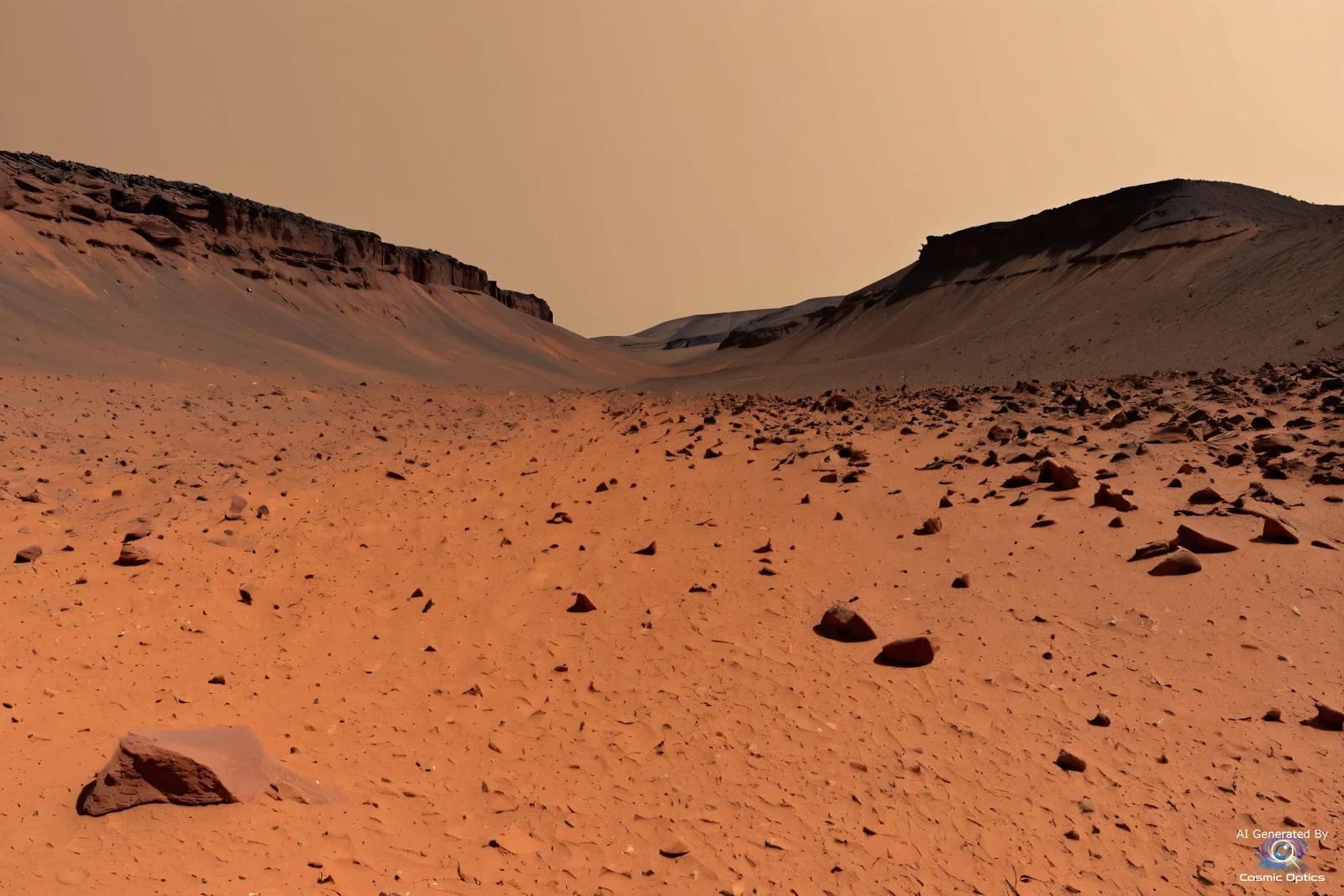
Mars’s distinctive crimson tint is perhaps its most iconic feature, a color derived from iron oxides, essentially rust, coating its surface. But beneath this rusty veneer lies a planet far more complex and dynamic than its desolate appearance might suggest. Billions of years ago, Mars was a very different place. Evidence from orbiting spacecraft and intrepid rovers paints a vivid picture of a planet with a much thicker atmosphere, host to vast oceans, meandering rivers, and perhaps even lakes. Riverbeds, delta formations, and mineral deposits that only form in the presence of water are etched across the Martian landscape, silent testaments to a wetter, warmer past. What triggered this dramatic transformation, turning a potentially life-sustaining world into the arid desert we observe today, remains a central question in planetary science.
The quest to understand Mars isn't merely academic; it's deeply entwined with the search for life beyond Earth. If Mars once harbored liquid water for extended periods, it begs the tantalizing question: did life emerge there, as it did on our own planet? And if so, could microscopic remnants or even extant lifeforms persist in sheltered subsurface environments today? This is the driving force behind many of the sophisticated missions currently exploring Mars. Rovers like Perseverance are meticulously searching for biosignatures, chemical or structural evidence of past microbial life, by drilling into ancient lakebeds and collecting samples for eventual return to Earth. The very rocks and soil of Mars could hold the key to understanding the origins and distribution of life in the cosmos, a discovery that would fundamentally reshape our understanding of our place in the universe.
Our fleet of robotic emissaries has revolutionized our understanding of Mars. Orbiters tirelessly map its surface, analyze its atmospheric dynamics, and peer beneath its crust. Landers and rovers have endured the harsh Martian environment for years, acting as tireless geologists and astrobiologists, sending back a torrent of data, images, and scientific insights. From the first grainy images of Mariner 4 to the high-definition panoramas and laser-ablated rock analysis performed by Curiosity and Perseverance, each mission builds upon the last, incrementally unraveling the planet’s mysteries. These machines are not just instruments; they are our senses on a distant world, allowing us to touch, smell, and see Mars with unprecedented clarity.
Yet, for all the incredible successes of robotic exploration, the ultimate dream remains human footsteps on the Red Planet. The allure of sending astronauts to Mars is immense, promising scientific breakthroughs that only human intuition and adaptability can achieve, alongside an unparalleled triumph of the human spirit. The challenges are formidable: the immense distance, requiring months of travel through the unforgiving vacuum of space; the brutal radiation environment; the need for self-sustaining habitats; and the psychological toll of such an arduous journey. Developing the technologies for propulsion, life support, and in-situ resource utilization (ISRU) – turning Martian resources into necessities like water, oxygen, and rocket fuel – is a monumental task, but one that is actively being pursued by space agencies and private companies worldwide.
Imagine the day when humans stand on Mars, looking back at Earth as a distant blue marble. The scientific endeavors would be transformative, allowing for on-the-spot geological surveys, deep drilling for signs of subsurface life, and the establishment of long-term research outposts. Such a feat would not only expand our knowledge but also inspire a new generation to pursue science, technology, engineering, and mathematics. It would be a testament to our ingenuity, resilience, and an unwavering drive to push the boundaries of what is possible. Mars is not just a destination; it's a profound challenge that asks us to reach for new heights of innovation and collaboration.
In the distant future, some envision an even more audacious endeavor: terraforming Mars, transforming its barren landscape into a world capable of supporting Earth-like life. While currently a concept firmly in the realm of science fiction, the idea highlights the incredible potential and inspiring ambition that Mars evokes. Regardless of whether such a grand transformation is ever feasible, Mars will continue to serve as a critical laboratory for understanding planetary processes, a stepping stone for future deep-space exploration, and a constant reminder of the incredible opportunities that await us beyond our home world. The saga of Mars is far from over; it is a story that continues to unfold with every new discovery, every new mission, and every gaze turned skyward.


