
Exploring the Fiery Heart of Io Jupiter’s Most Volcanically Active and Dynamic Moon
Deep within the Jovian system, far beyond the frozen reaches of the asteroid belt, exists a world of fire and brimstone that defies every expectation of what a moon should be. While most celestial satellites are cold, cratered remnants of a distant past, Jupiter’s moon Io is a vibrant, hyper-active laboratory of planetary physics. It is the most volcanically active body in our entire solar system, a place where the ground is constantly being remade and the sky is frequently filled with plumes of sulfur reaching hundreds of miles into the void of space. To look upon Io is to see a world in a state of perpetual transformation, driven by forces so powerful they stretch the very fabric of the moon’s interior.
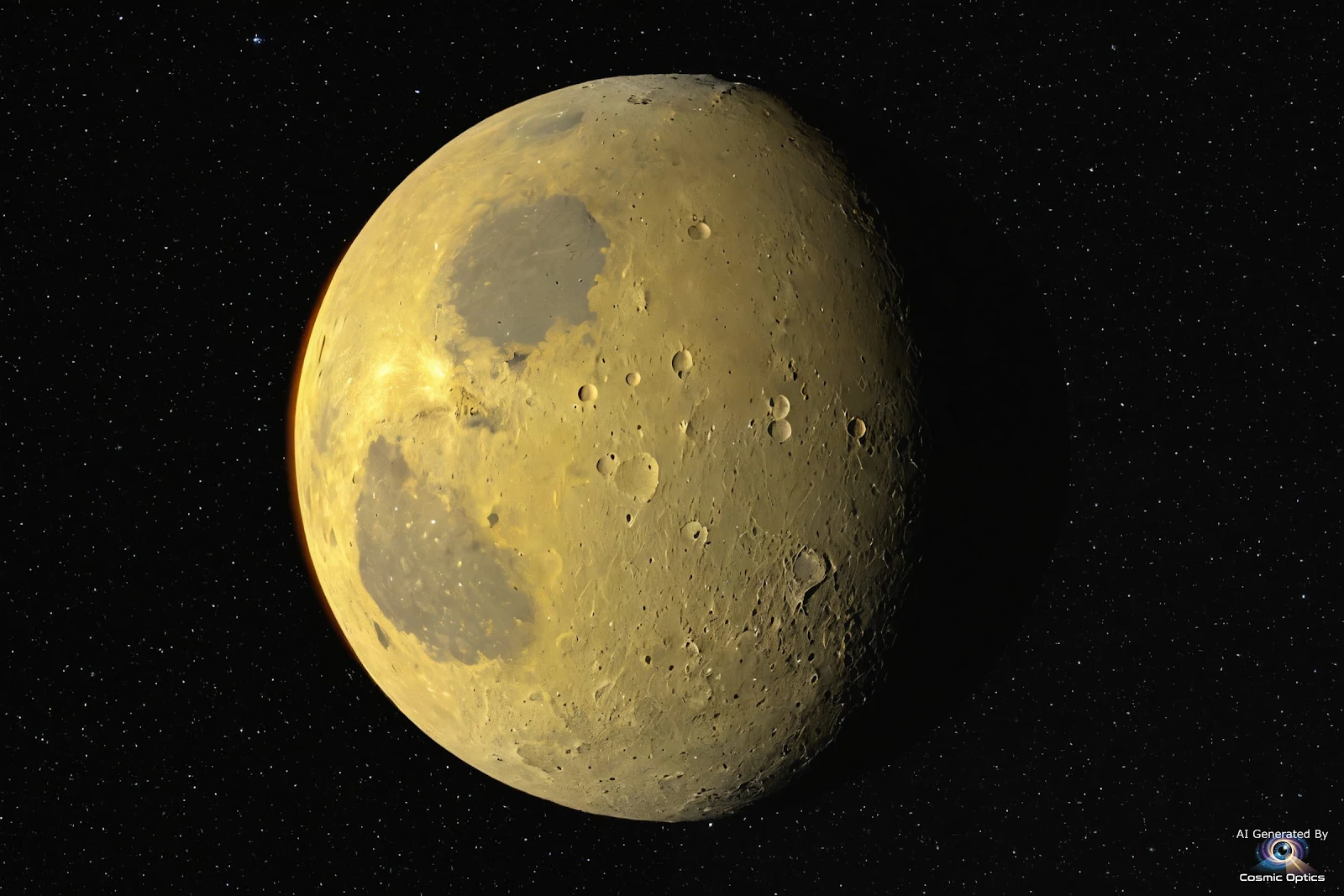
An authentic, standalone astrophotography snapshot of Jupiter's moon Io in deep space. A single, sol_00019
The secret to Io’s incredible energy lies in a phenomenon known as tidal heating. This is not the gentle rising and falling of tides we experience on Earth’s oceans; rather, it is a violent, internal friction caused by a gravitational tug-of-war. Io is caught in a rhythmic dance between the massive gravity of Jupiter and the smaller but significant pulls of its sibling moons, Europa and Ganymede. These moons exist in an orbital resonance—for every one orbit Ganymede completes, Europa completes two, and Io completes four. This alignment ensures that Io’s orbit is not a perfect circle but an ellipse. As Io moves closer to and then further from Jupiter, the planet’s immense gravitational field kneads the moon like a piece of clay, generating enough internal heat to melt rock into a vast subterranean ocean of magma.
This internal pressure must find a way to escape, and it does so through hundreds of active volcanic centers. Unlike Earth, where volcanism is primarily localized at the boundaries of tectonic plates, Io’s entire surface is a patchwork of volcanic activity. Some of these eruptions are so energetic that they launch material at speeds exceeding 2,000 miles per hour, creating plumes that can be seen by passing spacecraft from millions of miles away. These plumes are composed primarily of sulfur and sulfur dioxide, which fall back to the surface as "snow," coating the moon in brilliant shades of yellow, orange, red, and black. This constant rain of volcanic debris is why Io has almost no impact craters; any scar from a meteor is quickly buried under a fresh layer of lava or sulfur ash.
The chemistry of Io is as fascinating as its geology. The variety of colors seen on its surface is a direct result of different allotropes of sulfur and various silicate rocks being heated to different temperatures. At the hottest volcanic vents, temperatures can soar above 1,300 degrees Celsius (2,400 degrees Fahrenheit), far hotter than any volcanic activity currently found on Earth. One of the most famous features, Loki Patera, is a massive volcanic depression larger than the state of Maryland, which appears to function as a giant lava lake that periodically "overturns," exposing a fresh surface of molten rock that glows brightly in the infrared spectrum.
Io’s influence extends far beyond its own surface, creating a complex relationship with Jupiter itself. As the moon orbits within Jupiter’s intense magnetic field, it acts as a giant electrical generator. This interaction strips away about a ton of material from Io every second, primarily sulfur and oxygen ions. This material forms a donut-shaped cloud of charged particles known as the Io Plasma Torus that encircles Jupiter. These ions are eventually funneled along Jupiter’s magnetic field lines toward the planet’s poles, where they collide with the atmosphere to create permanent, brilliant auroras. This "electrical umbilical cord" carries a current of about three million amperes, representing a transfer of power that is almost unfathomable in its scale.
Exploring Io presents one of the greatest challenges in modern astronomy. The moon resides deep within Jupiter’s radiation belts, where the intensity of charged particles is high enough to fry the electronics of most spacecraft within hours or days. Missions like NASA’s Galileo and the more recent Juno mission have had to employ specialized shielding and carefully designed orbits to peek at this moon without being destroyed. Every high-resolution image we obtain is a hard-won victory of engineering, providing us with clues not just about Io, but about the early history of our solar system when many worlds may have been as geologically active as this small, fiery moon.
To study Io is to witness the raw power of nature in its most unrestrained form. It serves as a reminder that the universe is not a static collection of rocks, but a dynamic and evolving system where gravity alone can turn a frozen moon into a world of molten fire. As we continue to refine our instruments and send our mechanical explorers further into the dark, Io remains a beacon of color and activity, a testament to the endless surprises waiting for us in the deep reaches of the Jovian neighborhood. It is a world that challenges our definitions of "alive," proving that even without a biological heartbeat, a planet can pulse with a terrifying and beautiful vitality of its own.


