
Exploring the Red Planet From Sapphire Sunsets to Ancient Water and Volcanic Giants
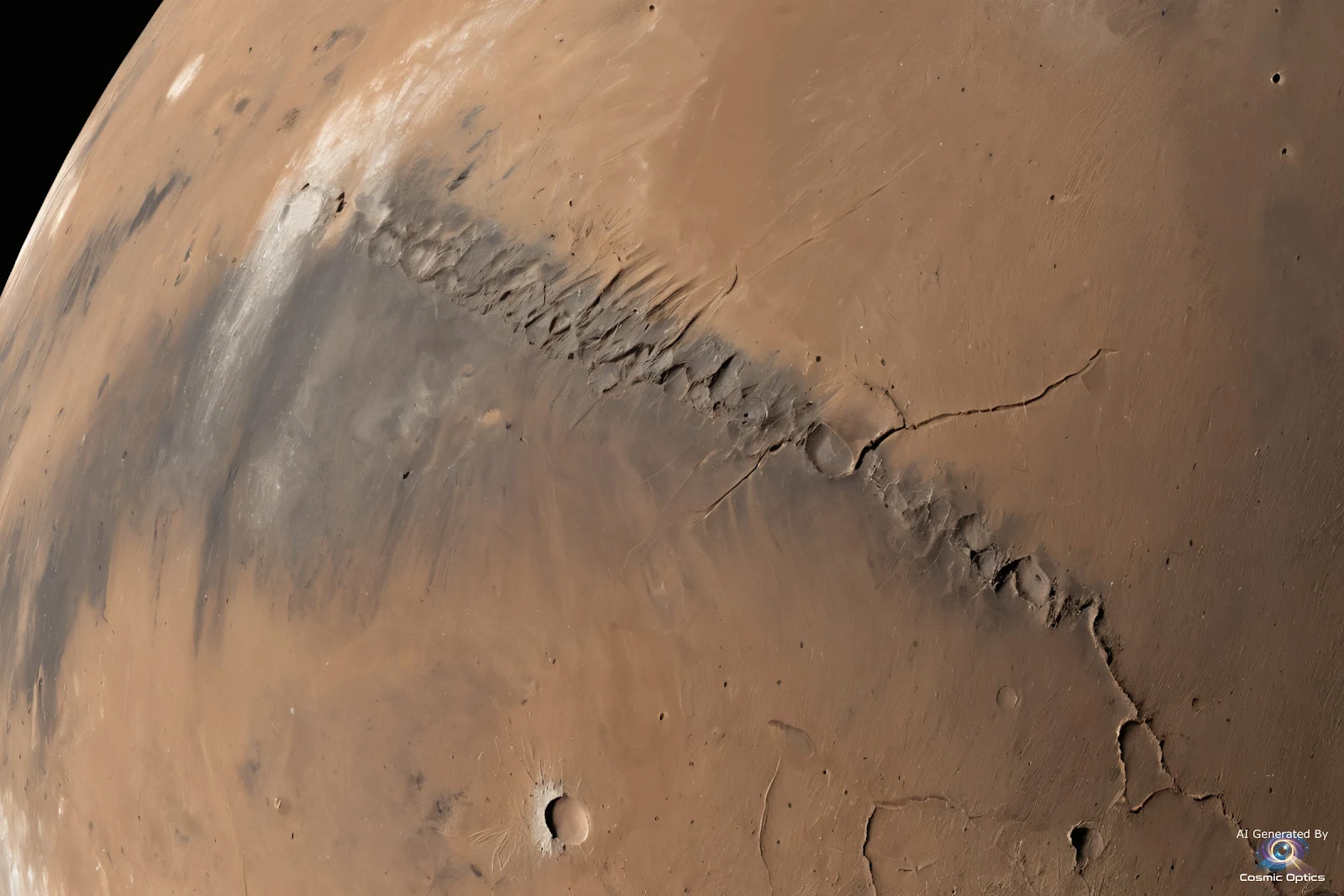
An authentic, photorealistic astronomical photograph of the planet Mars in deep space. A highly deta_00029
The Red Planet has long held a singular grip on the human imagination, serving as both a celestial neighbor and a potential future home for our species. While we often envision Mars as a monochromatic world of crimson dust and rust-colored rocks, its physical reality is far more complex and visually arresting. One of the most breathtaking phenomena observed by our robotic emissaries is the Martian sunset. In a poetic reversal of Earth’s atmospheric behavior, where a blue sky transitions into a fiery red dusk, the dusty Martian day gives way to a hauntingly beautiful blue glow around the setting sun. This inverse relationship highlights the profound differences in atmospheric composition and physics between our two worlds.
The science behind the Martian blue sunset is rooted in the physics of light scattering. On Earth, our atmosphere is composed primarily of small gas molecules—nitrogen and oxygen. These particles are much smaller than the wavelength of visible light, leading to Rayleigh scattering. This process scatters shorter wavelengths of light, like blue and violet, much more effectively than longer wavelengths like red. Consequently, our daytime sky appears blue, and when the sun is low on the horizon, the light must travel through more atmosphere, filtering out the blue and leaving the warm reds and oranges we associate with evening. Mars, however, operates under a different set of rules. Its atmosphere is exceptionally thin—roughly one percent of Earth's pressure—and is perpetually filled with fine silicate dust lifted from the surface by seasonal winds and dust devils.
These Martian dust particles are significantly larger than the gas molecules in Earth’s atmosphere. Their size is closer to the wavelength of visible light, which triggers a different physical process known as Mie scattering. While the dust scatters red light throughout the sky during the day, giving the Martian firmament its characteristic salmon-pink or butterscotch hue, it behaves differently as the sun approaches the horizon. The dust particles are sized such that they allow blue light to penetrate the atmosphere more efficiently in the direction of the sun. When a rover like Curiosity or Perseverance looks toward the setting sun, it sees a concentrated blue aura, a serene sapphire highlight in an otherwise amber world. This phenomenon provides scientists with critical data regarding the size and distribution of dust in the Martian atmosphere, which is essential for understanding the planet's climate and weather patterns.
Beyond its ethereal sunsets, the physical geography of Mars represents a study in geological extremes. It is home to the largest volcano in the solar system, Olympus Mons. This shield volcano stands a staggering 21.9 kilometers (13.6 miles) high, nearly three times the height of Mount Everest. Its footprint is so vast that if placed on Earth, it would cover the entire state of Arizona. The sheer scale of such a feature is possible only because Mars lacks the plate tectonics found on Earth. Instead of a crust that moves over volcanic hotspots, the Martian crust remains stationary, allowing magma to pile up in a single location for billions of years. This volcanic giant is flanked by three other massive volcanoes on the Tharsis Bulge, a tectonic uplift that dominates the western hemisphere of the planet.
Complementing these heights are the profound depths of Valles Marineris, a canyon system that dwarfs the Grand Canyon of the United States. Stretching over 4,000 kilometers (2,500 miles) long and reaching depths of up to 7 kilometers (4.3 miles), this "Grand Canyon of Mars" would span the width of the North American continent. Unlike Earth’s Grand Canyon, which was carved primarily by the erosive power of flowing water over millions of years, Valles Marineris is believed to be a tectonic fracture—a giant crack in the planet's crust that formed as the Tharsis volcanic region rose and put immense stress on the surrounding rock. However, evidence suggests that water may have later played a role in shaping the canyon's features, with ancient floods potentially scouring its floor.
The history of water on Mars is perhaps the most compelling chapter in its planetary biography. While the surface today is a frigid, hyper-arid desert where liquid water cannot exist for long due to the low atmospheric pressure, the landscape is scarred with the remnants of an aqueous past. Sinuous river valleys, ancient lake beds, and massive delta systems—like the one being currently explored by the Perseverance rover in Jezero Crater—point to a time, billions of years ago, when Mars was warmer and wetter. This "Noachian" period likely featured a thicker atmosphere capable of supporting a hydrological cycle. The discovery of hydrated minerals and clays further proves that water once interacted extensively with the Martian soil, creating environments that might have been hospitable to microbial life.
Understanding where that water went remains a central quest for planetary scientists. Current evidence suggests that as Mars lost its global magnetic field early in its history, the solar wind began to strip away its atmosphere. Without the protective blanket of a thick atmosphere and a magnetosphere, the water on the surface either evaporated into space or retreated underground. Today, vast reservoirs of water ice are known to exist at the polar caps and in thick layers beneath the mid-latitude regolith. In fact, if all the ice currently known to exist on Mars were melted, it could cover the entire planet in an ocean several meters deep. This subsurface ice is not just a geological curiosity; it is a vital resource for future human explorers, providing the potential for life support, oxygen production, and even rocket fuel.
The exploration of Mars has evolved from blurry telescopic observations to sophisticated robotic laboratories that roam the surface. Each mission has added a layer of sophistication to our understanding. We have transitioned from simply asking "Is there water?" to "Was this environment habitable?" and finally, with the Mars Sample Return campaign, "Can we find direct evidence of ancient life?" The sophistication of these missions is a testament to human ingenuity. We are now able to fly helicopters in the thin Martian air, listen to the sounds of the wind with sensitive microphones, and use lasers to vaporize rocks and analyze their chemical composition from several meters away.
As we look toward the future, Mars stands as the ultimate proving ground for humanity's expansion into the solar system. The challenges are formidable: high radiation levels, the psychological toll of isolation, and the physical demands of living in one-third gravity. Yet, the allure of the Red Planet remains undiminished. It is a world that mirrors our own in many ways—with seasons, polar caps, and weather—yet remains profoundly alien. Whether it is the sapphire glow of a sunset or the silent majesty of its towering volcanoes, Mars continues to beckon us, offering a window into the history of our solar system and a potential mirror for the future of our own planet.


