
The Enigmatic Dwarf Planet Haumea: A Spinning Egg of Ice and Ancient Cosmic Collisions
Deep within the frozen frontiers of our solar system, far beyond the orbit of Neptune, lies a realm of shadow and ice known as the Kuiper Belt. While many are familiar with Pluto, this vast expanse of space is home to a collection of enigmatic worlds that challenge our understanding of planetary physics and celestial evolution. Among these distant travelers, one object stands out as a true masterpiece of cosmic dynamics: the dwarf planet Haumea. This extraordinary body is not merely another frozen rock; it is a high-speed, elongated marvel that defies the typical spherical expectations of planetary science.
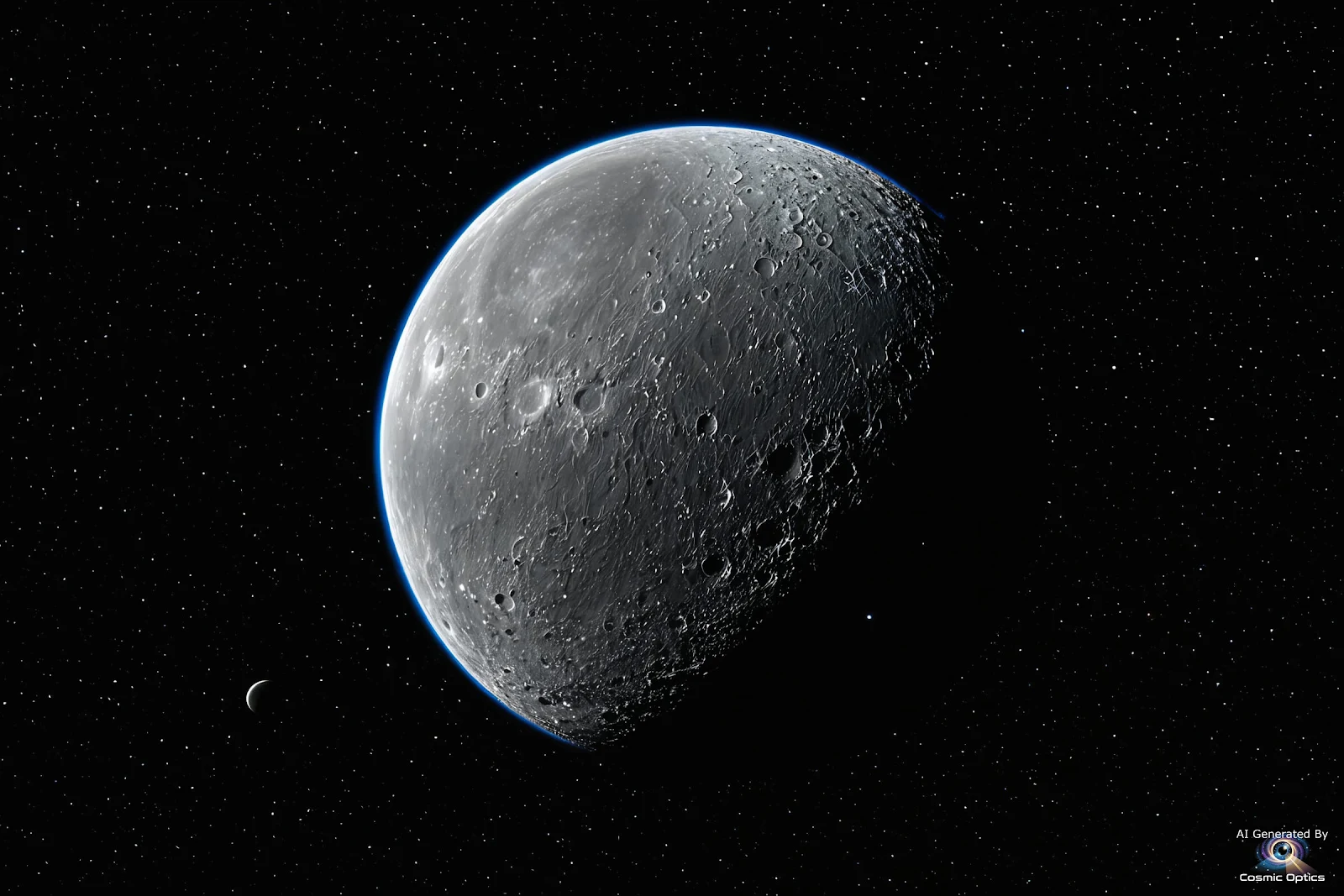
An authentic, photorealistic astronomical photograph of the dwarf planet Haumea floating in the abso_00053
The first thing that strikes researchers about Haumea is its bizarre, ellipsoidal shape. Often compared to an over-inflated American football or a giant spinning egg, Haumea is roughly the size of Pluto but lacks its famous cousin's roundness. This distortion is the result of a dizzying rotational velocity. Haumea completes a full rotation on its axis in just under four hours, making it one of the fastest-spinning large objects in our solar system. This extreme speed generates powerful centrifugal forces that have stretched the dwarf planet out into its distinctive triaxial ellipsoid form. If Haumea were to spin any faster, it might likely break apart, or at the very least, shed material into the surrounding void.
This rapid spin is more than just a visual curiosity; it is a window into a violent and chaotic past. Planetary scientists believe that billions of years ago, Haumea was involved in a massive collision with another large Kuiper Belt object. This ancient impact would have sent the dwarf planet into its frantic spin and stripped away much of its outer layer of light, icy material. What remains today is a dense, rocky core covered by a thin, brilliant shell of crystalline water ice. This composition makes Haumea exceptionally bright, reflecting light across the darkness of space with a luminosity that rivals the most pristine snowfields on Earth.
The mystery of Haumea deepened significantly in 2017 when an international team of astronomers made a groundbreaking discovery: Haumea has a ring. This was the first time a ring system had been identified around a dwarf planet in the Kuiper Belt, shattering the long-held belief that rings were the exclusive domain of the giant planets like Saturn and Jupiter. The ring, which is approximately 70 kilometers wide and orbits about 2,287 kilometers from the surface, consists of dust and debris likely left over from the same cataclysmic impact that gave Haumea its shape. The existence of this ring suggests that such structures may be far more common in the outer solar system than previously imagined, provided the central body has enough gravitational influence and a history of high-energy interactions.
Beyond its rings, Haumea is accompanied by two loyal companions: the moons Hiʻiaka and Namaka. These satellites are named after the daughters of the Hawaiian goddess Haumea, the deity of fertility and childbirth. Hiʻiaka, the larger and outer moon, appears to be composed of nearly pure water ice, reinforcing the theory that it formed from the debris of the original collision. Namaka, the smaller inner moon, follows a more complex, perturbed orbit, likely influenced by the gravitational tug-of-war between its larger sibling and the oddly shaped parent body. The presence of these moons allows scientists to calculate Haumea’s mass with high precision, revealing a density that confirms its primarily rocky interior.
One of the most fascinating aspects of Haumea is its "collisional family." Unlike most objects in the Kuiper Belt, which follow independent and scattered paths, Haumea is the progenitor of a group of icy fragments that share similar orbital characteristics and surface compositions. These "Haumeans" are the remnants of the dwarf planet’s original icy mantle, blasted into space during that primordial impact. This makes Haumea the only known dwarf planet with its own family of related objects, providing a unique "crime scene" for astronomers to reconstruct the history of the early solar system. By studying these fragments, researchers can better understand the frequency and intensity of collisions in the outer reaches of our neighborhood.
The surface of Haumea itself presents a scientific paradox. Because it is so far from the Sun—roughly 43 times farther than Earth—one would expect its surface ice to be "amorphous," a disordered state common in extremely cold environments. However, spectroscopic data suggests that much of the ice on Haumea is crystalline. Crystalline ice requires temperatures above a certain threshold to maintain its structured lattice, or it must be continuously "refreshed" by internal heat or cryovolcanic activity. This suggests that Haumea may be more geologically active than its frozen exterior implies, or perhaps radioactive decay within its rocky core provides just enough warmth to sustain its crystalline coat against the onslaught of cosmic radiation.
The naming of Haumea is a tribute to both science and culture. In Hawaiian mythology, Haumea represents the element of stone and the power of creation, often giving birth to her children from various parts of her body. This is a poetic and fitting parallel to the dwarf planet, which "gave birth" to its moons and its collisional family through the shattering force of an ancient impact. By incorporating indigenous nomenclature into the astronomical record, the scientific community honors the connection between humanity’s ancient stories and our modern quest to understand the heavens.
As we look toward the future of space exploration, Haumea remains a high-priority target for potential robotic missions. While no spacecraft has yet visited this distant world, the data we gather from terrestrial telescopes continues to paint a picture of a dynamic, complex, and beautiful environment. Haumea challenges our definitions of what a planet should look like and how it should behave. It serves as a reminder that the solar system is not a static collection of spheres, but a vibrant, evolving landscape of motion, light, and history. In the silent depths of the Kuiper Belt, the "spinning egg" continues its rapid dance, a testament to the enduring mysteries of the cosmos and the infinite wonders waiting to be discovered.


