
The Mysterious Wonders of Haumea: A Spinning Elongated Jewel of the Kuiper Belt
Deep within the frozen reaches of our outer solar system, far beyond the orbit of Neptune, lies a celestial body so peculiar that it challenges our fundamental understanding of planetary physics. This is Haumea, an extraordinary dwarf planet that glides through the Kuiper Belt like a cosmic spinning top. While many are familiar with the distant world of Pluto, Haumea offers a narrative of violence, speed, and unexpected beauty that is entirely its own. It is a world that defies the stereotypical image of a spherical planet, opting instead for a stretched, elongated form that makes it one of the most visually and scientifically captivating objects in the trans-Neptunian region.
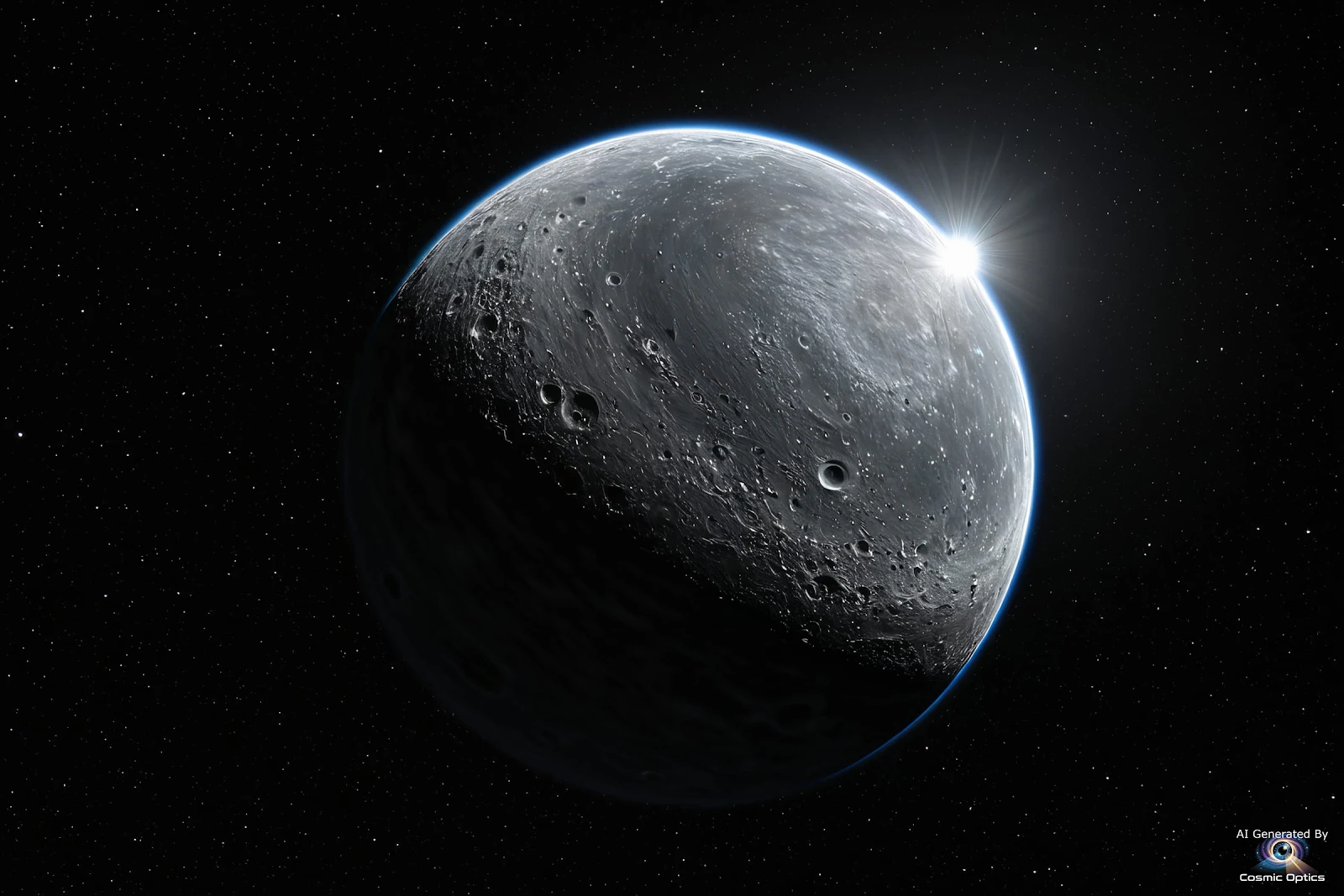
An authentic, photorealistic astronomical photograph of the dwarf planet Haumea floating in the abso_00049
The most striking characteristic of Haumea is its shape. Unlike the majestic spheres we associate with the major planets, Haumea is a triaxial ellipsoid, often compared to an over-inflated American football or a massive, celestial cigar. This distortion is not a result of some external pressure, but rather its own internal dynamics. Haumea is the fastest-spinning large object in our solar system. It completes a full rotation on its axis in just under four hours. This dizzying speed creates immense centrifugal forces that pull the planet's mass outward at its equator, stretching it into an oblong shape. If it were to spin any faster, it would likely break apart, but as it stands, it maintains a delicate, high-speed equilibrium between gravity and momentum.
The discovery of Haumea’s true nature was a breakthrough for planetary scientists. In 2017, an international team of astronomers observed Haumea as it passed in front of a distant star, an event known as an occultation. This rare alignment allowed researchers to measure its dimensions with unprecedented precision and led to a startling discovery: Haumea possesses its own ring system. It was the first time a ring had been found around a dwarf planet or any object in the Kuiper Belt. Measuring roughly 70 kilometers in width and with a radius of about 2,287 kilometers, this ring circles the dwarf planet’s equator, composed likely of dust and debris from a massive collision eons ago. The presence of this ring suggests that such features might be far more common among small, icy worlds than we previously dared to imagine.
Beyond its rings, Haumea is accompanied by two loyal companions, its moons Hiʻiaka and Namaka. Named after the daughters of the Hawaiian goddess of childbirth and fertility, these moons are not just passive observers. They provide essential clues to Haumea’s history. Hiʻiaka, the larger and outer moon, has a surface of nearly pure crystalline water ice, a feature it shares with Haumea itself. Namaka, the smaller moon, follows a more eccentric orbit. Scientists believe these moons, along with the ring and a group of smaller icy fragments known as the "Haumea family," were all birthed from a single, cataclysmic impact. Billions of years ago, a massive object likely slammed into the original Haumea, shattering its icy mantle and sending debris scattering across the Kuiper Belt. This "collisional family" is unique; it is the only such group identified so far in the outer solar system, providing a laboratory for studying the violent history of our cosmic neighborhood.
The surface of Haumea is a crystalline wonderland. Despite its immense distance from the Sun—where temperatures hover near absolute zero—the surface of the dwarf planet is coated in a layer of bright, white water ice. Curiously, this ice is crystalline rather than amorphous. In the extreme cold of the outer solar system, ice usually lacks a structured crystalline lattice because there isn't enough energy to organize the molecules. The presence of crystalline ice suggests that some internal heat source, perhaps from radioactive decay or tidal forces exerted by its moons, is keeping the surface active or that some process is constantly refreshing the ice. Observations have also revealed a distinct "red spot" on the surface, a region richer in minerals and organic compounds than the surrounding ice, which serves as a vibrant contrast to its otherwise pale, reflective exterior.
The naming of Haumea and its moons carries a profound cultural significance that mirrors the planet's unique physical traits. Haumea is the matron goddess of the island of Hawaiʻi, associated with the earth and fertility. In mythology, her children were born from different parts of her body, a poetic parallel to the way the dwarf planet's moons and collisional family were formed from the debris of the parent body. This choice of nomenclature by the International Astronomical Union reflects a growing effort to incorporate diverse cultural heritages into the map of the stars, grounding these distant, cold worlds in human storytelling and tradition.
Exploring Haumea pushes the limits of modern astronomy. Because it is so far away, it appears as little more than a point of light to even the most powerful ground-based telescopes. Much of what we know comes from the sophisticated interpretation of light curves and the rare opportunities provided by stellar occultations. Each new data point gathered by observatories like the James Webb Space Telescope or the Hubble Space Telescope adds a layer of complexity to our understanding of this world. Haumea serves as a reminder that the solar system is not a static collection of spheres, but a dynamic, evolving environment where high-speed rotations, ancient collisions, and hidden rings are part of the celestial norm.
As we look to the future, Haumea remains a high-priority target for theoretical missions. While there are currently no spacecraft en route to this distant ellipsoid, the success of the New Horizons mission to Pluto has fueled an appetite for exploring more "third zone" objects. A mission to Haumea would offer a chance to see its elongated horizon up close, to fly through its faint rings, and to study the crystalline frost of its surface. Until that day, Haumea continues its frantic, four-hour dance in the dark, a shimmering, oblong jewel that reminds us of the endless variety and mystery waiting to be discovered in the vast silence of the Kuiper Belt. Its existence challenges our definitions and expands our imagination, proving that in the universe, the truth is often far more fascinating than fiction.


